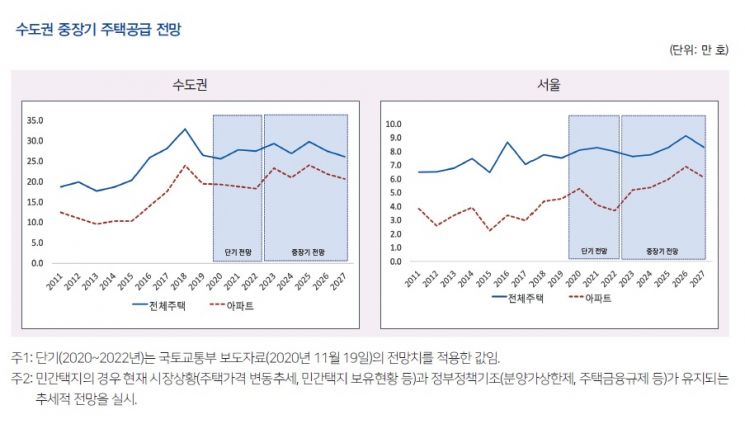
[Asia Economy Reporter Lee Chun-hee] Research from the Korea Research Institute for Human Settlements (KRHIS) indicates that housing supply in the Seoul metropolitan area will show a slight decline until 2022 but is expected to maintain a stable supply in the mid to long term (2023?2027).
Hwang Gwan-seok, Senior Research Fellow at KRHIS, revealed this in the 25th issue of the Land Issue Report titled "Mid- to Long-Term Housing Supply Outlook and Implications for the Seoul Metropolitan Area," released on the 25th.
The report anticipates that considering the supply lag of housing permits (2?3 years), the number of completed housing units in the metropolitan area will continue to decline in the short term from this year through 2022. From 2016 to this year, the average annual number of completed housing units in the metropolitan area was 265,000 units, but it is expected to slightly decrease over three years from 256,000 units this year to 251,000 units next year and 246,000 units in 2022.
Accordingly, the number of completions in Seoul averaged 75,000 units annually from 2016 to 2020, reached about 80,000 units this year, but is expected to decrease to 68,000 units next year and 64,000 units in 2022.
However, the report notes that considering the government's rental housing policy announced on the 19th to supply 70,000 rental units in the metropolitan area by 2022, the total supply in the metropolitan area is expected to increase from 251,000 units to 278,000 units next year, and from 246,000 units to 275,000 units in 2022. The number of completions in Seoul is also expected to rise to 83,000 units next year (from the previous 68,000 units) and 80,000 units in 2022 (from the previous 64,000 units). However, these trends assume that the government's measures proceed as planned.
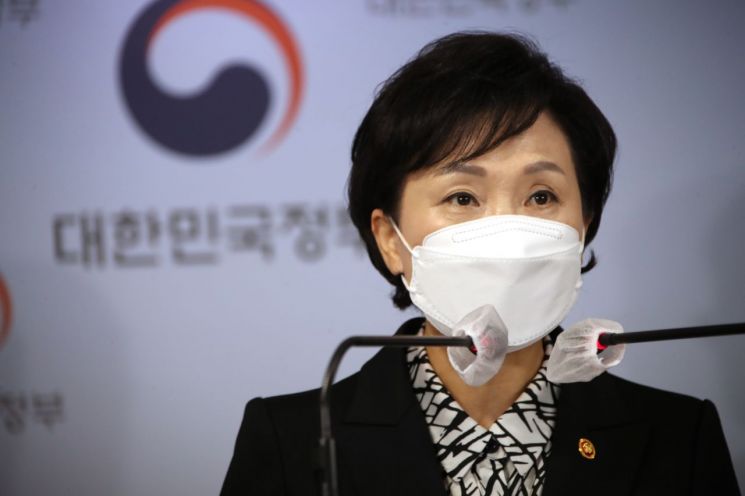 Minister of Land, Infrastructure and Transport Kim Hyun-mi is announcing support measures for housing stability for low-income and middle-class citizens at the government Seoul office briefing room on the 19th.
 [Image source=Yonhap News]
The report further forecasts that in the mid to long term from 2023 to 2027, housing supply in the metropolitan area will increase, maintaining a stable trend. The average annual new housing supply in the metropolitan area from 2023 to 2027 is projected to be 279,000 units, with Seoul expected to supply an average of 82,000 units annually.
For apartments specifically, the supply is predicted to be 222,000 units annually in the metropolitan area and 59,000 units in Seoul. These figures represent increases of 43.5% and 59.5%, respectively, compared to the short-term forecast of 154,000 units and 37,000 units.
The report anticipates that this increase in supply will significantly alleviate the supply-demand imbalance caused by apartment shortages. However, this projection assumes that housing supply on public land in the metropolitan area, including the 3rd New Town developments, proceeds according to government plans. The researchers emphasized that it is crucial for housing supply plans to be implemented without disruption.
Senior Research Fellow Hwang stated, "For the stabilization of the metropolitan housing market, the role of the public sector through stable supply of public land is very important," adding, "Since private land supply can vary greatly depending on economic and policy conditions, it is necessary to establish a supply system that can respond flexibly and proactively to market conditions."
© The Asia Business Daily(www.asiae.co.kr). All rights reserved.













