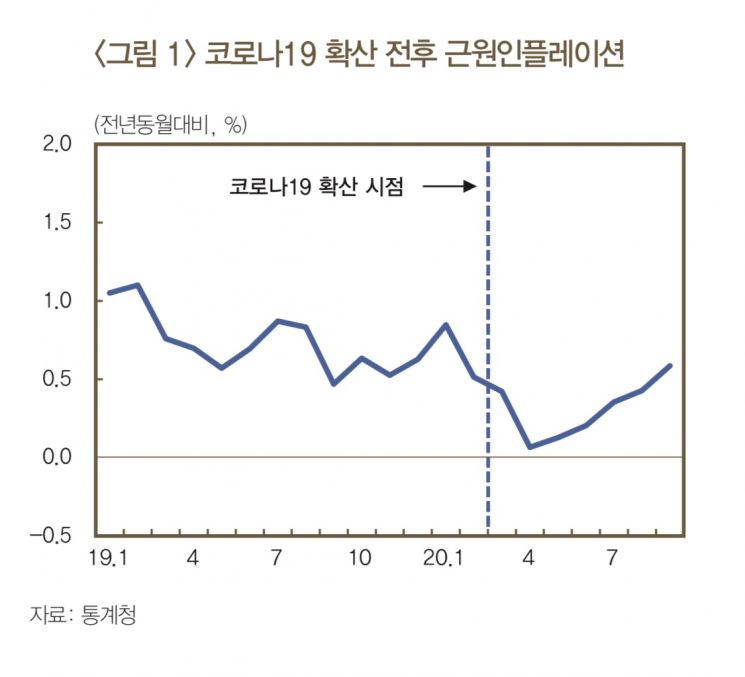
[Asia Economy Reporter Kim Eunbyeol] The novel coronavirus infection (COVID-19) has led to demand shocks for certain sensitive items, which in turn has affected core inflation. Therefore, it has been pointed out that continuous analysis of the impact of COVID-19 on inflation using this data is necessary.
According to the "Analysis of the Impact of COVID-19 on Inflation" released on the 10th by Park Sangwoo, head of the Price Trends Team at the Bank of Korea's Research Department, COVID-19 acted as a negative demand shock and influenced core inflation.
The core inflation rate, which was in the high 0% range during January to February this year, dropped to the low 0% range after the outbreak of COVID-19.
It is interpreted that the slowdown in the inflation rate of sensitive prices, especially demand-sensitive prices that react sensitively to COVID-19, was the cause. Demand-sensitive items included those related to face-to-face services whose demand declined due to the COVID-19 shock (such as travel, accommodation, dining out), as well as clothing and footwear.
Looking at the contribution of sensitive and non-sensitive prices to core inflation, the contribution of COVID-19 sensitive prices rapidly decreased from 0.5 percentage points in January and 0.2 percentage points in February to -0.3 percentage points in April, before showing signs of recovery after May.
The contribution of COVID-19 non-sensitive prices has remained stable at around 0.3 to 0.4 percentage points even after the spread of COVID-19.
Park said, "Demand-sensitive prices seem to reflect well the impact of COVID-19 on inflation," adding, "Since the impact of COVID-19 on inflation may change, it is necessary to continuously monitor the effect of COVID-19 on inflation using demand-sensitive prices."
© The Asia Business Daily(www.asiae.co.kr). All rights reserved.












