[Asia Economy, reporter Park Jihwan] The issuance of asset-backed securities (ABS) in the third quarter of this year saw a significant increase compared to last year, driven by the launch of the "Safe Conversion Loan for Ordinary Citizens" and other factors.
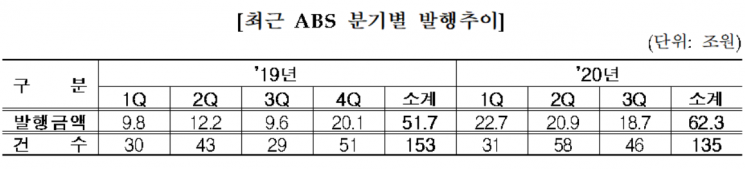
According to the "Analysis of ABS Registration and Issuance Performance for the Third Quarter" released by the Financial Supervisory Service on October 30, the total amount of ABS issued reached 18.7 trillion won, an increase of 9.1 trillion won (95.4%) compared to the same period last year. This surge in issuance was mainly due to an expansion in the issuance of mortgage-backed securities (MBS) by the Korea Housing Finance Corporation.
Since the third quarter of last year, the government has introduced the Safe Conversion Loan for Ordinary Citizens, which allows borrowers to switch their existing variable-rate mortgage loans to low-interest, fixed-rate mortgages. In the third quarter, MBS issuance amounted to 10.6 trillion won, up by 5.3 trillion won compared to the same period last year. An official from the Financial Supervisory Service stated, "Following the implementation of government policies such as the Safe Conversion Loan for Ordinary Citizens, MBS issuance has surged since the fourth quarter of last year."
Financial companies issued 5.1 trillion won in ABS, an increase of 3.2 trillion won from the same period last year. Specifically, banks issued 800 billion won in ABS backed by non-performing loans (NPLs); specialized credit finance companies issued 2.1 trillion won in ABS backed by installment finance receivables; and securities companies issued 2.2 trillion won in primary collateralized bond obligations (P-CBO) backed by corporate bonds from small and medium-sized enterprises. Notably, during the third quarter, the issuance of COVID-19 relief P-CBOs targeting large and mid-sized companies amounted to 1.2 trillion won, which contributed significantly to the overall increase in issuance.
During the same period, general companies issued 3 trillion won in ABS, an increase of 600 billion won (26.4%), backed by assets such as mobile device installment receivables, real estate project finance, and future sales receivables. As of the end of September this year, the total outstanding balance of ABS stood at 215.4 trillion won, up 6 trillion won (2.9%) compared to the end of June.
© The Asia Business Daily(www.asiae.co.kr). All rights reserved.












