[Asia Economy Reporter Lee Chun-hee] Nationwide land prices have continued to rise for 119 consecutive months.
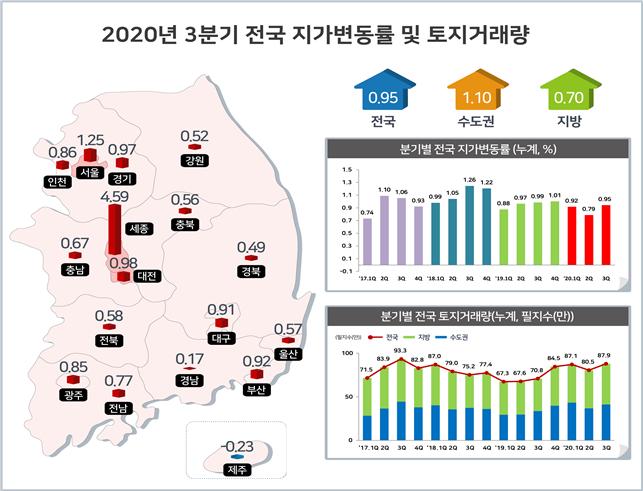
The Ministry of Land, Infrastructure and Transport announced on the 23rd that the national land price increased by 0.95% in the second quarter of this year. Monthly, it rose by 0.33% in April, 0.31% in May, and 0.31% in June, showing a continuous upward trend for 119 months since November 2010.
After recording 0.92% in the first quarter and slowing slightly to 0.79% in the second quarter, the upward trend picked up pace again in the third quarter to 0.95%. In July, it showed the highest increase this year at 0.33%. However, the Ministry analyzed that the cumulative increase up to the third quarter this year was 2.69%, which is 0.19 percentage points lower than the 2.88% cumulative increase in the same period last year and 0.64 percentage points lower than the 3.33% cumulative increase in 2018.
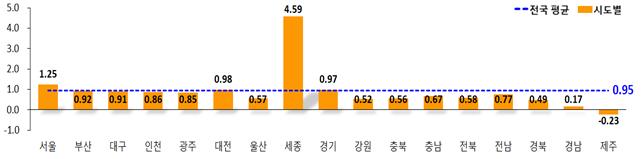 Land Price Change Rate by City and Province in Q3 2020 (Provided by the Ministry of Land, Infrastructure and Transport)
Looking at the data by city and province, land prices rose in all regions except Jeju Island during the third quarter. In particular, Sejong saw a 4.59% increase, nearly five times the average growth rate. Seoul ranked second with a 1.25% increase, followed by Daejeon, adjacent to Sejong, at 0.98% in third place.
The Ministry attributed Sejong's housing price increase to "expectations regarding the relocation of the administrative capital, the housing market's upward trend, and increased investment demand due to the full-scale development of the smart national industrial complex project."
Jeju Island has experienced a decline in land prices for 17 consecutive months from May last year to last month. This is the exact opposite of 2016, when it recorded an 8.33% increase, ranking first among metropolitan local governments nationwide in land price growth. As of the third quarter, it fell by 0.23%, with monthly declines of 0.08%, 0.07%, and 0.08% from July to September. However, the decline has been gradually decreasing compared to the 0.94% drop in the first quarter and the 0.62% drop in the second quarter.
By city, county, and district, the impact of various government development plans was prominent. Following Sejong, Gunwi County in Gyeongbuk ranked second with a 1.81% increase in land prices, driven by development expectations after the confirmation of the Daegu-Gyeongbuk new airport site (Gunwi and Uiseong counties), which led to increased purchase inquiries and sustained investment demand.
Next were Gwacheon City (1.71%), Hanam City (1.61%), and Sujeong District in Seongnam City (1.53%), ranking third to fifth nationwide in growth rates amid progress in development projects such as Gwacheon Knowledge Information Town, Juam District, Hanam Gam-il District, and Seongnam 3rd Pangyo Techno Valley.
On the other hand, Jeju's Seogwipo City (-0.39%) and Jeju City (-0.14%) ranked first and third in decline rates, respectively. This is attributed to a decrease in tourists due to the resurgence of COVID-19 and typhoon damage, as well as a sluggish real estate market. The remaining second, fourth, and fifth places were Ulsan Dong-gu, Tongyeong City in Gyeongnam, and Jinhae District in Changwon City, all of which have experienced contraction in their base industries. Although there were some signs of recovery amid the decline in shipbuilding and manufacturing industries, ongoing uncertainty led to either a wait-and-see approach or continued decline. The top five decline rankings remained the same as in the second quarter, with only Jeju City (2nd to 3rd) and Ulsan Dong-gu (3rd to 2nd) swapping places.
The total land transaction volume in the third quarter of this year was about 879,000 parcels, covering an area of 484.4 km², approximately 0.8 times the size of Seoul. This represents a 9.2% increase (74,095 parcels) compared to the second quarter.
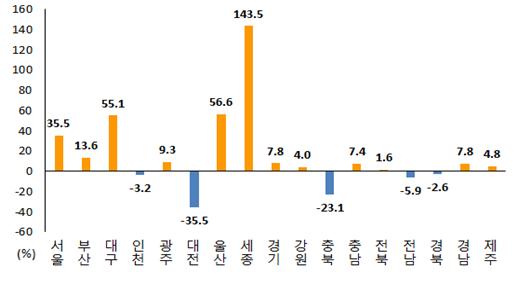 2020 Q3 Land Transaction Volume Growth Rate by City and Province (Provided by the Ministry of Land, Infrastructure and Transport)
In terms of trends, although the transaction volume sharply decreased in the second quarter, it began to increase from May, reaching the highest volume this year in July with 365,000 parcels traded. However, from August, due to government policies leading to a decrease in residential real estate transactions centered in the metropolitan area, the volume was around 256,000 parcels in August and 258,000 parcels in September.
By city and province, Sejong showed a remarkable increase in land transaction volume. The third quarter's transaction volume in Sejong rose by 143.5% compared to the previous quarter, showing an overwhelming upward trend. Ulsan (56.6%), Daegu (55.1%), and Seoul (35.5%) also showed significant increases. Conversely, Daejeon (-35.5%) and Chungbuk (-23.1%) showed decreases compared to the previous quarter.
A Ministry of Land, Infrastructure and Transport official stated, "The land market in the third quarter shows a trend of slowing increases in nationwide land transaction volume and land price change rates after August due to government policies. We plan to closely monitor the possibility of increased transaction volume and overheating in the land market and actively respond to any abnormal phenomena."
© The Asia Business Daily(www.asiae.co.kr). All rights reserved.














