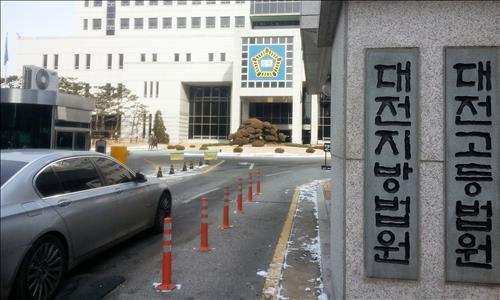
 Daejeon District Court
 [Image source=Yonhap News]
[Asia Economy Reporter Seongpil Cho] The appellate court overturned the first trial's not guilty verdict and found a couple guilty of embezzling the first prize lottery winnings from a person with an intellectual disability who was illiterate. While the first trial court stated that "the victim appeared to have a concept of property ownership," the appellate court judged that "the victim lacked the judgment to handle a large sum of money."
According to the legal community on the 23rd, the Criminal Division 1 of the Daejeon High Court (Chief Judge Junmyung Lee) sentenced the couple, A (65) and spouse, who were charged with fraud under the Act on the Aggravated Punishment of Specific Economic Crimes, to three years and three years and six months in prison, respectively. The couple was sentenced to prison and detained in court after receiving a prison term in the second trial, which is the final fact-finding trial.
The couple told B, who was illiterate and intellectually disabled, "We will buy land in Chungnam and build a building so that we can live together," and received a remittance of 880 million won, the lottery winnings. They did buy land and build a building with the money received, but registered the property under A's name. They also took out loans using the land and building as collateral. B later found out about this and filed a complaint against the couple.
The first trial court ruled that the defendants could not be held liable. It accepted the couple's claim that "the land and building were owned by the victim, but only the registration was under the defendants' names, and they agreed to operate a restaurant and provide living expenses to the victim." The court also stated, "It is difficult to recognize that the victim lacked the judgment to own property to the extent of being easily deceived by simple temptations."
However, the appellate court stated, "Considering that the victim had difficulty reading numbers, there is a disability in handling high-value property transactions." It also pointed out, "It is difficult to see that there was an agreement of nominal trust between the defendants and the victim," and criticized, "The defendants deceived the victim, who seemed not to clearly understand the concepts of ownership and registration, by pretending as if they were buying land or building a building in the victim's name."
© The Asia Business Daily(www.asiae.co.kr). All rights reserved.











