Last Month's Gulf Arab-Israel Normalization Talks Excluded King Salman
King Supports Palestinian Independent State and Pressures Israel
Crown Prince Reaches Out to Israel for Saudi Modernization
[Asia Economy Reporter Naju-seok] As the Middle East situation rapidly changes with countries like the United Arab Emirates (UAE) and Bahrain normalizing diplomatic relations with Israel one after another, an analysis has emerged that conflicts are also occurring within the Saudi Arabian royal family. It is said that King Salman bin Abdulaziz of Saudi Arabia (84) and Crown Prince Muhammad bin Salman (35), who are father and son, have differing views on normalizing diplomatic relations with Israel.
On the 20th (local time), The Wall Street Journal (WSJ) reported that King Salman opposes normalizing relations with Israel without resolving the Palestinian issue, while Crown Prince bin Salman wants to strengthen economic cooperation and enhance checks on Iran through normalization with Israel.
The difference in their positions became apparent due to the peace talks between Arab countries and Israel named the "Abraham Accords." According to WSJ, King Salman, who had planned to go on summer vacation, was shocked after hearing on the 13th of last month that Israel and the UAE had decided to normalize relations. At that time, Crown Prince bin Salman was reportedly not surprised because he had known in advance that the UAE would normalize relations with Israel. However, he did not inform King Salman, fearing that the king would try to stop it.
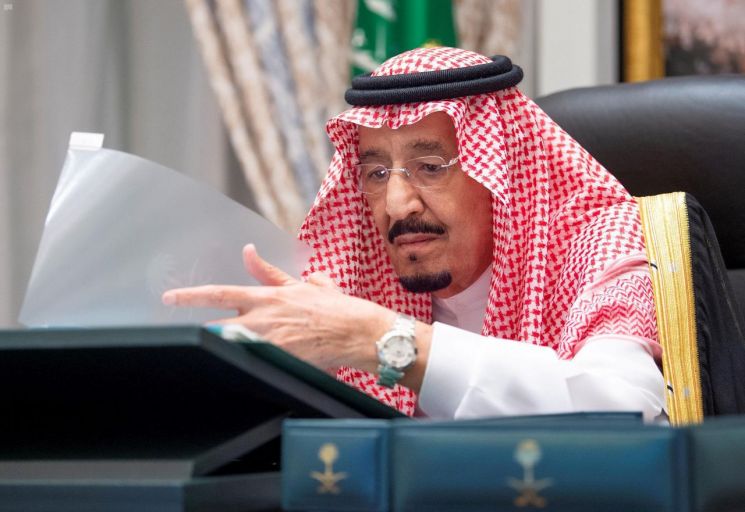
The differing opinions between father and son on the Israel issue stem from their differing stances on the Palestinian issue. The UAE has stated that the Abraham Accords have somewhat helped the Palestinian issue. Through this agreement, Israel halted its moves to annex the West Bank, a Palestinian residential area. However, this falls far short of King Salman's hope for the establishment of an independent Palestinian state. Angered, King Salman responded by instructing the foreign minister to reaffirm Saudi Arabia's support for an independent Palestinian state in relation to the Abraham Accords.
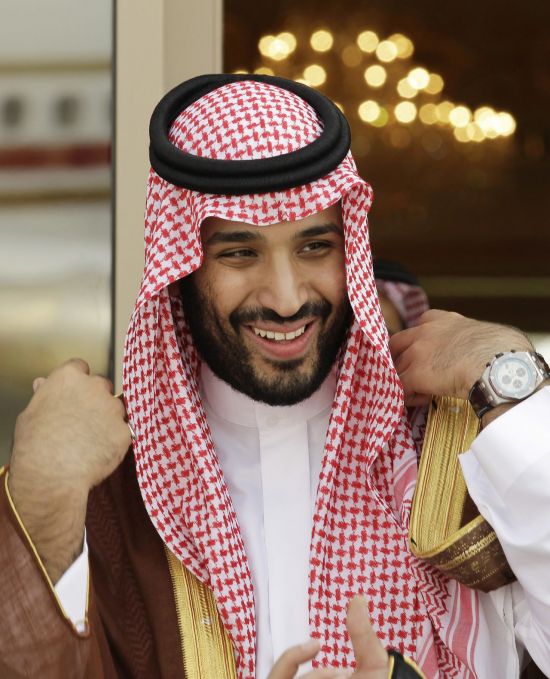 Muhammad bin Salman Al Saud, Crown Prince of Saudi Arabia
 [Photo by AP Yonhap News]
King Salman has long held the belief that Palestine must be independent from Israel. Even before ascending the throne, he referred to himself as the "Saudi ambassador to Palestine," taking on the role of protector of Palestine. On the 6th of this month, during a call with President Trump, King Salman raised the two-state solution supported by Saudi Arabia as a condition for normalizing diplomatic relations with Israel. Earlier, the Arab League proposed a solution to the Israeli-Palestinian conflict to the international community in 2002. According to this plan, based on the borders before the 1967 Six-Day War, an independent Palestinian state with Jerusalem as its capital would be established, allowing Israel and Palestine to coexist as two states.
On the other hand, Crown Prince bin Salman has a different view. For economic and security reasons, he seeks to strengthen relations with Israel. Previously, he pressured the Palestinian leadership to accept the "Middle East peace plan," which U.S. President Donald Trump called the deal of the century. At that time, Crown Prince bin Salman reportedly warned that rejecting Trump's peace plan would also make the establishment of an independent Palestinian state difficult.
Close aides explain that Crown Prince bin Salman's active pursuit of normalization with Israel is because he believes Israel's cooperation is necessary to modernize the Saudi economy. He holds the view that investments in Israel's biotechnology and cybersecurity technologies are essential for Saudi modernization. Furthermore, having ascended to crown prince through a coup and other events, it is analyzed that he seeks U.S. support for a stable succession to the throne. He was internationally condemned and diplomatically isolated after being implicated in the assassination of Saudi journalist Jamal Khashoggi. For these reasons, despite criticism from within Saudi Arabia and the international community, U.S. support is crucial for the succession to the throne.
In fact, Saudi Arabia showed mixed reactions regarding the Abraham Accords. It approved Israeli aircraft moving to the UAE and tolerated Bahrain normalizing diplomatic relations with Israel. From these actions alone, it could be seen as tacit approval or support for Arab countries establishing diplomatic ties with Israel. However, at the Arab League meeting concerning the Abraham Accords, Saudi Foreign Minister Prince Faisal bin Farhan expressed continued support for the two-state solution based on establishing a sovereign Palestinian state with East Jerusalem as its capital, insisting that the Palestinian issue be resolved first.
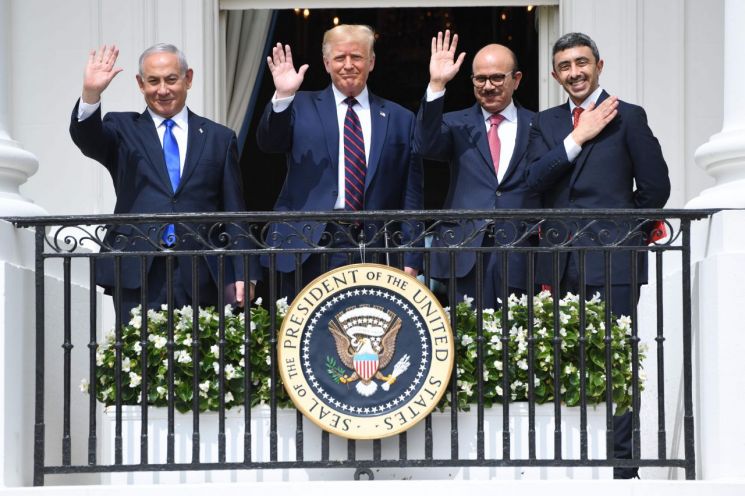 On the 15th, after signing the 'Abraham Accords,' an agreement for normalization of relations between Israel, the United Arab Emirates (UAE), and Bahrain, held at the White House in the United States, Israeli Prime Minister Benjamin Netanyahu (from the left), U.S. President Donald Trump, Bahraini Foreign Minister Abdullatif bin Rashid Al Zayani, and UAE Foreign Minister Sheikh Abdullah bin Zayed Al Nahyan are waving their hands and taking a commemorative photo on the balcony.
 [Image source=Yonhap News]
Saudi Arabia's stance on normalizing relations with Israel is a matter of intense interest in the overall Middle East situation. If Saudi Arabia, the leader of Arab countries, also normalizes relations, Israel's isolation could be alleviated. Moreover, other Arab countries could gain momentum to normalize diplomatic relations with Israel. Conscious of this, the U.S. is also pressuring Saudi Arabia. After the Abraham Accords were signed at the White House on the 15th, President Trump said, "I expect 7 to 9 countries to normalize relations," adding, "Saudi Arabia will be one of them."
Some speculate that Saudi Arabia will support other Arab countries in normalizing relations with Israel first and then take the lead last.
Meanwhile, Sudan, which is facing difficulties such as economic hardship, is reportedly negotiating with the U.S. over removal from the "state sponsors of terrorism" list. Sudan plans to discuss this issue in the UAE. Sudan is also known as a country likely to normalize relations with Israel. Just as the UAE is pursuing the acquisition of weapon systems such as the F-35 from the U.S. in exchange for normalizing relations with Israel, Sudan is also seeking removal from the terrorism list by improving its relations with Israel.
© The Asia Business Daily(www.asiae.co.kr). All rights reserved.













