Martial Arts 'Trends in India's Import Regulations and Response Strategies for Our Companies' Presentation
[Asia Economy Reporter Hwang Yoon-joo] It has been revealed that India is increasingly protecting its domestic industries through trade remedy measures such as anti-dumping actions. In particular, domestic petrochemical and steel companies are becoming regular targets of anti-dumping and countervailing duties, highlighting the need for appropriate response strategies.
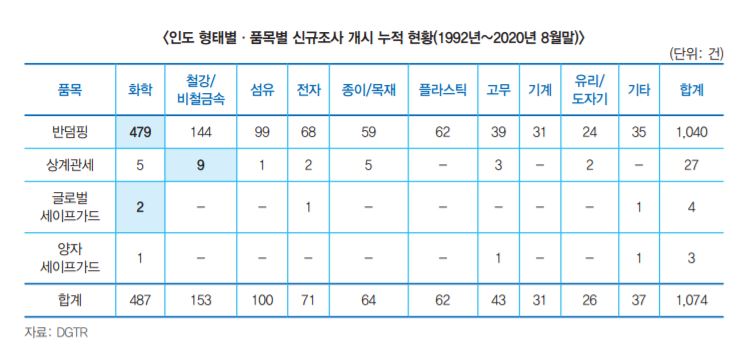
According to the "Trends in Indian Import Regulations and Response Strategies for Korean Companies" report released on the 15th by the Korea International Trade Association's International Trade and Commerce Research Institute, the number of newly initiated import regulation investigations by India from 2016 to 2019 averaged 60.5 cases per year. This figure is nearly double the annual average of 30.3 cases recorded between 2010 and 2015.
Since 2016, China ranked first with 77 cases as the target country for India's new investigations, followed by Korea (24 cases), Thailand (22 cases), and Malaysia (21 cases).
The report stated, "India's recent import regulations are very stringent and aggressive, requiring export companies targeting the Indian market to exercise special caution. Especially, petrochemical and steel companies are consistently targeted by India's anti-dumping and countervailing duties, making it crucial to prepare for potential import regulation risks even before exporting."
The report further analyzed, "With India's revision of the anti-dumping, subsidy, and countervailing duty enforcement decrees in February this year, including the expansion and establishment of circumvention investigation scopes, protectionist tendencies are being further strengthened through regulatory restructuring."
Recently, India has improved procedural fairness by adhering to the deadlines for anti-dumping investigations as stipulated by the World Trade Organization (WTO) and by enhancing information disclosure. However, there remain opaque aspects in dumping margin calculations and industry injury determinations, causing difficulties for exporting companies. Notably, India imposes response obligations even on companies involved in exports related to firms sued by India, establishing excessively stringent investigation standards rarely seen in anti-dumping investigations of other countries, thereby increasing the burden on exporters.
Industry experts and professionals with long experience in responding to Indian import regulations advised, "Indian exporters should continuously prepare for the possibility of import regulation measures through volume and price management, promptly select advisory firms before the initiation of anti-dumping investigations, thoroughly prepare documents and responses during investigations, actively provide explanations, and cooperate with importers and consumers as necessary to respond to investigations."
Kim Kyung-hwa, Senior Researcher at the Korea International Trade Association, said, "With India recently announcing tariff increases on automobiles and automobile parts, protectionist measures are continuing, so related companies must closely monitor India's actions."
© The Asia Business Daily(www.asiae.co.kr). All rights reserved.













