Delivery Demand Surges Due to Social Distancing Level Increase
'41.7% Charge Delivery Fees to Customers'
Experts Say "Clear Standards Needed for Delivery Fee Increases"
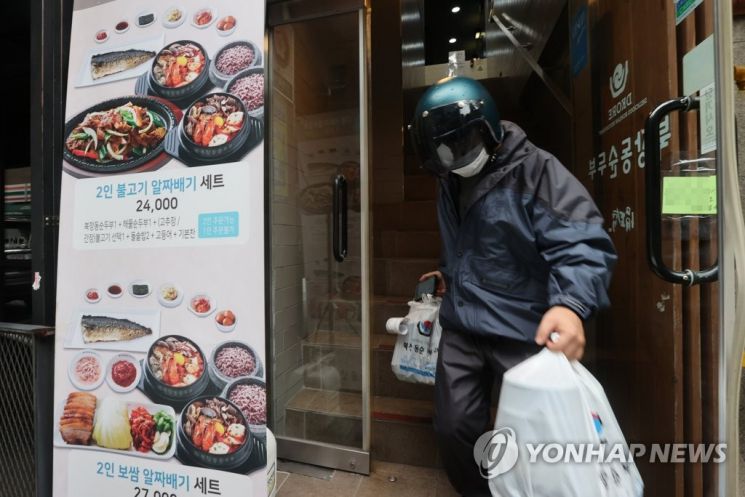 On the morning of the 2nd, a staff member is making a delivery at a restaurant in Jung-gu, Seoul. The photo is unrelated to specific expressions in the article content. Photo by Yonhap News.
[Asia Economy Reporters Seunggon Han and Seulgi Kim] As the COVID-19 pandemic has increased the time people spend at home due to remote work and other factors, the demand for delivery services has surged. However, some delivery companies have raised delivery fees under the so-called 'COVID surcharge,' leading to growing dissatisfaction among citizens. Critics point out that the lack of clear standards for delivery fee increases means the burden is entirely passed on to consumers.
On the 31st of last month, the government implemented social distancing level 2.5, mainly in the metropolitan area, to prevent the spread of COVID-19. As a result, citizens refrained from unnecessary outings, increasing the time spent at home.
The Central Disaster and Safety Countermeasures Headquarters of the Ministry of Health and Welfare announced on the 3rd that an analysis of mobile phone and public transportation usage showed a 25% decrease in mobility.
As citizens spent more time at home, delivery demand surged. According to the delivery platform company 'Barogo,' on the last Sunday of last month, the 30th, about 570,000 orders were placed through the Barogo platform in one day. This represents approximately a 25% increase compared to 450,000 orders on the last Sunday of July, the 26th.
With more citizens relying on delivery food for meals, some delivery companies have raised delivery fees citing a 'COVID surcharge.' They argue that the increase in delivery demand has led to higher accident rates and workload burdens for delivery workers.
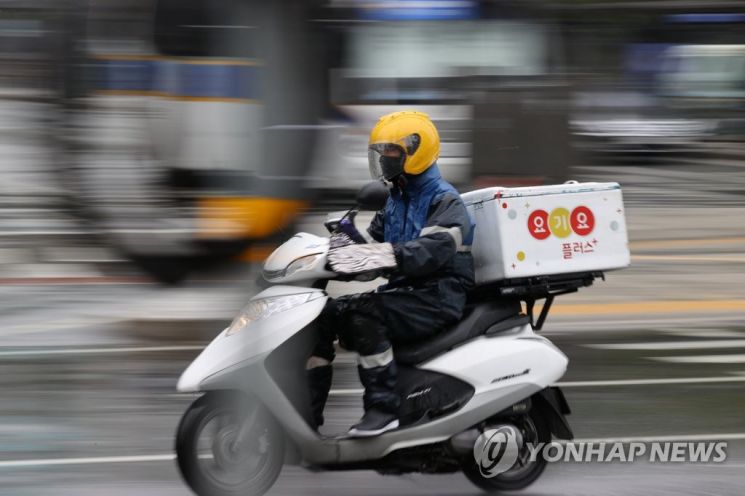 On the afternoon of the 2nd, a delivery rider is moving near Gwanghwamun Station in Jongno-gu, Seoul. The photo is unrelated to specific expressions in the article content. Photo by Yonhap News.
On the 29th of last month, the Nowon branch of the delivery platform 'Saenggakdaero' raised the basic fee from 3,000 KRW to 3,500 KRW per 500 meters of delivery distance.
The company stated in an official document, "This is a temporary measure until COVID-19 subsides, and we ask for the understanding and cooperation of franchise owners. Most delivery agencies have already increased delivery fees by more than 1,000 KRW per order," adding, "If the increase is charged only to the stores, the burden will be significant, so we would like to encourage passing the delivery tip cost on to consumers."
The problem lies in the absence of clear standards for price increases, resulting in inconsistent delivery fee hikes and ultimately placing the financial burden on consumers.
A survey conducted by the Metropolitan Fair Economy Council targeting about 2,000 dining delivery restaurants in the metropolitan area found that 8 out of 10 businesses responded that the advertising fees and commissions charged by delivery app companies were excessively high.
Additionally, 41.7% of respondents said that the burden of advertising fees and commissions paid to delivery app companies was passed on to customers through delivery charges.
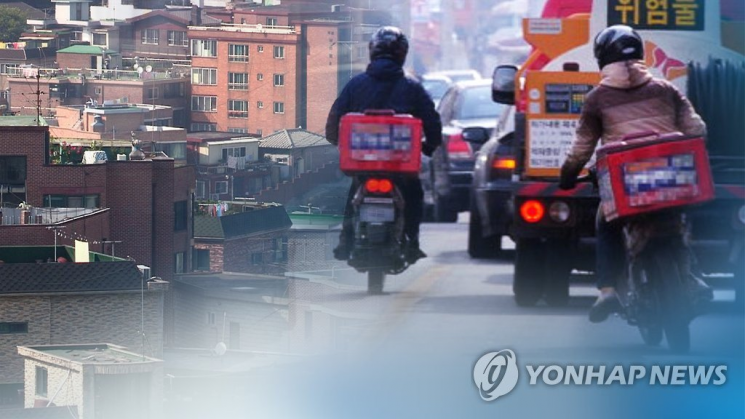 Delivery workers are delivering food. The photo is unrelated to specific expressions in the article. [Image source=Yonhap News]
Consequently, citizens collectively voiced complaints about the excessively high delivery fees.
Park, a worker in his 20s, said, "For a 3,000 KRW coffee, the delivery fee was 4,000 KRW. Also, setting a minimum delivery amount of 10,000 KRW and then raising delivery fees on top of that is absurd. Even if I want just one cup of coffee, I have to spend at least 14,000 KRW because of the minimum order amount and delivery fee."
Choi, a 34-year-old office worker, also said, "Since working from home, I tend to have lunch delivered rather than going out to eat. With COVID-19, I feel uneasy about dining in restaurants, so I use delivery services frequently. But delivery fees keep rising. Just yesterday, the delivery fee was 1,500 KRW, but today I saw it doubled to 3,000 KRW."
Choi expressed frustration, saying, "When delivery fees increase, they just raise them without prior notice. People who can't go out because of COVID-19 have no choice but to use delivery services, so they end up paying high delivery fees reluctantly."
Experts emphasize that issues like delivery fee increases should be communicated to consumers in advance so they can decide whether to use the service and make informed choices.
Professor Eunhee Lee of Inha University's Department of Consumer Studies explained, "Delivery platform operators, who are in an oligopolistic position, should take primary responsibility and cooperate with related businesses such as delivery agencies to prevent excessive surcharges."
Professor Lee added, "From the consumer's perspective, it is problematic that there is no clear disclosure of how delivery fees are determined. Consumers should be able to see the criteria beforehand and decide whether to use delivery services. The Fair Trade Commission should establish guidelines to prevent erratic delivery fee fluctuations. The responsibility for delivery fee increases should not be shifted to consumers."
© The Asia Business Daily(www.asiae.co.kr). All rights reserved.














