When Counting Owned Homes, Under 30s Treated as Same Household as Parents
Unmarried 20s Flooded with Complaints
Ministry of the Interior and Safety: "Not Applied if Able to Buy a House and Household is Separate"
Not Applied if Married or Income Exceeds 40% of Median (700,000 KRW/month)
Explanation Targeting Economically Disadvantaged 'Geumsujeo'
Complaints Also Arise Over '30-Year Age Criterion' and 'Household Unit Aggregation' Itself
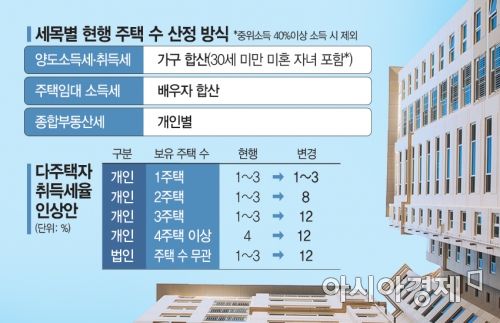
[Asia Economy Reporter Lee Chun-hee] The government plans to recognize households with separated family units as independent households even if they are under 30 years old, provided they have an income above 40% of the median income, despite the increase in housing acquisition tax rates. In this case, the number of houses owned by the parents will not be combined, so they are expected to avoid paying high acquisition taxes. This is in response to concerns that the government's plan to raise acquisition tax rates could discriminate against people in their 20s.
According to the Ministry of the Interior and Safety on the 3rd, the government will announce for public comment by today a revision to the "Local Tax Act Enforcement Decree" that, in principle, counts the number of houses by combining those owned by parents for those under 30 years old when applying housing acquisition tax rates, but includes this exception.
According to the amendment to the Property Tax Act, which the government is promoting as follow-up legislation to the July 10 real estate measures, the acquisition tax rate, which was up to 3% for up to three houses per household, will sharply rise to 8% for two houses and 12% for three or more houses. Under the current law, unmarried people in their 20s are treated as the same household as their parents when counting the number of houses owned.
For example, currently, even if the parents own one house, if the child buys an 84㎡ (exclusive area) house worth 600 million KRW, a 1% acquisition tax rate applies, so they only pay 6 million KRW. However, if the Property Tax Act is amended, they will have to pay an acquisition tax of 48 million KRW, which is 7 percentage points higher. If the parents own two houses, a 12% rate applies, and the acquisition tax jumps to 72 million KRW.
"Adults but treated like kids when buying a house"... Ministry of the Interior and Safety's stance targeting 'gold spoons'
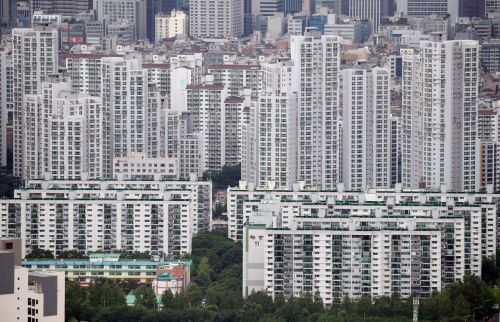
The government is preparing such an exception because raising acquisition tax rates sharply for multi-homeowners has led to complaints from people in their 20s. On social networking services (SNS) and real estate-related online cafes, there are complaints from people in their 20s such as, "Legally adults, but why are we still treated like kids when buying a house?" and "Isn't it excessive to prevent someone who graduates high school and immediately becomes a large corporation production worker from saving billions and buying a house before 30?"
A 20-something office worker said, "Applying a 12% acquisition tax on a 600 million KRW house is like the price of a luxury car," and asked, "Can't we buy a house freely before 30?" Currently, many petitions opposing the acquisition tax rate increase have been posted on the Blue House's national petition site regarding this issue.
The Ministry of the Interior and Safety, the responsible ministry, plans to apply standards similar to those for capital gains tax for recognizing separate households for people in their 20s. Currently, for capital gains tax, under the Enforcement Decree of the Income Tax Act, even if family separation is recognized, if the child's income is below 40% of the median income or if unmarried, they are considered the same household as their parents.
This year, the median income for a single-person household is 1,757,194 KRW per month. Forty percent of this is 702,878 KRW per month, so unmarried people whose income is below this are considered 'gold spoons' who cannot purely purchase a house on their own.
On the other hand, the Ministry of the Interior and Safety's position is to recognize independent households if people in their 20s can sufficiently prove their income. A government official explained, "Considering realistic housing purchasing ability, this standard is reasonable."
Criticism of uniform standards... Issues raised about age and household-based aggregation
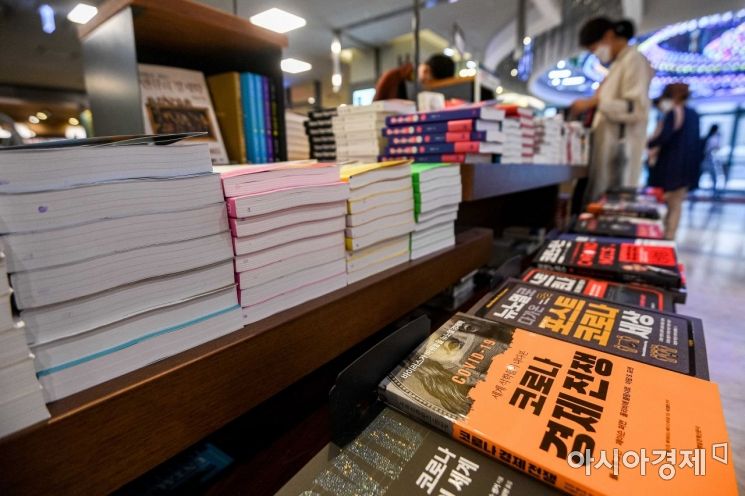 Amid the rapid changes in the stock markets of major countries such as South Korea, the United States, and China due to the COVID-19 pandemic, a large number of young individual investors in their 20s and 30s have entered the market, leading to a significant increase in the sales of finance and investment books. On the 27th of last month, economic books were displayed at Kyobo Bookstore Gwanghwamun Branch in Jongno-gu, Seoul. Photo by Jinhyung Kang aymsdream@
However, some argue that judging solely by income such as salary is problematic. With increasing youth entrepreneurship and some young people rapidly increasing assets through financial investments, economic capabilities vary widely even among people in their 20s, so it is inappropriate to sharply judge housing purchasing ability based on the age of 30.
There are also criticisms that household-based aggregation itself is unreasonable. A representative example is the comprehensive real estate tax. Currently, the comprehensive real estate tax is levied on an individual basis based on each person's name, even if they are family. In 2008, household-based aggregation was ruled unconstitutional by the Constitutional Court and changed to individual taxation.
At that time, the Constitutional Court ruled that "Our Civil Code adopts a separate property system for spouses" and "There is no legal basis to presume shared property for family members other than spouses," and judged that the relevant provision violated the Constitution. The Court also explained, "There is no reason to treat families disadvantageously compared to singles or de facto married couples just because they form a family."
© The Asia Business Daily(www.asiae.co.kr). All rights reserved.














