Daewoo E&C, Hyundai Electric, etc.
Surge in Unsold A-Rated Bonds
Avoided Due to Conservative Investment Sentiment
Continued Concentration on High-Quality Ratings
SPV Launch Scheduled This Week
Bond Purchases Expected Within This Month
Securities Industry Skeptical of Direct Impact
[Asia Economy Reporter Minji Lee] Despite the stabilization of the corporate bond issuance market following measures taken by the government and the Bank of Korea after the COVID-19 pandemic, the concentration on high-grade investment ratings continues. While supply and demand for high-grade investment ratings have recovered to pre-COVID-19 levels, the neglect of A-rated corporate bonds remains. Attention is focused on whether the special purpose vehicle (SPV) for purchasing low-credit corporate bonds and commercial paper (CP), set to launch this week by financial authorities, will provide relief to the A-rated bond issuance market.
◆ The successive hardships of A-rated corporate bonds = According to the financial investment industry on the 15th, the corporate bonds that had unsold volumes in demand forecasts this month were all A-rated bonds, including Daewoo Construction (A-), Hyundai Electric (A-), and HDC Hyundai Development Company (A+). Daewoo Construction and HDC Hyundai Development Company were analyzed to have seen weakened investor sentiment due to unfavorable business conditions caused by a contraction in the housing market. Hyundai Electric offered fixed interest rates to create a favorable investment environment but managed to fill only 10% of the offered amount due to operating losses and excessive financial burdens.
The reason A-rated bonds have become a shunned grade in the market is due to conservative investor sentiment. Institutions continue to invest mainly in high-grade bonds, and the government’s bond stabilization fund, which was established as a market stabilization measure, also purchased corporate bonds rated AA- or higher. The fact that many A-rated companies are in industries expected to face sluggish conditions, such as construction and machinery, also seems to have influenced this trend.
Researcher Taehoon Lee of Ebest Investment & Securities explained, "When institutions select bonds, they usually eliminate bonds with negative factors one by one," adding, "Although A-rated bonds offer high interest rates, risks related to business conditions and credit rating changes weigh more heavily in investment decisions."
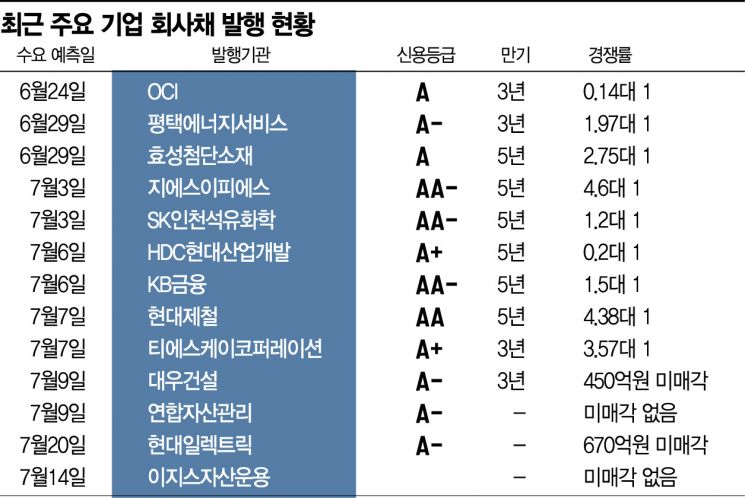
More funds than expected are flowing into corporate bonds rated AA or higher. Many companies have even increased their issuance size beyond the initial planned amount. GSPS (AA-) raised 150 billion KRW in demand forecasts but attracted over 900 billion KRW, issuing 250 billion KRW in corporate bonds, exceeding the plan. Interest rates were also applied lower than the individual average market rates by tranche. SK Incheon Petrochem (AA-), KB Financial Group (AA-), Hyundai Steel (AA), and Union Asset Management (AA), which held demand forecasts this month, also increased issuance volumes due to high competition rates.
However, differentiation appeared even within A-rated corporate bonds by individual issues. Interest in companies with high proportions in construction and chemical sectors fell sharply in the issuance market, but companies with attractive business prospects received sufficient funding. In the secondary market, interest in private power generation and food and beverage sectors remained high. For example, Aegis Asset Management (A-) reportedly filled all 30 billion KRW of its first corporate bond issuance in a 2-year single tranche demand forecast. TCK Corporation (A+) also recorded a competition rate of 3.57 to 1 in a 3-year single tranche demand forecast, with the stability of its waste treatment business drawing attention.
◆ Will the SPV be a breakthrough? = As the neglect of A-rated corporate bonds continues, the market is focusing on the low-credit corporate bond and CP purchasing institution launching this week. A financial authority official said, "Although the exact date cannot be specified yet, we are working toward launching the SPV as early as this week." Once established, the SPV plans to form an investment management committee and begin bond purchases as early as this month.
The low-credit corporate bond and CP purchasing institution supports companies that have struggled to raise funds smoothly due to the impact of COVID-19. The main purchase targets are corporate bonds rated AA to BB, and CP and short-term bonds rated A1 to A3. In May, the Bank of Korea and the Korea Development Bank planned to establish a 10 trillion KRW SPV to calm instability in the bond issuance market, securing the budget through the third supplementary budget and preparing to purchase bonds. However, delays in the approval of the third supplementary budget led the Korea Development Bank to proceed with a pre-purchase process for low-credit corporate bonds and CP to support lower-rated companies.
Some in the securities industry believe that even if the SPV launches this week, it will be difficult to have an immediate direct impact on the market. This is because the purchase direction has not yet been clearly revealed, and it is expected that purchases will not be made at interest rates lower than market rates.
Researcher Eun-gi Kim of Samsung Securities said, "While the SPV may help absorb unsold volumes in the low-credit corporate bond issuance market below A rating, it is uncertain whether it will reduce credit spreads," adding, "If issuers demand high issuance spreads, the spreads will not decrease." He added, "It should be seen as playing a role in preventing a sharp rise in A-rated credit spreads in the event of an additional crisis."
© The Asia Business Daily(www.asiae.co.kr). All rights reserved.












