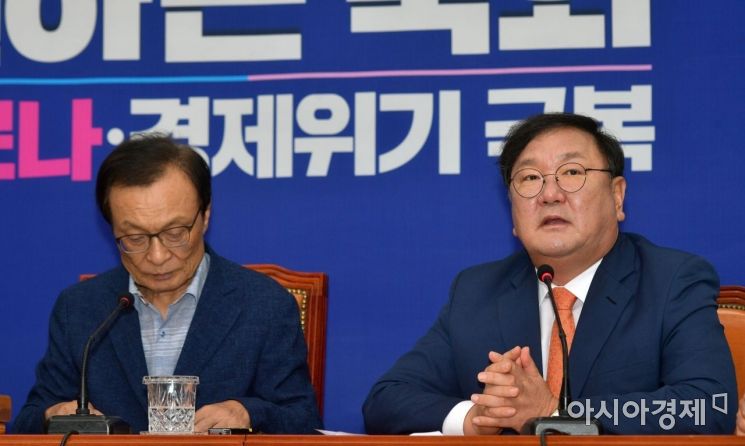
 Kim Tae-nyeon, floor leader of the Democratic Party of Korea, is attending the Supreme Council meeting held at the National Assembly on the 8th and delivering an opening remark. Photo by Yoon Dong-joo doso7@
[Asia Economy Reporters Kim Hyemin and Wondara] President Moon Jae-in has expressed his determination to focus the national agenda on real estate measures, while the ruling and opposition parties are strongly clashing over solutions to the real estate issue. Although there is consensus that the government's measures over the past three years have been insufficient, their approaches are completely opposite. The Democratic Party of Korea advocates regulatory measures through tax increases such as acquisition tax, capital gains tax, and comprehensive real estate tax, whereas the United Future Party has settled on expanding housing supply.
The Democratic Party plans to soon introduce a bill to strengthen the comprehensive real estate tax on multi-homeowners and speculative housing holders. On the morning of the 8th, Kim Tae-nyeon, the floor leader, said at the Supreme Council meeting held at the National Assembly, "This is a bill to be prioritized for passage in the National Assembly this month," and added, "We will soon prepare follow-up bills to be handled in the (September) regular session and establish a comprehensive plan to eradicate apartment speculation and stabilize prices."
Democratic Party lawmakers have already been actively proposing bills to strengthen real estate taxation. On the previous day, Representative Kang Byung-won introduced a bill to significantly increase the capital gains tax rate on houses held for less than one year from the current 50% to 80%. The comprehensive real estate tax law is expected to include provisions to raise the tax rate for 'owners of three or more houses or two houses in regulated areas' from the current maximum of 3.2% to a maximum of 4.0%, which was discarded due to the expiration of the 20th National Assembly's term.
Alongside this, the Democratic Party is conducting a survey on multi-homeowners within the party. They announced that they will advance the promise of 'disposal within two years' to demonstrate leadership in stabilizing the real estate market.
On the other hand, the United Future Party strongly criticizes the ruling party's real estate taxation measures. Kim Jong-in, the emergency committee chairman of the United Future Party, stated at a seminar led by the party's Policy Committee and Yeouido Institute held the previous day, "These are measures that have been taken for decades, yet they have resulted in price increases," and argued, "Raising taxes cannot curb real estate speculation." Representatives Bae Hyun-jin, Tae Young-ho, Park Sung-joong, and Yoo Kyung-joon, who represent constituencies in the Gangnam 3 districts (Seocho, Gangnam, Songpa), have taken a stance opposing the ruling party by proposing a bill to raise the tax exemption standard for housing from the current 600 million KRW to 900 million KRW.
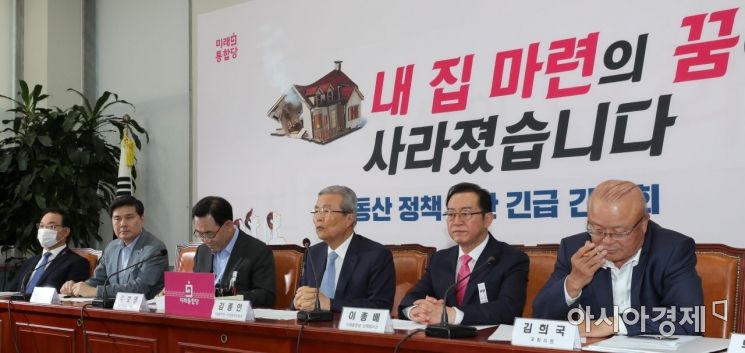 Kim Jong-in, Emergency Committee Chairman of the United Future Party, is delivering a greeting at the 'Urgent Meeting for Real Estate Policy Diagnosis' held at the National Assembly on the 7th. Photo by Yoon Dong-joo doso7@
The United Future Party's solution to the real estate issue focuses on increasing housing supply in the metropolitan area, especially Seoul, where demand exists, instead of regulating demand.
Ji Sang-wook, director of the Yeouido Institute, argued, "This is a problem that will be resolved if supply and demand are balanced," and insisted that floor area ratio restrictions and greenbelt development restrictions should be lifted to increase housing supply in Seoul. Former Seoul Mayor Oh Se-hoon proposed lifting redevelopment and reconstruction regulations and massively supplying 'half-price apartments' by public enterprises in Gangnam, Seoul. At a lecture invited by the Future Innovation Forum held at the National Assembly, he said, "If two public enterprises led by the government’s Korea Land and Housing Corporation (LH) and Seoul Housing and Communities Corporation (SH) supply thousands of half-price apartments at 30 million KRW per 3.3㎡ in Gangnam, it will drastically reduce surrounding apartment prices and temporarily halt the upward trend."
Representative Kim Ki-hyun also emphasized on BBS Buddhist Broadcasting radio that day, "During the Lee Myung-bak administration, when the United Future Party was the ruling party, the policy focused on developing 'workplace-proximity' housing close to workplaces, and statistics show that housing prices fell."
© The Asia Business Daily(www.asiae.co.kr). All rights reserved.













