Commemoration of Kim Il-sung's 26th Anniversary at Kumsusan Sun Palace... No Direct Message to the U.S.
Instead, a Silent Message Sent by Placing Near Ri Pyong-chol, Symbol of North Korean Weapons
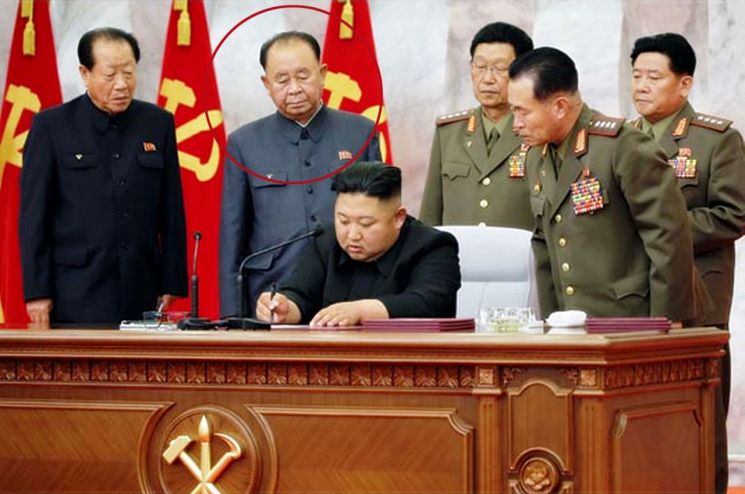 Ri Pyong-chol (red circle), vice chairman of the Party Central Military Commission and recognized as a key figure in North Korea's strategic weapons development, closely observed Chairman Kim Jong-un signing a document during the 4th expanded meeting of the 7th Party Central Military Commission held last May. Vice Chairman Ri drew attention when he was abruptly elected as vice chairman of the Party Central Military Commission, a position that had remained vacant since Choe Ryong-hae.
 North Korean State Affairs Commission Chairman Kim Jong-un paid tribute at the Kumsusan Palace of the Sun, where the bodies of President Kim Il-sung and National Defense Commission Chairman Kim Jong-il are enshrined, on the 26th anniversary of Kim Il-sung's death. The public appearance attracted attention as it came at the time when Stephen Biegun, U.S. Deputy Secretary of State and Special Representative for North Korea, began his official schedule after arriving in South Korea, but there was no content related to inter-Korean or North Korea-U.S. relations, nor any separate message from Chairman Kim.
However, some evaluations suggest that by highlighting the presence of Ri Pyong-chol, vice chairman of the Party Central Military Commission and a key figure in missile development, a "silent message" was conveyed.
North Korea’s state media, Korean Central News Agency, reported on the 8th, calling it "the nation’s greatest day of mourning on the 26th anniversary of Comrade Kim Il-sung’s passing," and stated, "Comrade Kim Jong-un visited the Kumsusan Palace of the Sun." Chairman Kim and other attendees conducted the tribute and floral offering without wearing masks separately.
Attending the tribute were Choe Ryong-hae, chairman of the Standing Committee of the Supreme People's Assembly and first vice chairman of the State Affairs Commission; Pak Pong-ju, vice chairman of the Workers' Party and the State Affairs Commission; Premier Kim Jae-ryong; as well as members of the State Affairs Commission, members and alternate members of the Party Central Committee Political Bureau, and members of the Party Central Military Commission, among other senior officials.
Chairman Kim did not issue any direct external message that day. In the photos reported of the tribute, Vice Chairman Ri was seen standing in the front row alongside Chairman Choe, Vice Chairman Pak, and Premier Kim.
Given North Korea’s stance to strengthen its "war deterrence" in response to U.S. military threats, analysts interpret that Chairman Kim conveyed a message pressuring both South Korea and the U.S. by elevating Vice Chairman Ri’s status.
Vice Chairman Ri is regarded as a key figure in North Korea’s strategic weapons development, including nuclear and missile programs, since Kim Jong-un came to power. He has earned Chairman Kim’s strong trust for his contributions to weapons development and has been rapidly promoted since the end of last year.
In the context of North Korea’s move to enhance its "nuclear war deterrence" in response to U.S. military threats following the collapse of the Hanoi North Korea-U.S. summit, attention to his role and position is inevitably increasing.
Over the past several years, he has accompanied Chairman Kim at major weapons test sites, demonstrating his influence in North Korea’s weapons development sector. In March, he accompanied Chairman Kim to observe test firings of "tactical guided weapons" and test firings for the deployment of "super-large multiple rocket launchers."
© The Asia Business Daily(www.asiae.co.kr). All rights reserved.












