Analysis of Revenue Estimates Over the Past 5 Years
Increased Tax Burden Due to Adjustments in Corporate Tax for High-Income Earners and Large Corporations
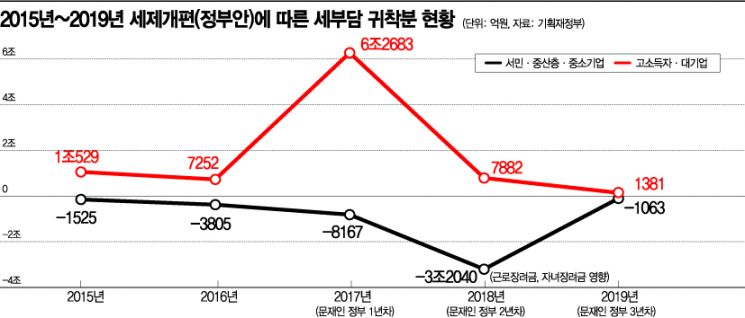
[Asia Economy Reporter Jang Sehee] It has been revealed that the tax burden has only increased for high-income earners and large corporations due to the annual tax reforms carried out under the Moon Jae-in administration. The upcoming tax reform to be announced this month is also likely to lead to tax increases targeting specific groups such as high-income earners and large corporations. Experts emphasize the 'principle of tax equity,' warning that if the tax burden continues to concentrate on high-income earners and large corporations, the entire economy could contract.
According to an analysis of revenue projection data over the past five years by Asia Economy on the 8th, the tax burden on high-income earners and large corporations increased by 7.1946 trillion won during the first three years of the Moon Jae-in administration. In particular, the year with the largest increase in tax burden on high-income earners and large corporations in the past five years was 2017, the first year of the Moon administration, with an increase of 6.2683 trillion won. This was due to the introduction of a new corporate tax bracket for taxable income exceeding 300 billion won, raising the tax rate from the existing 22% to 25%, a 3 percentage point increase. In 2018 and 2019, the tax burden on high-income earners and large corporations also increased by 788.2 billion won and 138.1 billion won, respectively.
◆ Concentrated Increase in the First Year of the Moon Administration = On the other hand, the tax burden on low-income earners, the middle class, and small and medium-sized enterprises (SMEs) decreased by 4.127 trillion won over the past three years. In particular, in 2018, due to the expansion of the Earned Income Tax Credit and Child Tax Credit, the tax burden on low-income earners, the middle class, and SMEs decreased by 3.204 trillion won. Last year, it decreased slightly by 106.3 billion won. As a result, the taxes collected from increased levies on high-income earners and large corporations were used for welfare expenditures.
A government official stated, "Usually, major tax reforms are implemented in the first year of a government," adding, "It is true that a significant amount of corporate tax was collected due to the corporate tax adjustment in 2017." In fact, the '2018 Fiscal Year Total Revenue and Expenditure Closing Results' showed national tax revenue of 293.6 trillion won, marking a record high in excess tax revenue. At that time, corporate tax revenue was 70.9 trillion won, which was 7.9 trillion won more than initially expected.
The government plans to announce the tax reform plan on the 22nd, and the trend of tax increases focused on high-income earners is expected to continue. There are forecasts that the credit card income deduction limit to be included in this year's tax reform plan may increase less for the income bracket exceeding 120 million won (2 million won) compared to the brackets below 70 million won (3 million won) and between 70 million won and 120 million won (2.5 million won). Regarding the comprehensive real estate holding tax, the government is reportedly considering lowering the taxable income brackets to increase the number of multi-homeowners subject to the highest tax rates of 3-4%.
Controversy over double taxation continues in the financial tax reform as well. Capital gains tax and securities transaction tax are imposed only on high-income earners with capital gains exceeding 20 million won, leading to ongoing criticism that this is effectively a tax increase. The government previously decided to fully introduce taxation on capital gains from financial investment income such as stocks starting in 2023, while lowering the securities transaction tax from the current 0.25% by 0.1 percentage points.
Additionally, policies such as monthly rent tax credits (for those with total annual income below 70 million won and no home ownership) and credit card income deductions (for spending exceeding 25% of total income) have income limits, making it difficult for high-income earners to benefit from them.
◆ Tax Experts Say "Tax Burden Concentration Is Excessive" = Experts point out that even considering the policy environment, the concentration of tax burden on high-income earners and large corporations is excessive. Kim Woo-chul, professor of taxation at the University of Seoul, said, "The nominal top income tax rate already exceeds 40%, and including local taxes, it rises to 44%." He added, "With corporate tax increases, the perceived tax burden on large corporations has become even higher," emphasizing that "maintaining tax equity is important."
Park Ki-baek, professor of taxation at the University of Seoul, said, "If the securities transaction tax is not abolished, the problem of double taxation will arise," and added, "It is questionable whether adjusting the rates of the comprehensive real estate holding tax will stabilize housing prices." Sung Tae-yoon, professor of economics at Yonsei University, said, "Expanding welfare through tax expenditures can lead to budget waste," and warned, "If taxes are collected intensively only from high-income earners and large corporations, it will dampen motivation and eventually affect economic growth." He further pointed out, "Government spending will expand inefficiently, and the tax burden for that will fall on the middle class and above, as well as businesses."
© The Asia Business Daily(www.asiae.co.kr). All rights reserved.












