[Asia Economy Reporter Kwangho Lee] Due to the impact of the novel coronavirus infection (COVID-19), the number of employed people in April decreased by the largest margin in 21 years and 2 months.
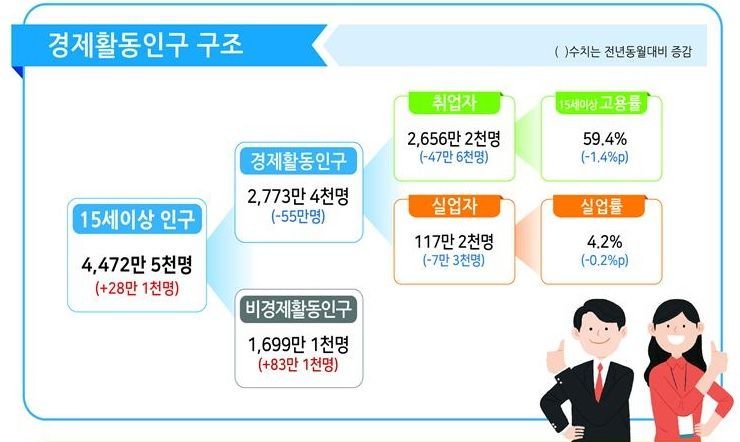
According to the 'April Employment Trends' announced by Statistics Korea on the 13th, the number of employed people last month was recorded at 26,562,000, a decrease of 476,000 compared to one year ago. This is the largest decline since February 1999 (658,000), when the effects of the foreign exchange crisis were felt.
The employment market showed a relatively favorable trend as recently as February, with an increase of 492,000 employed people. However, the number decreased by nearly 200,000 in March, and last month the decline more than doubled to 476,000. The economic crisis caused by the spread of COVID-19 is showing signs of escalating into an unemployment disaster.
The employment rate for those aged 15 and over fell by 1.4 percentage points from a year earlier to 59.4%, marking the lowest since April 2010 (59.2%). The drop was the largest since May 2009 (1.4 percentage points). The employment rate for those aged 15 to 64, the OECD comparison standard, also fell by 1.4 percentage points to 65.1%. The economically active population was 27,734,000, down 550,000 (-1.9%) from a year earlier.
By industry, there were notable decreases in sectors with high consumer contact such as accommodation and food services (-212,000, -9.2%), education services (-130,000, -6.9%), and wholesale and retail trade (-123,000, -3.4%).
On the other hand, health and social welfare services (77,000, 3.5%) and agriculture, forestry, and fisheries (73,000, 5.2%) increased. In particular, due to the spread of the 'social distancing' campaign and increased use of delivery services, transportation and warehousing (34,000, 2.4%) also grew.
By age group, employment decreased in all age groups except those in their 60s. Employment among people in their 60s increased by 274,000, but decreased by 190,000 in their 40s, 172,000 in their 30s, 159,000 in their 20s, and 143,000 in their 50s.
The non-economically active population, those who neither sought employment nor were employed, rose by 831,000 to 16,991,000 compared to a year ago. The decrease in the economically active population and the increase in the non-economically active population are the largest since June 2000, when the statistical standards were changed.
The unemployment rate was 4.2%, down 0.2 percentage points from a year earlier. The youth unemployment rate for those aged 15 to 29 was 9.3%, down 2.2 percentage points. The number of unemployed was 1,172,000, a decrease of 73,000 compared to a year ago. The expanded unemployment rate (Employment Supplementary Indicator 3), which reflects the actual experience of job seekers, was 14.9%, the highest since statistics began in 2015. The youth perceived unemployment rate was also a record high at 26.6%.
Eun Soonhyun, Director of the Social Statistics Bureau at Statistics Korea, explained, "To prevent the spread of COVID-19, gatherings and outings have been restrained, and due to the sharp decline in tourists, employment decreased mainly in accommodation and food services and education services."
© The Asia Business Daily(www.asiae.co.kr). All rights reserved.













