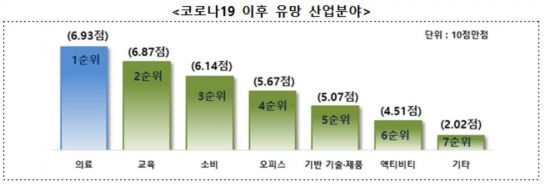
[Asia Economy Reporter Kim Daeseop] The top promising industry identified by domestic startups after the COVID-19 pandemic was the 'medical sector.' Additionally, 4 out of 10 startups predicted that the startup ecosystem would develop in a positive direction following COVID-19.
According to the 'Post-COVID-19 Startup Environment Change Survey' released by the Ministry of SMEs and Startups on the 12th, the top three promising industries were the 'medical sector' (6.93 points), 'education sector' (6.87 points), and 'consumer sector' (6.14 points), respectively.
Startups gave the highest scores to the medical sector, including diagnostic kits, masks, and telemedicine, on a 10-point scale. The education sector, including online education and childcare services, and the consumer sector, including online fresh food shopping, subscription economy, and unmanned stores, also ranked high. 'Office solutions such as video conferencing' (5.67 points), 'cloud and other foundational technologies/products' (5.07 points), and 'activities such as home training' (4.51 points) followed as the 4th to 7th promising industry sectors.
This appears to be due to increased social interest in non-face-to-face areas such as health management, education, childcare, consumption, and work using online platforms caused by COVID-19. Notably, female entrepreneurs gave the highest scores to the consumer sector.
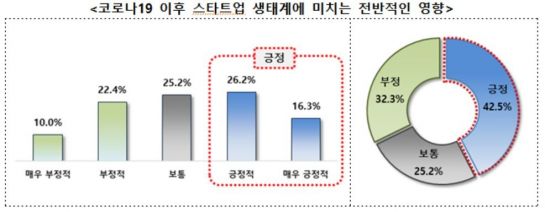
Regarding the outlook for the startup ecosystem after COVID-19, positive perceptions were more prevalent. The proportion of respondents who viewed the overall impact on the startup ecosystem as 'positive' was 42.5%. Meanwhile, 32.3% responded 'negative,' and 25.2% responded 'neutral,' indicating that there is slightly more focus on positive opportunities to discover new businesses and items rather than negative impacts.
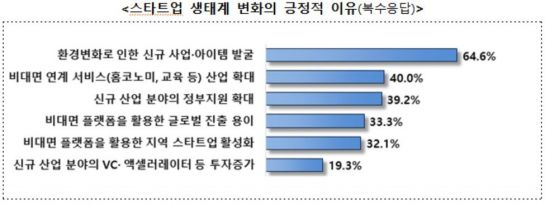
The reasons for viewing changes in the startup ecosystem positively (multiple responses allowed) were 'discovery of new businesses and items due to environmental changes' (64.6%), 'expansion of non-face-to-face linked service industries such as home economy and online education' (40.0%), and 'increased government support for new industrial sectors' (39.2%).
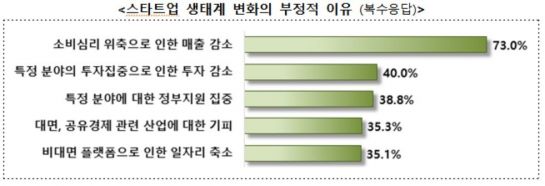
Conversely, the reasons for viewing changes in the startup ecosystem negatively (multiple responses allowed) were 'sales decline due to reduced consumer sentiment' (73.0%) and 'decreased investment due to concentration of investment in specific sectors' (40.0%).
Regarding requests to the government from startups, the most common opinion, at 60.9%, was the need to expand specialized support for promising industries (non-face-to-face, bio, etc.). This was followed by 'expansion of government support projects such as R&D and deregulation' (36.1%) and 'promotion of public utilization of non-face-to-face services' (3.0%).
This survey was conducted on 492 startups participating in government startup support projects. It aimed to understand how companies on the ground perceive changes in the startup ecosystem due to COVID-19 and promising industries moving forward. The survey was conducted online from the 10th to the 30th of last month.
Looking at the distribution of respondents by founder characteristics, 84.3% (415 companies) were male and 15.7% (77 companies) were female. By age, 40s accounted for 33.7% (166 companies), 50s for 32.7% (161 companies), and 30s for 22.8% (112 companies). Regarding startup company types, 63.6% (313 companies) were corporations and 36.4% (179 companies) were individuals. By industry, knowledge service industries accounted for 51.0% (251 companies) and manufacturing industries for 49.0% (241 companies).
Lee Soon-bae, Director of Startup Policy at the Ministry of SMEs and Startups, said, "With the acceleration of the transition to a digital economy after COVID-19, non-face-to-face sectors are expected to emerge globally as promising industries. The government will spare no policy support to enable Korean startups in the non-face-to-face sector to lead the global market."
© The Asia Business Daily(www.asiae.co.kr). All rights reserved.













