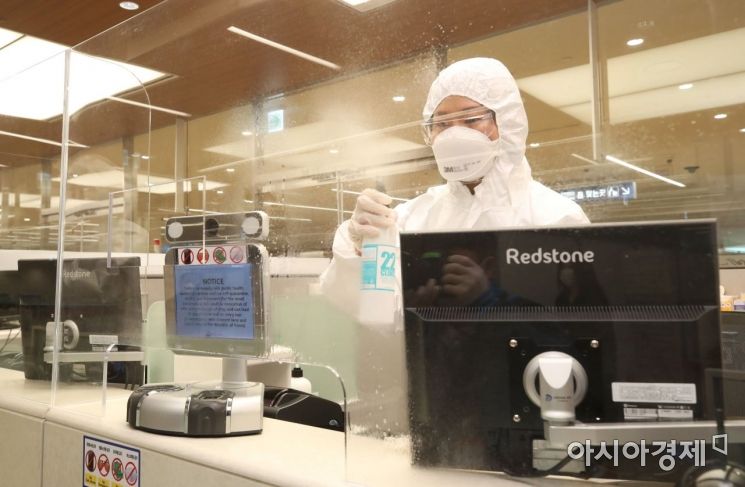
 An immigration inspector from the Ministry of Justice's Incheon Airport Immigration Foreigners Office is disinfecting the area while waiting for arrivals from Europe at the dedicated symptomatic arrivals inspection counter at Terminal 2 of Incheon International Airport on the 8th. Photo by Moon Honam munonam@
[Asia Economy Reporter Junho Hwang] Research papers related to the novel coronavirus infection (COVID-19) have been rapidly increasing across various countries. Although there are no notable research results yet on treatments or vaccines, studies related to drug repositioning and new drug development are on the rise. Among them, South Korea is analyzed to be focusing on COVID-19 diagnosis and new drug development.
The Future Technology Analysis Center of the Korea Institute of Science and Technology Information (KISTI) announced on the 9th the results of an analysis of recent three-month trends in research papers uploaded to representative preprint repositories bioRxiv and medRxiv. KISTI utilized the Altmetric index, which measures the attention level of research by reflecting various dissemination routes of knowledge, to analyze research papers awaiting peer review.
Rapid Increase in COVID-19 Research
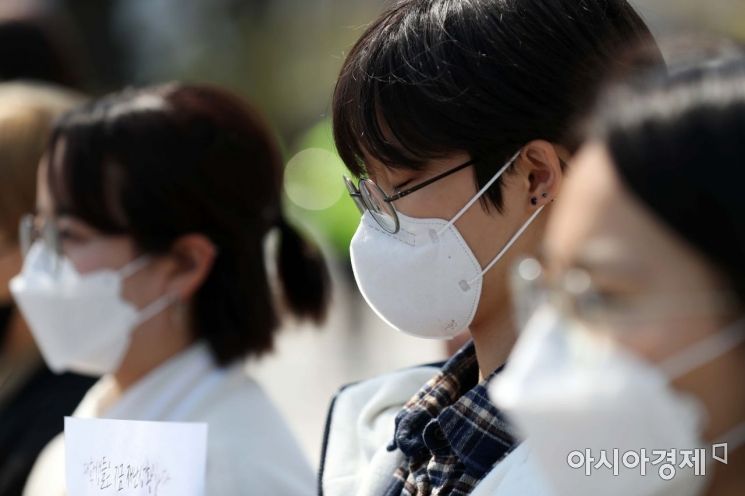 Students from the National University Student Council Network are making a disaster declaration for the COVID-19 university crisis on the 6th in front of the Government Seoul Office in Jongno-gu, Seoul. They urged for tuition refunds and measures for remote lectures. Photo by Moon Honam munonam@
Scientific and technological communities worldwide appear to be actively responding to COVID-19. Research papers have recorded a cumulative growth rate of 64% over the past three months. In particular, China, known as the outbreak origin of COVID-19, accounted for 56% of the research papers. Following were the United States with 15%, France with 10%, and the United Kingdom with 5% of the paper shares.
By topic, many studies focused on COVID-19 infection spread models, epidemiological characteristic analysis, and case-centered clinical features. Research activities for developing treatments or vaccines, such as virus genome analysis, antigen receptors, and antibody development, were minimal. However, studies on epidemiological characteristics using deep learning and big data, drug repositioning, and new drug development showed an increasing trend.
By country, China conducted research covering all stages of COVID-19 response, including epidemiology, clinical, diagnosis, and treatment. In contrast, the United States focused more on diagnosis and treatment, while South Korea emphasized diagnosis and new drug-related research.
High Attention to COVID-19 Survival Period Research
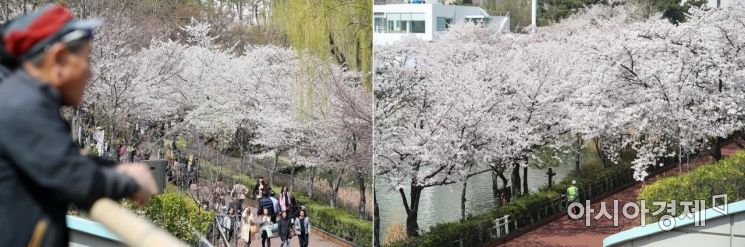 The 2019 Seokchon Lake Cherry Blossom Festival held on April 5th last year (left photo). Seokchon Lake in Songpa-gu, Seoul is filled with citizens enjoying a spring outing. A staff member is patrolling under the cherry blossoms at Seokchon Lake, which was closed to prevent the spread of COVID-19 (right photo). / Photo by Moon Honam munonam@
The research attention was high for studies related to the survival period of the COVID-19 virus, basic epidemiological characteristic research using spread models, the origin and transmission routes of COVID-19, virus stability, airborne transmission, non-pharmaceutical interventions (NPI), and prediction and forecasting.
In the diagnosis and treatment development field, interest focused on the analysis of viral genome structure and function including the spike protein, expression profiles of proteins binding COVID-19 to the human body, monoclonal antibodies isolated from confirmed patients that neutralize COVID-19, candidate drugs for targeted therapy and drug repositioning, use of malaria treatments, and plasma therapy.
Additionally, KISTI stated that the scientific and technological data ecosystem responding to COVID-19 is rapidly changing. Fast and diverse communication channels have been established through archives and GitHub, and the number of institutions providing real-time sharing of research data and analysis results is increasing.
Senior Researcher Eunsu Son of KISTI said, "The attention level of archive data on COVID-19 is at an unprecedentedly high level," and added, "While there is still high attention on transmission and clinical cases, including emphasis on non-pharmaceutical interventions, various possibilities for diagnosis and treatment are emerging."
The research results can be viewed on KISTI DATA INSIGHT, a big data-based science and technology issue analysis channel.
© The Asia Business Daily(www.asiae.co.kr). All rights reserved.














