[Asia Economy Reporter Hwang Yoon-joo] The European Union (EU) has declared its full-scale commitment to fostering the artificial intelligence (AI) industry.
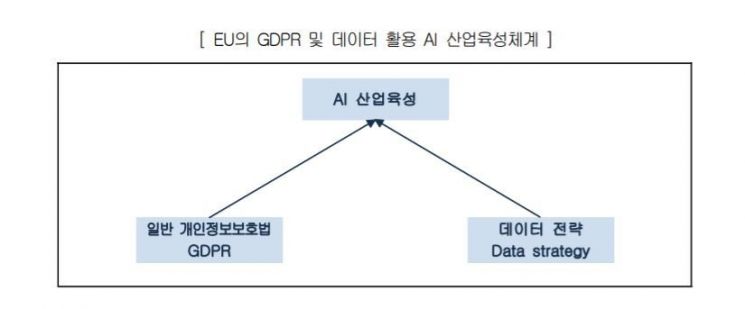
According to the 'Future Industrial Strategy and Implications of the New EU Government' released on the 6th by the Korea International Trade Association Brussels Office, the EU Commission unveiled an AI white paper outlining AI industry development strategies and a draft data strategy containing key points on data sharing last February. It announced plans to invest over 20 billion euros annually in the AI industry over the next decade.
The EU defines the use of AI technologies in five areas?healthcare, transportation, security, employment, and legal systems?that pose potential harm to humans or legal disputes as "high-risk" and has established this as a regulatory standard. Accordingly, all high-risk AI technologies must undergo the EU's conformity assessment and obtain certification to be used within the region.
Regarding data collection and utilization, the EU plans to build a public data repository to allow EU companies and individuals access to all information except personal data. It will also actively encourage data sharing with mutually trusted countries that have enacted data laws equivalent to the EU's standards.
The report explained, "The mandatory EU conformity assessment certification applies to both EU and non-EU companies but is essentially a measure to check a few global IT companies, such as those from the US and China, which already dominate the AI market." It added, "The establishment of a public data repository and mandatory data sharing are also intended to prevent monopolization by certain companies."
The report further evaluated, "With the announcement of this AI industry development strategy and data strategy, the EU has begun to take the lead in the competition to establish international standards in related fields," and predicted, "In the long term, EU AI companies will play a significant role in acquiring technological capabilities that surpass IT companies from the US and China."
Kang No-kyung, Deputy Director of the Brussels Office, said, "In preparation for the EU allowing third-country inspection bodies to conduct conformity assessments, it is worth considering establishing related certification bodies domestically." He added, "If such certification bodies are established, it will alleviate the certification acquisition burden for our startups and companies planning to enter the EU and greatly assist their successful settlement."
© The Asia Business Daily(www.asiae.co.kr). All rights reserved.