US Stock Market Drops Over 4%
March PMI Revised Downward
Commerzbank Chief Economist: "Feels Like Flying Blind"
[Asia Economy New York=Correspondents Baek Jong-min and Na Ju-seok] The US stock market recorded a decline of over 4% on the first trading day of the second quarter on the 1st (local time), and international oil prices once again fell into the $10 range during intraday trading. This was the result of downward revisions to the March Purchasing Managers' Index (PMI), which indicates industrial indicators from Asia and Europe to the US. Experts said that the uncertainty of the economic outlook was fully reflected, making it difficult to cautiously be optimistic about the second quarter situation.
According to the US Institute for Supply Management (ISM) on the 1st (local time), the US manufacturing PMI fell from 50.1 in February to 49.1 in March. This showed that the manufacturing economy had shifted from an expansion phase to contraction. The US manufacturing PMI surveyed by IHS Markit was also 48.5, the lowest since 2009. The situation in the European Union (EU) was similar. The finalized March EU manufacturing PMI announced by IHS Markit was only 44.5. This is the lowest since mid-2012 during the Eurozone (19 countries using the euro) debt crisis. Earlier, the PMI announced by IHS for South Korea and Japan also fell to 44.2 and 44.8, respectively. The manufacturing indices released worldwide clearly showed the economic contraction caused by the novel coronavirus disease (COVID-19).
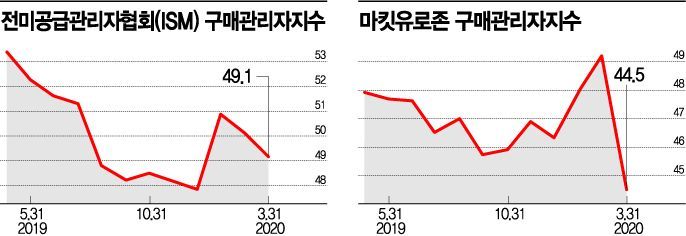
At least these indicators do not fully reflect the economic activity shutdown caused by COVID-19, so the second quarter indicators, which represent the situation over the next three months starting this month, are expected to worsen further.
The New York stock market, which closed on this day, fully reflected the unstable real economy indicators. The Dow Jones Industrial Average fell 4.44% (973.65 points) to close at 20,943.51, the S&P 500 index dropped 4.41% (114.09 points) to 2470.50, and the Nasdaq index also declined 4.41% (339.52 points) to 7360.58. West Texas Intermediate (WTI) crude oil continued its weakness, recording $19.90 per barrel during intraday trading.
The poor performance of various economic indicators is largely due to the growing fear that the spread of COVID-19 is difficult to control. Local media reported that investors focused on the relentless spread of COVID-19 within the US. The number of confirmed cases in the US exceeded 200,000 on this day.
With ongoing concerns about COVID-19, uncertainty in the market is not easily resolved. Analysts say that if the vicious cycle of mass unemployment caused by COVID-19 shrinks consumption and leads companies to bankruptcy continues, it is difficult to expect the current situation to be resolved in the short term.
Peter Dixon, chief economist at Commerzbank, described the current situation as "feeling like flying blind."
David Blanchflower, a professor at Dartmouth College, said, "Jobs are disappearing at a rate 20 times faster than during the financial crisis," adding, "I have never seen unemployment progress this quickly."
Oil price instability is also fueling economic contraction. As global oil demand decreases, oversupply is accelerating. Due to unprecedented demand reduction, there are concerns that storage space for oil is running out, potentially leading to situations where oil is sold at a premium. The oil trading company Trafigura predicted that global daily oil demand would decrease by 30 million barrels this month. On the other hand, Saudi Arabia, which used to produce 9.7 million barrels per day, announced plans to increase production to 12.3 million barrels, and other oil-producing countries such as the United Arab Emirates and Iraq have also announced production increases. Demand is decreasing, but supply is increasing.
As refining margins turned negative due to demand reduction caused by falling oil prices, refineries are reluctant to secure crude oil. Brjan Schildrop, an analyst at Sweden's SEB Markets, said, "Refineries everywhere are losing money every time they refine crude oil or are unable to secure storage for refined products."
In particular, Schildrop predicted that as refineries refrain from refining crude oil, crude oil producers will face difficulties finding places to send their oil. Some crude oil producers in parts of the US are already selling at prices in the $10 range per barrel. In some areas, prices as low as $1 per barrel have appeared.
The Wall Street Journal (WSJ) said, "Factories in Asia, the US, and Europe are cutting staff and production at the fastest pace since the global financial crisis," adding, "This is evidence that the global economy is rapidly contracting as countries worldwide implement control measures to prevent the spread of the virus." The US stock market's sharp decline of over 4% at the start of the day can be seen as reflecting these concerns.
© The Asia Business Daily(www.asiae.co.kr). All rights reserved.












