[Asia Economy Reporter Kim Hyewon] Amid growing concerns over a global economic slowdown due to the spread of the novel coronavirus infection (COVID-19), an analysis has emerged that the "double C (Corona-China) fear" and the "weakening of the global value chain" will act as downward factors for domestic exports this year. Additionally, concerns over a decline in exports to China following the Phase 1 trade agreement between the U.S. and China, as well as the potential expansion of trade disputes between the U.S. and the European Union (EU), are increasing global uncertainties. However, expectations for a recovery in the semiconductor market and export growth to ASEAN amid unfavorable external conditions are seen as key points to watch for potential improvements in the export economy.
In its economic weekly report "Key Issues in Domestic Exports in 2020," published on the 8th, Hyundai Research Institute stated, "Due to the recent spread of COVID-19, unexpected adverse factors such as a decline in global economic growth rates and reduced trade are emerging, worsening the external conditions for exports."
The "double C fear" refers to the judgment that if China's economic slowdown intensifies due to production disruptions and deteriorating consumer sentiment caused by COVID-19, it will become a downward factor for the domestic export economy, which is highly dependent on China. It is clear that China's economic growth rate this year will fall short of previous forecasts. The OECD lowered its forecast for China's GDP growth rate this year from 5.7% in November last year to 4.9% in March, a 0.8 percentage point drop. Several global investment banks have also revised their forecasts for China's economic growth rate downward by between 0.2 and 1.2 percentage points.
Due to demand contraction caused by China's economic downturn, South Korea's exports to China are expected to decrease, and supply disruptions of Chinese components will inevitably have a negative impact on South Korea's global exports. The share of exports to China in South Korea's total exports rose from 10.7% in 2000 to 25.1% last year. In this context, Hyundai Research Institute estimates that if China's economic growth rate falls by 1 percentage point due to COVID-19, South Korea's export growth rate to China will decline by 0.48 to 0.8 percentage points, and total exports will decrease by $150 million to $250 million.
Furthermore, the weakening of the global value chain, caused by China's industrial upgrading and the continuation of global protectionism, is expected to intensify with the recent spread of COVID-19. The weakening of the global value chain is analyzed to act as a downward factor for South Korea's export economy, which actively participates in international production division.
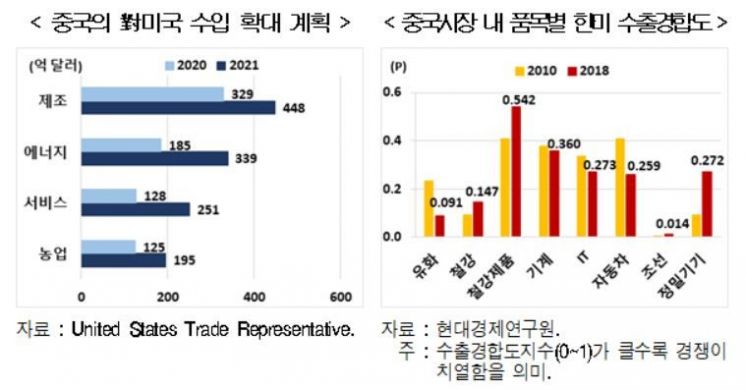
In the U.S.-China trade negotiations, the agreement for China to increase imports from the U.S. raises concerns over a decline in South Korea's exports to China in manufacturing sectors that compete closely with the U.S. in the Chinese market. The deepening trade conflicts between the U.S. and the EU over goods and services could also lead to a contraction in global investment and trade. Since last year, the U.S. and the EU have imposed mutual tariffs amid disputes over aircraft subsidies and digital taxes, escalating tensions.
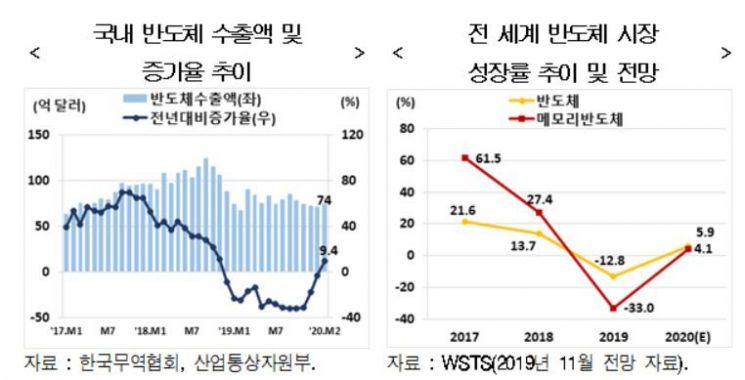
Expectations and concerns about a recovery in the semiconductor market coexist. Although the semiconductor export growth rate turned positive this year, raising hopes for a market recovery, COVID-19 poses a potential risk. Despite increased uncertainty due to COVID-19, semiconductor exports grew by 9.4% in February, marking a positive turn after 15 months, driven by rising demand for data servers and increasing DRAM prices. However, if COVID-19 spreads globally and prolongs, it is widely agreed that semiconductor demand will weaken and prices will fall, causing inevitable damage.
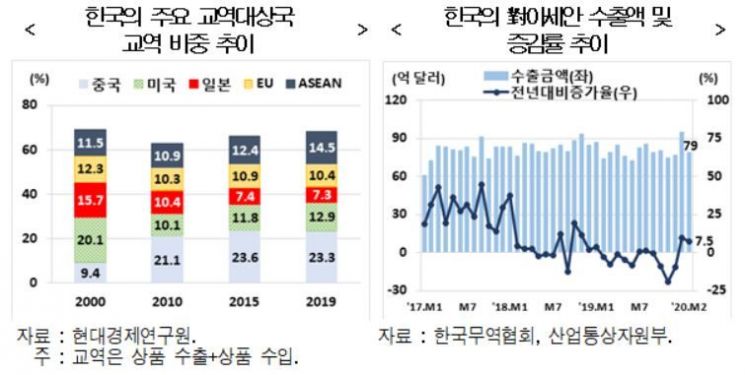
Expanding trade with ASEAN, which shows relatively high economic growth rates, is expected to partially offset the downward pressure on South Korea's exports this year. From 2000 to 2019, the share of trade with ASEAN in South Korea's total trade increased by 3.6 percentage points, surpassing the 2.2 percentage point increase in trade with China. Last year, South Korea's trade share with ASEAN was 14.5%, higher than with the U.S. (12.9%), the EU (10.4%), and Japan (7.3%). However, if the COVID-19 outbreak prolongs, the possibility of export stagnation to ASEAN also remains.
Ryu Seunghee, a researcher at Hyundai Research Institute's Industrial Analysis Team, pointed out, "In preparation for the global economic downturn, especially in China, caused by the spread of COVID-19, it is necessary to strengthen monitoring of international financial markets, establish an early warning system for external risks, and implement active export stimulus measures." She added, "As the restructuring of the global value chain accelerates, investment and support should also be expanded to promote the high-techization of intermediate goods and the high value-added transformation of consumer and capital goods."
Researcher Ryu also emphasized, "With the Phase 1 trade agreement between the U.S. and China leading to increased Chinese imports from the U.S., it is necessary for the government and companies to develop strategies to minimize potential damage to domestic industries." She stressed, "It is important to prepare for uncertainties arising from the possible expansion of trade disputes between the U.S. and the EU, and to devise measures to reduce damage to related domestic industries if the disputes spread to the automotive sector under Section 232 of the Trade Expansion Act." Furthermore, she added, "Continuous efforts to discover emerging markets and new industries are needed to reduce concentration on specific markets and products, thereby securing the stability of export industries through policy support."
© The Asia Business Daily(www.asiae.co.kr). All rights reserved.














