Phase 1 US-China Trade Deal Followed by Overwhelming Senate Approval of USMCA
Leading the Global Trade Order
Next Target EU Also on Alert
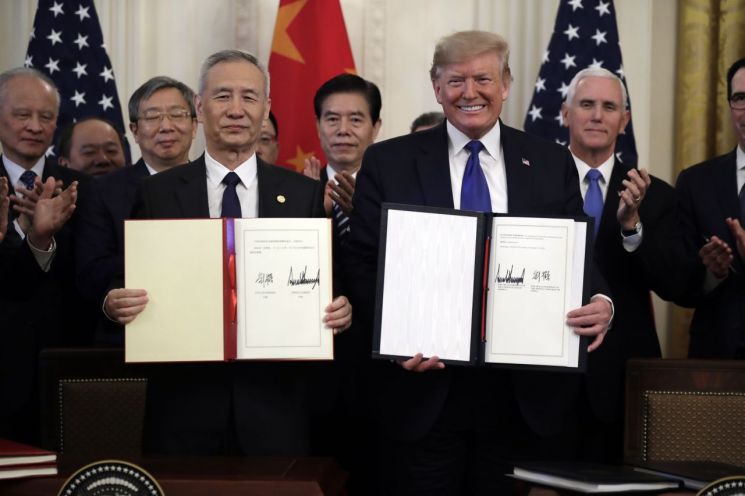 Donald Trump (right), President of the United States, and Liu He, Vice Premier of China, are holding up the US-China Phase One trade agreement after signing it at the White House in Washington DC on the 15th (local time).
 [Image source=Yonhap News]
[Asia Economy New York=Correspondent Baek Jong-min] U.S. President Donald Trump is gaining the upper hand in trade agreements as the new year begins. Just one day after the signing of the Phase One trade deal between the U.S. and China, the U.S. Senate passed the ratification of the new trade agreement between the United States, Mexico, and Canada, known as USMCA (United States-Mexico-Canada Agreement). This marks the beginning of Trump-style trade order exerting significant influence on the global economy.
On the 16th, the U.S. Senate approved the USMCA agreement with 89 votes in favor and 10 against. The United States, Mexico, and Canada had agreed on USMCA in September 2018 to replace the existing North American Free Trade Agreement (NAFTA), but the U.S. Democrats delayed the ratification process. After additional negotiations, a revised agreement was reached on the 10th of last month.
The ratification bill, which had already passed the House of Representatives on the 19th of last month, passed the Senate without major issues, leaving only President Trump's signature remaining. Unlike the Phase One trade deal with China, USMCA has support from the Democratic Party as well. President Trump is expected to sign the USMCA next week.
Although there are minority opinions opposing USMCA, they are overshadowed by the majority in favor. On this day, Senate Minority Leader Chuck Schumer and Senator Bernie Sanders, both Democrats, voted against the USMCA ratification, but failed to change the overall outcome. Despite opposition from some major labor unions and environmental groups, further reversals are considered unlikely.
Once the U.S. ratification is complete, Canada’s ratification remains. Although Canadian Prime Minister Justin Trudeau’s party was reduced to a minority government in last year’s general election, the opposition parties have expressed willingness to cooperate on USMCA, making smooth ratification expected.
Attention is also focused on President Trump’s future moves, having effectively shaped trade relations between China and North America according to his will. From Trump’s perspective, it is positive that trade-related achievements have been highlighted consecutively since the impeachment proceedings began in the Senate. Especially encouraging is the bipartisan support USMCA received in the Senate. The prevailing assessment is that a green light has been turned on for his presidential campaign despite the impeachment turmoil.
Following these consecutive successes, President Trump tweeted, "One of the greatest trade deals ever! Also good for our long-term relationship with China." He added, "Nothing like this has ever happened in American history," and said, "Next is USMCA (United States-Mexico-Canada Agreement)!"
The online media outlet Vox evaluated the recent developments by saying, "President Trump’s trade negotiations are gradually becoming a reality," and that the situation is unfolding favorably for President Trump.
On the other hand, opposition to Trump-style trade order remains strong. Phil Hogan, European Union (EU) Commissioner for Trade, said on the same day that it is necessary to examine whether the contents of the Phase One trade agreement between the U.S. and China comply with World Trade Organization (WTO) regulations.
Commissioner Hogan stated, "The devil is in the details," assessing that the specifics of the U.S.-China trade agreement are "somewhat incomplete," and added, "The U.S. and China have proceeded with direct agreements outside the usual framework. We need to verify whether it complies with WTO rules."
Hogan’s remarks can also be seen as a response to reports on the 15th that the Trump administration warned it would impose a 25% tariff on European cars if Europe does not initiate dispute procedures holding Iran accountable for its actions.
After achieving results in North America and China, President Trump’s next target is likely to be Europe. The EU and the U.S. are clashing over various issues, including disputes over subsidies to aircraft manufacturers Airbus and Boeing, as well as France’s imposition of a digital tax.
© The Asia Business Daily(www.asiae.co.kr). All rights reserved.

![Clutching a Stolen Dior Bag, Saying "I Hate Being Poor but Real"... The Grotesque Con of a "Human Knockoff" [Slate]](https://cwcontent.asiae.co.kr/asiaresize/183/2026021902243444107_1771435474.jpg)














