[Asia Economy New York=Correspondent Baek Jong-min] The United States and China have finally signed the Phase One trade agreement. This marks a truce in the US-China trade dispute that has threatened the global economy for the past two years, and is also seen as partially alleviating a major source of global economic uncertainty.
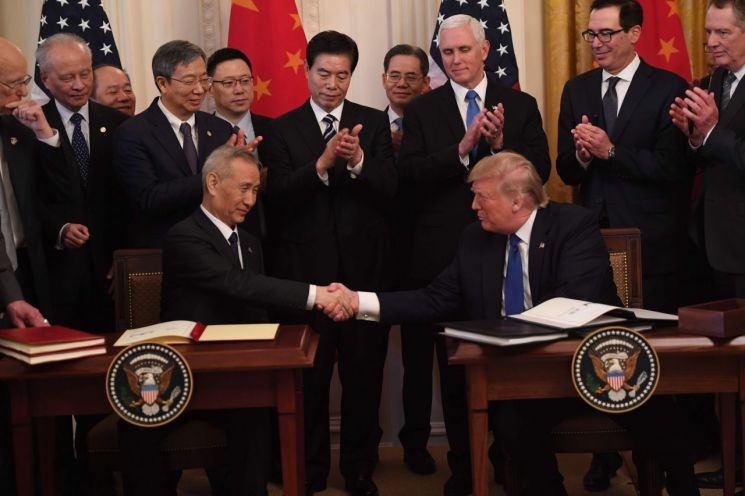
On the 15th (local time), US President Donald Trump signed the trade agreement at the White House together with Liu He, Vice Premier of the State Council of China, who led the Chinese delegation visiting the US. This came about a month after both sides announced the official Phase One agreement on December 13 last year. The 96-page agreement released by the US Trade Representative (USTR) on the same day consists of eight chapters covering intellectual property (IP), technology transfer, agricultural products, financial services, macroeconomic policy and foreign exchange transparency, trade expansion, and enforcement mechanisms.
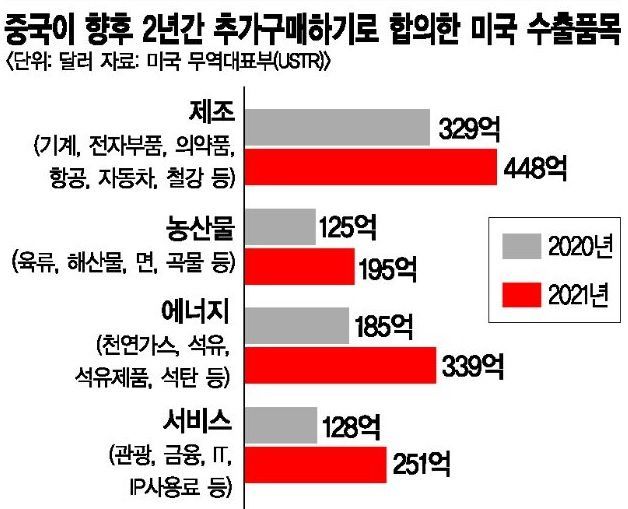
The main points of the agreement are that China will purchase an additional $200 billion worth of US goods over the next two years, including agricultural products, manufactured goods, and services, while the US will withdraw plans to impose additional tariffs on China and reduce tariff rates on some existing products. China will purchase $76.7 billion in the first year and $123.3 billion in the second year. Specifically, this includes $37.9 billion in services, $77.7 billion in manufactured goods, $32 billion in agricultural products, and $52.4 billion in energy.
In addition, the agreement includes commitments to protect IP rights, prohibit forced technology transfers, ban currency manipulation, and ease US companies' access to the Chinese financial market?issues that the US had consistently raised concerns about. Under this agreement, the US will not impose tariffs on $160 billion worth of Chinese products that were originally scheduled to be taxed starting December 15 last year. The 15% tariff on $120 billion worth of other Chinese products will be reduced to 7.5%. However, the 25% tariff on $250 billion worth of Chinese products will remain unchanged. President Trump expressed hope that tariffs could be lifted if a Phase Two trade agreement is reached.
According to foreign media, China will submit an 'action plan' within 30 days after the agreement takes effect to implement the agreed terms. Both leaders evaluated the agreement positively for the global economy. President Trump said, "Today we are taking an important step that we have never taken before with China," while Chinese President Xi Jinping, in a letter read by Vice Premier Liu, stated, "The US-China agreement is good for the world."
Following the US-China trade agreement, the US stock market rose again. Among the three major New York stock indices, the Dow Jones increased by 0.31% to 29,030.22, setting a new all-time high. The S&P 500 and Nasdaq also rose by 0.19% and 0.08%, reaching 3,289.30 and 9,258.70, respectively. Attention is also on when Phase Two negotiations will begin. President Trump said on the day, "We are not expecting Phase Three negotiations," and "We will start Phase Two negotiations immediately." Phase Two negotiations are expected to be much more difficult than Phase One, as they include sensitive issues such as IP protection, forced technology transfers, and subsidies to Chinese state-owned enterprises.
© The Asia Business Daily(www.asiae.co.kr). All rights reserved.

![Clutching a Stolen Dior Bag, Saying "I Hate Being Poor but Real"... The Grotesque Con of a "Human Knockoff" [Slate]](https://cwcontent.asiae.co.kr/asiaresize/183/2026021902243444107_1771435474.jpg)















