Concentration in U.S. Stock Investments Eases
Rebalancing Toward an Inflation Portfolio
It has been observed that Japanese individual investors' New Year funds have been directed toward global funds and safe assets such as gold.
On February 2 (local time), Investing.com reported this, citing Bank of America's (BOA) fund flow analysis. During the month of January, Japanese individual investors invested over 2 trillion yen (approximately 1.8633 trillion won) in overseas investment trust funds (Toshin). This figure slightly exceeds the amount invested in January of last year.
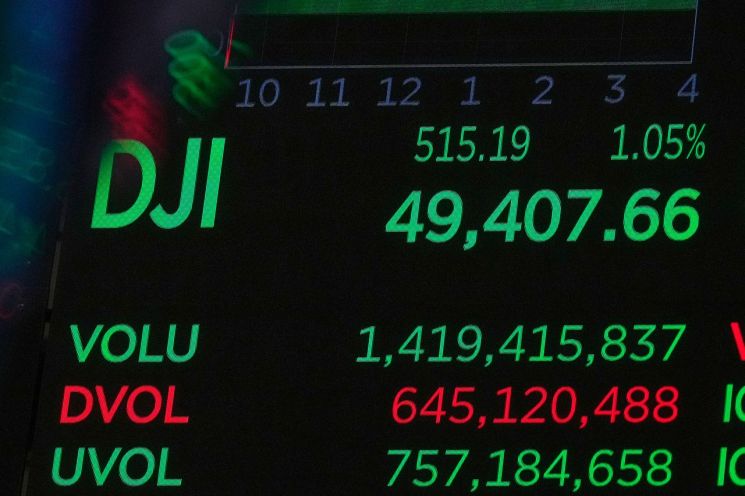 On the 2nd (local time), the closing price of the Dow Jones Industrial Average is displayed on the electronic board at the top of the trading floor of the New York Stock Exchange. New York (USA) = AP Yonhap News.
Notably, the concentration of investments in U.S. stocks has eased. Inflows into U.S. stock funds decreased by 540 billion yen (about 5.03 trillion won), while inflows into global funds increased by 440 billion yen (about 4.09 trillion won). This is the opposite of the previous trend, where Japanese retail investors, taking advantage of the tax-exempt status of the Nippon Individual Savings Account (NISA) regardless of investment region, invested in U.S. funds and sought foreign exchange gains from the weak yen.
Retail investors who reduced their allocation to the U.S. market instead chose gold, a safe asset. Gold fund inflows increased by 220 billion yen (about 2.05 trillion won). Investing.com analyzed, "Although the amount flowing into stock funds decreased slightly compared to the same month last year, the increased portfolio allocation to gold funds led to a rise in the overall scale of overseas asset investment."
In Japan, the movement of individual investors' funds in January each year draws attention due to investment patterns utilizing NISA. On January 1 every year, the investment limit for NISA accounts is reset, leading to a tendency for lump-sum investments at the beginning of the year to take advantage of the annual NISA exemption. In fact, nearly 2 trillion yen flowed in last January as well. However, the average monthly inflow for the remainder of the year was only 890 billion yen (about 829.2 billion won).
BOA pointed out, "Japanese individual investors are seen reallocating to an 'inflation portfolio,' and concerns about the reliability of the U.S. dollar are growing." However, it added that even if the proportion of U.S. funds does not increase, U.S. stocks make up a significant share of global funds, so demand for the dollar will continue. Investing.com evaluated this portfolio redistribution as "a notable shift in the behavior of Japanese individual investors."
© The Asia Business Daily(www.asiae.co.kr). All rights reserved.














![The Special Connection Between the Statue of Martyr Lee Jun in Jangchungdan Park and Mayor Oh Sehoon ③ [Current Affairs Show]](https://cwcontent.asiae.co.kr/asiaresize/319/2026012110001599450_1768957215.jpg)
