Aiming to Mitigate Interest Rate Fluctuation Risks
The financial authorities have decided to introduce a 30-year ultra-long-term fixed-rate mortgage product within this year and will soon announce the related measures. This will be the first time that a purely fixed-rate product with a 30-year maturity, not a policy mortgage, is launched by the private sector.
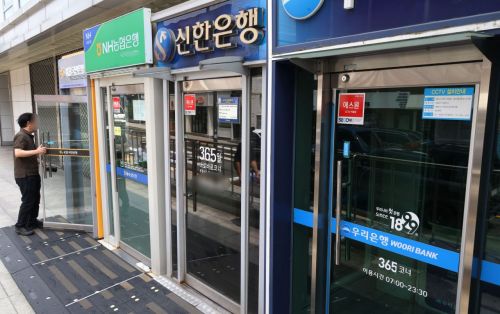 On the 24th, automatic teller machines (ATMs) of commercial banks were installed on a street in downtown Seoul. Photo by Yongjun Cho jun21@
According to the financial sector on February 2, the Financial Services Commission is expected to announce a plan for private financial institutions to launch ultra-long-term fixed-rate products as early as this month. The product is anticipated to be released in the second half of the year.
Banks are currently offering mainly 5-year hybrid mortgages (5-year fixed rate followed by a variable rate) or periodic rate products (interest rate changes every five years) as fixed-rate mortgages. The new product is being designed to apply a single fixed rate from the beginning to maturity.
Most of the so-called fixed-rate loans in the market are in fact hybrid products that switch to a variable rate after a 5-year fixed period, which has drawn criticism from borrowers.
The financial authorities have devised this product to reduce uncertainty for borrowers caused by interest rate fluctuations. The aim is to encourage borrowers to bear a consistent repayment burden over a long period without changes in interest rates.
The authorities believe that ultra-long-term fixed-rate products will help improve the quality of household debt. Mortgage products that mainly use variable rates have the drawback of a sharp increase in borrowers' interest burdens during periods of rising rates. This can potentially lead to loan defaults.
The authorities are also considering setting the interest rate for ultra-long-term fixed-rate mortgages at a level similar to the current 5-year hybrid or periodic rate products. This is because even with a long-term fixed rate, excessive rate increases could suppress customer demand.
Even after the launch of ultra-long-term mortgages, the authorities plan to strengthen the overall cap on total lending to manage the growth of household loans.
The Financial Services Commission plans to ease the total lending cap in non-metropolitan areas compared to the Seoul metropolitan area, while keeping the overall annual growth rate of household loans lower than last year's 1.8%.
© The Asia Business Daily(www.asiae.co.kr). All rights reserved.









![The Special Connection Between the Statue of Martyr Lee Jun in Jangchungdan Park and Mayor Oh Sehoon ③ [Current Affairs Show]](https://cwcontent.asiae.co.kr/asiaresize/319/2026012110001599450_1768957215.jpg)
