KOSPI Triggers Sell-Sidecar During Trading
KOSDAQ Also Closes Down 4.44%
"Concerns Over Warsh Nomination Overblown... Volatility Expected to Subside"
The KOSPI index closed down more than 5%, falling below the 5000 mark. The recent rally in the KOSPI had led to accumulated fatigue, and news of Kevin Warsh's nomination as the next Chairman of the U.S. Federal Reserve (Fed) heightened volatility, prompting profit-taking.
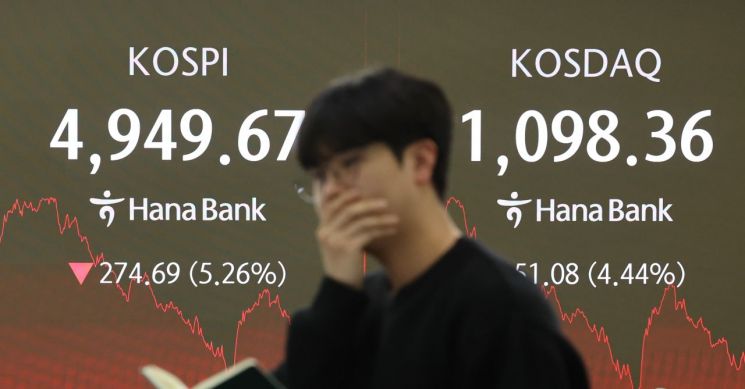 On the 2nd, due to the weak performance of the US stock market, the KOSPI fell below the 5000 mark, and the closing prices of KOSPI and KOSDAQ were displayed on the status board in the dealing room of Hana Bank in Jung-gu, Seoul. Photo by Yonhap News
On February 2, the KOSPI index closed at 4,949.67, down 274.69 points (-5.26%) from the previous trading day. The index opened at 5,122.62, down 101.7 points (-1.95%) in early trading, and the decline deepened as the session progressed. In terms of trading volume, foreign investors were net sellers of 2.5313 trillion won, and institutions sold a net 2.2127 trillion won. Individual investors were net buyers of 4.5861 trillion won.
The Korea Exchange triggered a sell-sidecar on the main board at 12:31 p.m. on this day. The sell-sidecar is a system that suspends the effectiveness of program trading sell orders for five minutes if KOSPI200 futures fall for one minute. This was the first time in about three months that a sell-sidecar was triggered on the KOSPI, since November 5 of last year.
"Warsh, Fed Chairman Nominee, Considered Relatively Hawkish"
As a result, most sectors weakened. Metals (-6.98%), electrical and electronics (-6.90%), securities (-6.28%), manufacturing (-5.87%), medical precision instruments (-5.53%), and machinery and equipment (-5.34%) all saw significant declines. Finance (-4.16%), transportation equipment and parts (-4.12%), IT services (-3.89%), insurance (-3.68%), and entertainment and culture (-3.68%) also fell.
Major blue-chip stocks also closed lower across the board. SK Square (-11.40%), SK Hynix (-8.69%), Samsung Electronics (-6.29%), Samsung Electronics Preferred (-6.22%), Samsung Life Insurance (-4.94%), Doosan Enerbility (-4.86%), Hanwha Aerospace (-4.69%), LG Energy Solution (-4.52%), HD Hyundai Heavy Industries (-4.52%), and Hyundai Motor (-4.40%) all ended the day in the red.
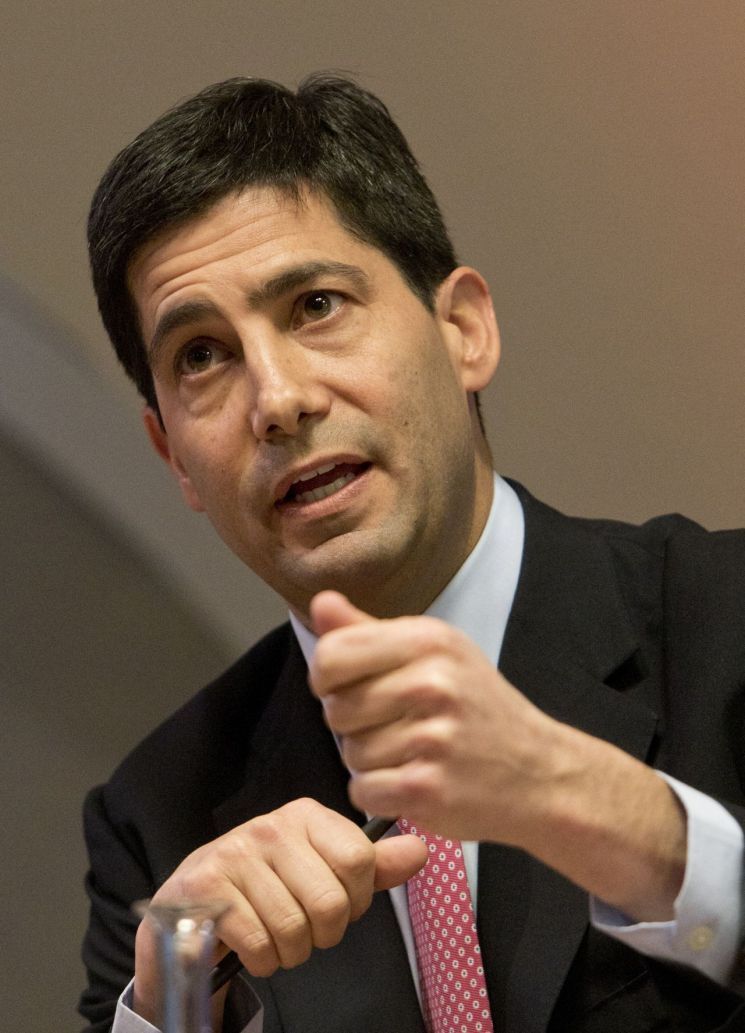
Previously, on January 30 (local time), U.S. President Donald Trump nominated former Fed Governor Kevin Warsh as the 17th Chairman of the Fed. The global asset markets were shaken by expectations that Warsh, known as a "hawkish dove," could both cut interest rates and tighten liquidity at the same time. Precious metals and digital asset prices plummeted, while the value of the dollar rose.
Jo Ain, a researcher at Samsung Securities, said, "Warsh is considered relatively hawkish," adding, "During his tenure as a Fed governor from 2006 to 2011, he emphasized price stability, was critical of the Fed's quantitative easing, and advocated for balance sheet reduction."
The KOSDAQ index closed at 1,098.36, down 51.08 points (-4.44%) from the previous trading day. Foreign investors were net buyers of 407.2 billion won, and individuals bought a net 215.1 billion won. In contrast, institutions sold a net 550.4 billion won.
Among the leading KOSDAQ stocks, Caregen (-15.30%), Wonik IPS (-11.01%), Pharmaresearch (-10.77%), Leeno Industrial (-10.58%), and Robotis (-9.16%) plunged. Medy-Tox (-8.41%), Ecopro BM (-7.54%), Peptron (-6.06%), D&D Pharmatech (-5.82%), EO Technics (-5.72%), LIG ChemBio (-5.07%), Alteogen (-4.60%), Voronoi (-4.46%), Samchundang Pharm (-3.43%), and HLB (-2.34%) also closed lower.
"Korean Stock Market May See Short-Term Correction, But Remains a Stable Choice"
Experts believe that uncertainty over the Fed's monetary policy may trigger short-term volatility in financial markets, but that excessive concerns will gradually subside.
Researcher Jo said, "It is difficult to expect Warsh to be truly hawkish after taking office as Chairman in May. While he is critical of unconventional monetary policies like quantitative easing, he does not oppose adjusting the benchmark interest rate based on economic conditions," adding, "Even if the Fed proceeds with balance sheet reduction, it will not necessarily lead to a liquidity squeeze."
He noted, "Despite the recent sharp rally, the Korean stock market remains the most undervalued among major markets in terms of price-to-book ratio (PBR) relative to return on equity (ROE)," adding, "While the correction has been concentrated in assets that had risen the most, the Korean stock market may experience a short-term correction, but from a valuation perspective, it remains a stable choice."
© The Asia Business Daily(www.asiae.co.kr). All rights reserved.








![The Special Connection Between the Statue of Martyr Lee Jun in Jangchungdan Park and Mayor Oh Sehoon ③ [Current Affairs Show]](https://cwcontent.asiae.co.kr/asiaresize/319/2026012110001599450_1768957215.jpg)

