Joint Public-Private Meeting Held Following Korea-US Tariff Negotiations
Samsung: AI Data Centers "Outside the Seoul Metropolitan Area as a Principle"
SK: "Annual Employment Effect of 14,000 to 20,000"
Hyundai Motor: "125 Trillion Won Domestic In
On November 16, just two days after the announcement of the "Joint Fact Sheet" summarizing the results of the Korea-US tariff negotiations, President Lee Jaemyung met with the heads of major business groups at the Yongsan Presidential Office and called on them to "turn external crises into opportunities for expanding domestic investment, employment, and industrial advancement." In response, the leaders of major groups such as Samsung, SK, Hyundai Motor, LG, HD Hyundai, and Celltrion unveiled plans for investments amounting to hundreds of trillions of won and large-scale recruitment.
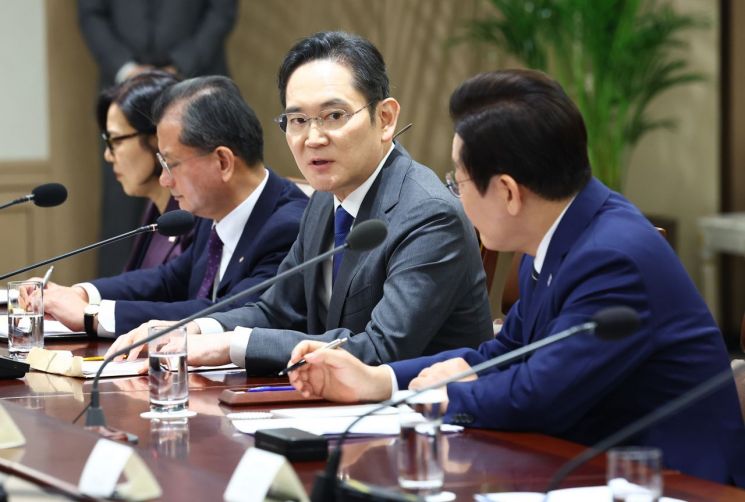 Samsung Electronics Chairman Lee Jae-yong is speaking at the follow-up public-private joint meeting on Korea-US tariff negotiations chaired by President Lee Jae-myung at the Yongsan Presidential Office on the 16th. Photo by Yonhap News
Lee Jaeyong, Chairman of Samsung Electronics, was the first to speak, stating, "Companies are greatly relieved by the conclusion of the tariff negotiations. Mr. President, you have worked tirelessly for this result," and added, "Based on this outcome, we will actively cooperate with the government to ensure there are no setbacks in follow-up measures."
Chairman Lee said, "Some are concerned that domestic industrial investment might decline, but Samsung will make greater efforts to expand domestic investment, create quality jobs for young people, and foster mutual growth with small and venture businesses so that this does not happen. As promised last September, we will hire 60,000 people domestically over the next five years." He continued, "We will also be more aggressive in investing in domestic facilities, including research and development (R&D)."
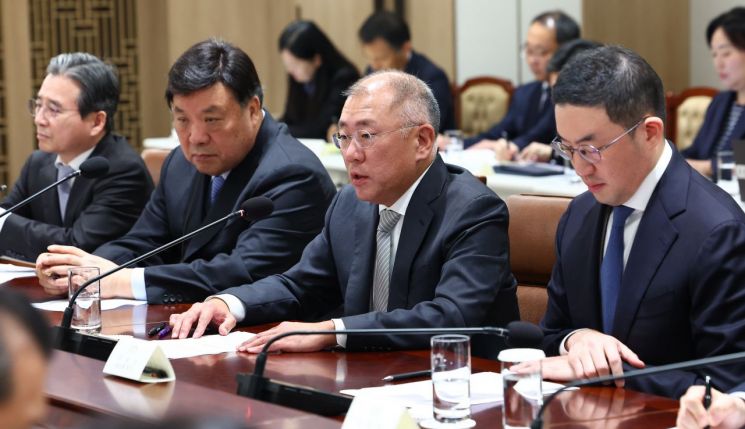
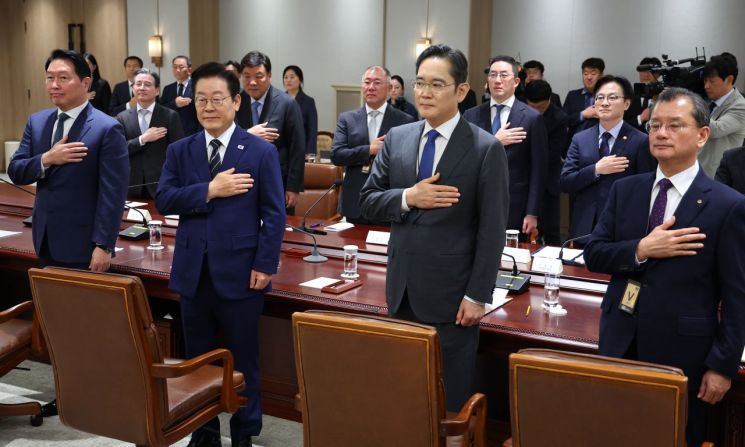
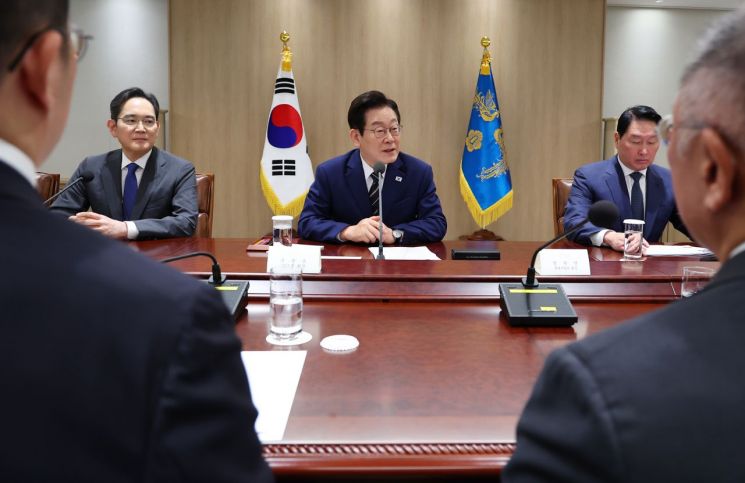 President Lee Jae-myung is speaking at the joint public-private meeting following the Korea-US tariff negotiations held on the 16th at the Yongsan Presidential Office. Clockwise from the center: President Lee Jae-myung, Chey Tae-won, Chairman of SK Group, Chung Eui-sun, Chairman of Hyundai Motor Group, Koo Kwang-mo, Chairman of LG Group, and Lee Jae-yong, Chairman of Samsung Electronics. Photo by Yonhap News Agency
Regarding balanced regional development, he said, "To promote balanced regional growth as the President emphasized, our AI data centers are, as a rule, being built outside the Seoul metropolitan area. In addition to diplomatic power, national defense, and cultural assets like K-culture, I believe industrial competitiveness is a key element in strengthening national power. Samsung will do everything possible to develop future technologies."
SK: "Up to 600 trillion won investment in Yongin alone... Annual employment effect of 14,000 to 20,000 people"
Chey Taewon, Chairman of SK Group, said, "I am grateful for the President's prudent and decisive leadership in successfully concluding the negotiations. With the tariff negotiations and preparations for the Asia-Pacific Economic Cooperation (APEC) summit coinciding, I was anxious, but the successful conclusion of the negotiations seems to have contributed to the success of APEC as well."
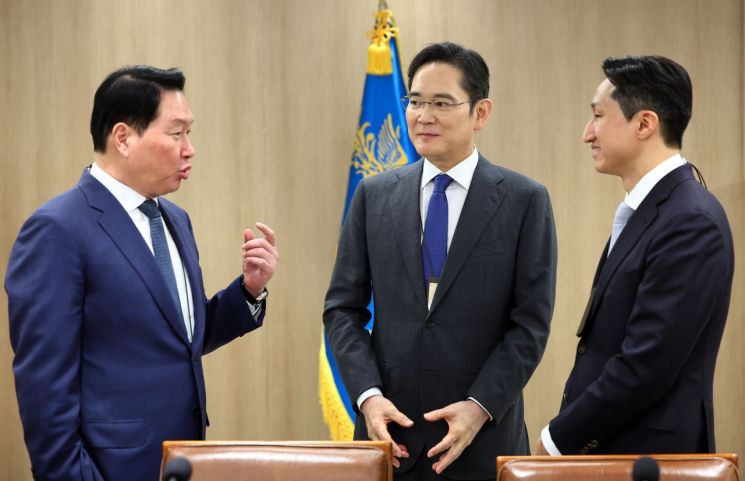 Taewon Chey, Chairman of SK Group (from left), Jae-yong Lee, Chairman of Samsung Electronics, and Ki-sun Chung, Chairman of HD Hyundai, are conversing at the joint public-private meeting following the Korea-US tariff negotiations presided over by President Jae-myung Lee on the 16th at the Yongsan Presidential Office. Photo by Yonhap News Agency
Chairman Chey stated, "We originally planned to invest 12.8 trillion won domestically by 2028, but due to increasing demand for memory semiconductors and the advancement of processes, investment costs are continuously rising. For the Yongin semiconductor cluster alone, investments of around 600 trillion won are expected to continue." However, he noted, "The key will be how quickly this can proceed, depending on demand coordination."
Regarding employment, he said, "SK has maintained annual recruitment of more than 8,000 people, and each time a semiconductor fab opens, more than 2,000 additional jobs are created. If the pace of fab construction accelerates, the employment effect could reach 14,000 to 20,000 people per year." Referring to SK hynix's "Trinity Fab" project and partnerships with Nvidia, Amazon Web Services (AWS), and Siemens, he added, "Through manufacturing AI, AI factories, and expanding the nationwide AI data center infrastructure, we will contribute to the domestic high-tech industrial ecosystem and balanced regional development."
Hyundai Motor: "125 trillion won domestic investment... Expanding eco-friendly vehicle exports by 2.5 times"
Chung Euisun, Chairman of Hyundai Motor Group, said, "I thank the President and the government for providing an opportunity to leap forward as a global powerhouse through the successful hosting of APEC and the conclusion of the Korea-US negotiations. Through these tariff negotiations, Hyundai Motor Group expects to strengthen its competitiveness and advance its global strategy."
Hyundai Motor Group plans to invest 125 trillion won domestically over five years from 2026 to 2030, or 25 trillion won annually. Chairman Chung explained, "This is an increase of 8.2 trillion won over the previous plan of 116 trillion won for 2025-2029. We will allocate 39 trillion won to strengthen domestic R&D and existing mobility competitiveness, 50 trillion won to future new businesses such as software-defined vehicles (SDV), AI, semiconductors, and hydrogen energy, and 36 trillion won to respond to changes in production facilities and manufacturing environments."
He added, "To secure global competitiveness in 'physical AI' fields such as autonomous driving, autonomous manufacturing, and robotics, we will build AI data centers and promote the establishment of robot manufacturing and foundry (semiconductor contract manufacturing) plants. In the southwest coastal region, we will build water electrolysis plants to increase green hydrogen production and renewable energy efficiency, and also promote the creation of hydrogen and AI cities." Hyundai Motor Group hired 7,200 people this year and aims to hire 10,000 next year.
He also said, "We are well aware of concerns about reduced exports and shrinking domestic production due to the 15% US tariff," and added, "By diversifying export regions and establishing dedicated electric vehicle production lines at domestic plants, we will increase finished vehicle exports from the current 2.18 million units to 2.47 million units by 2030, and exports of eco-friendly vehicles such as electric, hybrid, and hydrogen cars from 690,000 units to 1.76 million units."
LG: "100 trillion won investment over 5 years... 60% for materials, parts, and equipment"
Koo Kwangmo, Chairman of LG Group, said, "I deeply thank the government for prioritizing the national interest and seeing the negotiation process through to the end. The Korea-US tariff negotiations have resolved much of the longstanding uncertainty, and now companies must focus on enhancing global competitiveness from a long-term perspective."
Chairman Koo stated, "Seeing countries like the United States, European Union, Latin America, and India strengthen their own industrial bases through regulatory and tariff policies, I feel we also need to reinforce our domestic industrial ecosystem. Of the planned 100 trillion won in domestic investment over the next five years, we will allocate 60% to the development and expansion of materials, parts, and equipment technologies."
He added, "It is important to introduce AI across industries to enhance efficiency and strengthen fundamentals. We have improved productivity by sharing automation and AI application know-how with partner companies, and we will continue to expand such activities to raise the qualitative competitiveness of Korea's industrial ecosystem."
Shipbuilding, Defense, and Bio: "Two pillars-US cooperation and domestic investment"
Yeo Seungjoo, Vice Chairman of Hanwha Group, said, "I am very pleased with the successful conclusion of the Korea-US tariff and security negotiations. The construction of nuclear-powered submarines will elevate Korea's national prestige and strengthen security in the Asia-Pacific region."
He noted that Hanwha is investing about $5 billion (over 7 trillion won) in the Philly Shipyard in the US and is pursuing additional shipyard acquisitions and new construction, emphasizing, "This is not about relocating domestic production to the US, but about entering a new market where Korea's shipbuilding and equipment industries can grow." Hanwha aims to invest about 11 trillion won in Korea's shipbuilding and defense sectors over the next five years, with the goal of increasing partner company sales from 9 trillion won in 2024 to 21 trillion won in 2030, a 2.3-fold increase.
Chung Kisun, Chairman of HD Hyundai, said, "The rebuilding of the US shipbuilding industry is an issue that will persist beyond any one administration. As China's dominance in shipbuilding grows, we must seize new business opportunities." HD Hyundai has created a $5 billion "Maritime Fund" with Cerberus Capital in the US to pursue shipyard acquisitions and upgrades, advanced vessel development, and supply chain expansion, and is expanding cooperation with companies such as Huntington Ingalls, Edison Chouest, Anduril, and Siemens.
Chairman Chung stated, "Easing regulations on the defense sector in the US is a key issue. Domestically, we plan to invest 15 trillion won over the next five years in defense, energy, robotics, and shipbuilding and marine sectors, and will contribute to revitalizing regional economies through projects such as the smart shipyard at Daebul Industrial Complex in Jeonnam and the linkage of the Haenam Solaseado AI data center."
Seo Jungjin, Chairman of Celltrion in the bio sector, said, "Watching these negotiations, I was once again impressed by the President's boldness and determination. About 2 trillion won will be invested in building production facilities in the US, and domestically, we will invest 4 trillion won in facilities in Songdo, Ochang, and Yesan over the next three years."
He added, "We will expand the 500 billion won fund we created with startups to 1 trillion won, and by the year after next, we will increase our annual R&D spending to more than 1 trillion won. I propose that regulations on pharmaceuticals and bio be adjusted not by easing them, but by aligning them with global standards."
© The Asia Business Daily(www.asiae.co.kr). All rights reserved.