'2+2' Diplomatic and Trade Talks Canceled; Public-Private Negotiation Cooperation in Full Swing
President Lee Jaemyung Holds Consecutive Meetings with Major Business Group Leaders
Samsung, Hyundai Motor, and Others Deploy Government Affairs Teams to Washington
"All Tangible Cards Needed: Shipbuilding, Minerals, AI Semiconductors"
"Securing a 15% Tariff Reduction Like Japan Is the Realistic Goal"
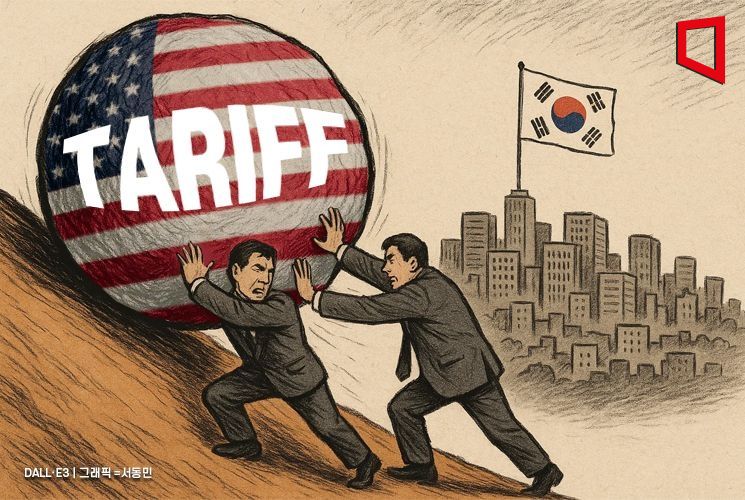
With the unexpected cancellation of the '2+2 High-Level Diplomatic and Trade Talks' between South Korea and the United States, both the government and the business sector have effectively switched to an emergency response mode. Under the assessment that the final negotiation proposal must be delivered to the United States by next week at the latest, discussions on negotiation strategies are also accelerating.
On the afternoon of July 25, a trade countermeasure meeting will be held, presided over by Chief Presidential Secretary Kang Hoonshik, with Policy Chief Kim Yongbum, National Security Office Chief Wi Sunglak, Deputy Prime Minister and Minister of Economy and Finance Koo Yooncheol, and Cabinet Office Chief Yoon Changryul in attendance. The Presidential Office has sharply increased its contacts with the heads of major business groups, while large corporations are mobilizing all available resources, including their external relations and government affairs departments, as well as local networks and lobbying channels in the United States. Attention is also focused on whether trade negotiation issues were discussed, following the news that President Lee Jaemyung and Samsung Electronics Chairman Lee Jaeyong held a surprise meeting.
Korea on the Trade Front... Major Companies Deploy Government Affairs Teams to Washington
According to the business community, President Lee has recently held a series of meetings with the heads of major business groups. On July 21, he had dinner with Hanwha Group Vice Chairman Kim Dongkwan, and on July 22, with SK Group Chairman Chey Taewon. On July 24, he also met with Chairman Lee Jaeyong. Previously, he had met with Hyundai Motor Group Chairman Chung Euisun and LG Group Chairman Koo Kwangmo.
The Presidential Office explained that no specific agenda was set for these individual dinners with business leaders, and that a wide range of opinions were exchanged freely. Given that tariff negotiations with the United States are the most pressing issue, it is highly likely that concerns over ultra-high tariffs and plans for investment in the United States, among other negotiation cards, were discussed. Reportedly, the Presidential Office listened to the group chairmen's views on U.S. investment plans, global trade strategies, regional revitalization measures, R&D investment, and strategies for responding to future societal changes.
Although the details of the meeting with Chairman Lee Jaeyong the previous day were not disclosed, industry sources suggest that, in addition to maximizing the total amount of local investment, non-monetary cooperation cards such as social contribution programs targeting the Rust Belt's youth may also have been discussed. An industry insider said, "If additional investment is realistically difficult, showing sincerity in a way that provides tangible benefits to the American people is another approach," adding, "During past international event bids, there were cases where local social contribution or youth education programs were used strategically."
As the negotiation phase is rapidly shifting in an uncontrollable direction, there is a growing sense of crisis that both the government and businesses must mobilize every available resource. Although the schedule for resuming high-level talks has not yet been set, the key issue is what combination of private sector strategic assets?including investment size, method, and symbolism?will be brought to the negotiation table.
The government plans to officially deliver domestic companies' U.S. investment plans to the U.S. government as early as next week. The Presidential Office has recently contacted major groups such as Samsung, SK, Hyundai Motor, and LG to confirm the scale of available local investments, and the total investment amount tallied so far is reportedly close to $100 billion.
The business community, having effectively received a 'request for support' from the government, is also moving swiftly. A significant number of external relations and policy cooperation personnel from major groups such as Samsung Electronics, Hyundai Motor, LG, and SK have already been dispatched to Washington, D.C., and are responding through congressional and executive channels in line with the schedules of government officials visiting the U.S. It is also reported that contacts are ongoing with lawmakers representing districts where each company's U.S. factories are located.
An official from a large corporation said, "There is a growing internal consensus to fully mobilize overseas government affairs organizations in preparation for a possible worsening of the trade negotiation situation," adding, "In fact, most of our government affairs staff have been dispatched to Washington." Another company official explained, "While it is difficult for companies to take the lead in negotiations, we are monitoring the White House and Congress's reactions and internal sentiment and sharing this information with the government."
However, there are also limitations to local responses. Companies have actively hired U.S. citizens to strengthen their government affairs capabilities in the United States, but these individuals cannot participate in intergovernmental trade negotiations. The United States can hold its citizens legally accountable even when abroad if national interests are harmed. Therefore, even if affiliated with a foreign company, it is difficult for U.S. citizens to be involved in matters contrary to U.S. government policy. From Korea's perspective as well, it is important not to create unnecessary legal or diplomatic misunderstandings during negotiations with the United States.
Despite these constraints, companies are gathering all available resources. Since the outcome of these negotiations is directly linked to their business base in the United States, it is being recognized not simply as a matter of cooperation, but as an issue of survival. An industry insider said, "We are aware that it is difficult to directly influence actual policy decisions, but the current atmosphere is that we should mobilize all available networks and try everything we can."
From Shipbuilding to Semiconductors... All Remaining Tangible Cards on the Table
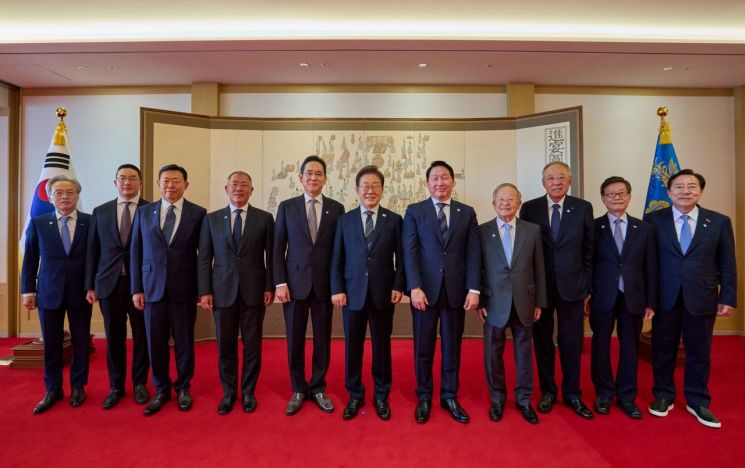 President Lee Jae-myung is taking a commemorative photo with participants of the meeting with six economic organizations and business leaders at the Yongsan Presidential Office building in Seoul on the 13th of last month. From the left, Choi Jinsik, Chairman of the Korea Federation of Medium-sized Enterprises; Koo Kwangmo, Chairman of LG Group; Shin Dongbin, Chairman of Lotte Group; Chung Euisun, Chairman of Hyundai Motor Group; Lee Jae-yong, Chairman of Samsung Electronics; President Lee; Choi Taewon, Chairman of SK Group and Chairman of the Korea Chamber of Commerce and Industry; Sohn Kyungshik, Chairman of the Korea Employers Federation; Ryu Jin, Chairman of the Korea Economic Association; Yoon Jinsik, Chairman of the Korea International Trade Association; Kim Gimoon, Chairman of the Korea Federation of Small and Medium Business. Photo by Presidential Office
Industry observers believe that President Donald Trump is likely to quickly conclude negotiations with allies such as Japan and South Korea, and then move on to exert full-scale pressure on the European Union and China. As a result, there is a growing perception that Korea can no longer remain on the sidelines. In fact, in negotiations with Japan, the United States applied tariff reductions on automobiles without separate quotas, and Japan reportedly presented an investment plan totaling $550 billion.
Kim Changbum, Executive Vice Chairman of the Korea Economic Association, said, "We have less than ten days left in the negotiation deadline, and we must overcome a steep uphill phase," adding, "If negotiations with the EU are concluded after Japan, Korea will be left alone, so it is essential to reach a broad agreement."
Shin Wonkyu, Invited Research Fellow at the Korea Economic Association, also stated, "For Korea, achieving a 15% tariff reduction, as Japan did, should be the realistic goal of negotiations," adding, "If we fall short of Japan in terms of investment size or diversity of items, the negotiations themselves will not be easy."
Experts believe that, as in Japan's case, negotiating item-specific tax reductions and structuring investment funds could be practical negotiation strategies. Shin noted, "It is necessary to persuade the United States through tangible cooperation proposals such as participation in shipbuilding and liquefied natural gas (LNG) projects, thereby establishing a framework for economic security cooperation involving steel, parts, equipment, and skilled personnel exchanges."
Within the industry, there is both anticipation that shipbuilding could become South Korea's 'hidden card' and concern over institutional constraints. In fact, the United States has reportedly requested investment, technology transfer, and personnel dispatch from allied countries to revitalize its own shipbuilding industry, but has yet to select a concrete implementation partner. An industry insider said, "In reality, the only countries capable of fulfilling such a role are Korea and Japan," adding, "If the government reaches out at the national level rather than through individual companies, the United States would have no reason to refuse."
The business community is preparing to mobilize all available negotiation assets beyond shipbuilding. Key examples include investment in refining and supply chains for critical minerals, expansion of U.S. operations by semiconductor and secondary battery supply chain companies, cooperation in space and defense industries, and expansion of partnerships in advanced process equipment and materials technology. In addition, joint development of Korean-style artificial intelligence (AI) semiconductors (PIM), joint ventures by small and medium-sized enterprises and startups, linked investment in data centers and power infrastructure, and joint development and supply cooperation in the health and bio sectors are also considered major cards.
However, some warn that excessive concessions or merely formal investment plans could backfire. The overall structure and balance of the negotiations must be carefully weighed, and prioritizing concessions without concrete reciprocal benefits could set a negative precedent for future negotiations. In fact, while the Korean government and domestic companies are reviewing U.S. local investment plans exceeding $100 billion (approximately 137 trillion won), the U.S. side is reportedly demanding a much larger investment commitment. On July 24 (local time), Bloomberg News cited multiple negotiation sources in reporting that Korea is considering establishing an investment fund to secure U.S. tariff reductions, and that U.S. Secretary of Commerce Howard Lutnick asked Korea's Trade Minister Yeo Hankoo for a $400 billion (approximately 547 trillion won) fund. This is similar to the $550 billion financial support package Japan pledged to the United States.
© The Asia Business Daily(www.asiae.co.kr). All rights reserved.