Interview with Hanhee Baek, Director of IBM Quantum Algorithm Center
"Software and Algorithms Will Determine the Success of the Quantum Industry"
Korea Has Abundant Talent and Technological Capability
Proactive Government Investment Is Crucial... Public-Private-Academic Cooperation Needed
"Once quantum advantage is achieved, it will enable research in areas such as materials and new drug development that was previously impossible."
Hanhee Baek, Director of the IBM Quantum Algorithm Center, who visited Korea to attend the "2025 Asia Future Enterprise Forum" hosted by Asia Economy, expressed strong confidence in the industrial application of quantum computers during an interview on the 11th. Dr. Baek explained the significance of quantum advantage, stating, "It will become possible not only to calculate the energy states of matter, but also to simulate changes in physical properties over time and chemical reactions between molecules."
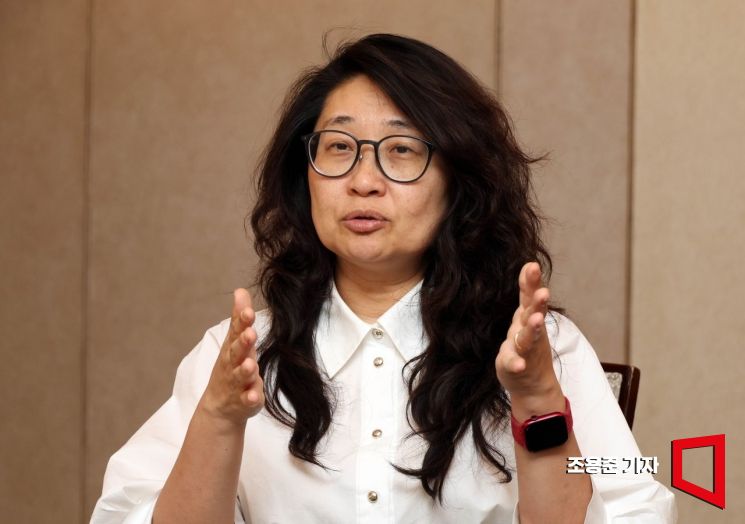 Dr. Hanhee Baek of IBM is being interviewed by Asia Economy on the 11th at Lotte Hotel, Jung-gu, Seoul. Photo by Yongjun Cho
Dr. Baek is currently one of the key figures leading quantum algorithm and system development at IBM, spearheading the industrialization of quantum technology while working between Japan and the United States.
Just before the interview, IBM announced that it is developing the "Starling" system, which will be capable of performing over 100 million error-free quantum operations based on 200 logical qubits by 2029, drawing significant attention from the global quantum academic and industrial communities. Quantum computers are next-generation technology that can solve problems difficult for conventional computers, but error correction remains a formidable challenge. An "error-tolerant system," meaning a structure that can autonomously correct errors occurring during computation, is required, and IBM revealed that it plans to release a product that addresses this issue. This also means that quantum computers will reach quantum advantage, surpassing the performance of supercomputers. Subsequently, IBM plans to expand performance with the "BlueJay" system, which will feature 2,000 logical qubits and enable one billion operations. Dr. Baek described this as "the true beginning of the quantum advantage era."
IBM is regarded as a leader in quantum computer hardware. However, Dr. Baek diagnosed that "the real key to quantum technology lies in algorithms and software." According to his analysis, there is still considerable room for expansion in this field, which remains almost untapped.
He emphasized that Korea should also foster quantum computer development with a focus on software and algorithms. Dr. Baek explained, "Quantum algorithms are not simply about coding, but about inventing new ways to solve problems," adding, "True innovation will only be possible when a 'quantum-native' generation familiar with quantum technology grows up." In this regard, IBM is working with institutions such as Seoul National University and Yonsei University to train quantum specialists, and is operating quantum education programs for university students and business professionals in Busan and Gyeongnam.
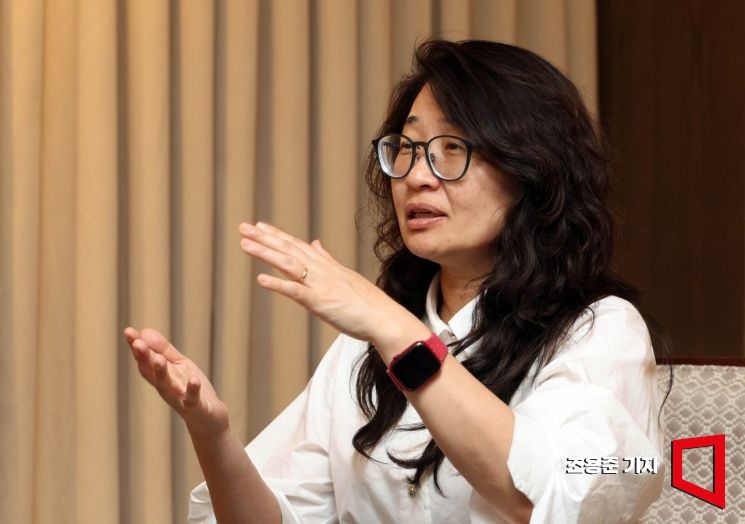 Dr. Hanhee Baek of IBM is being interviewed by Asia Economy on the 11th at Lotte Hotel, Jung-gu, Seoul. Photo by Yongjun Cho
Quantum technology is a field where it is difficult to achieve economic effects in the short term. In the early stages, proactive government investment is crucial. The United States established the "National Quantum Initiative Act" in 2018, laying the groundwork for research and development (R&D), public-private cooperation, and talent cultivation, while Japan is strengthening links between academia and industry through the "Quantum Technology Innovation Hub." In contrast, Korea is criticized for still lacking an integrated strategy or a control tower.
Dr. Baek stated, "Korea has both talent and technological capability," and added, "The government should take the lead in setting the direction and make balanced investments in the software and algorithm sectors as well."
Currently conducting quantum computer research in Japan, Dr. Baek expressed the view that Japan and Korea should cooperate in the quantum field. While the United States and China are leading the quantum sector, Japan is also a quantum powerhouse, so there is ample synergy to be gained through collaboration. Japan is achieving rapid results through a cooperative structure that organically connects industry and academia. As a representative example, Dr. Baek cited the "QII (Quantum Innovation Initiative)" led by the University of Tokyo. This consortium includes major universities such as the University of Tokyo, Keio University, and Tokyo University of Agriculture and Technology, as well as leading Japanese companies such as Sony, Hitachi, Toyota, Mitsubishi, and SoftBank, all conducting joint research on quantum computers. They have shared a single platform to verify industrial applicability and have published more than 140 joint papers to date. In other words, technology development is being pursued not as isolated efforts, but within a national-level cooperative structure. Dr. Baek emphasized, "Japan is open to exchanges with Korea."
Quantum computers are evolving in a direction where they can be combined with existing supercomputers to deliver even greater performance. IBM refers to this as "quantum-centric supercomputing." This approach maximizes the strengths of both systems by making quantum computers a core element of existing high-performance computing systems. Japan is a supercomputing powerhouse.
Dr. Baek stressed, "In the future, not only quantum computers, but also artificial intelligence (AI) and neuromorphic computing that mimics the brain will be integrated into a new era of computing," adding, "To be at the center of this, we must begin building a foundation for cooperation now."
© The Asia Business Daily(www.asiae.co.kr). All rights reserved.