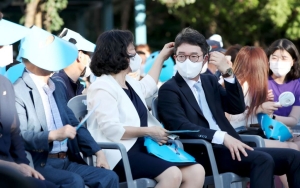
The delegations, led by U.S. Treasury Secretary Scott Besant and Chinese Vice Premier He Lifeng, began talks at 10 a.m. at the Villa Saladin (currently the Swiss Ambassador's Residence to the United Nations Office at Geneva). Given the sensitivity of the meeting, it was held behind closed doors, with even the customary opening remarks by the chief representatives not being disclosed to the public.
U.S. President Donald Trump wrote on the social media platform Truth Social, "We had a very good meeting with China in Switzerland today," adding, "Many things were discussed, and many agreements were reached."
President Trump further commented, "There was a friendly but constructive negotiation for a full reset of U.S.-China trade relations," and stated, "We want to see China open its markets to U.S. industries for the benefit of both countries," evaluating that "significant progress has been made."
If President Trump's remarks are taken at face value, it suggests that a certain consensus may have been reached on the most pressing issue of tariff reductions.
The previous day, President Trump stated that an 80% tariff rate on Chinese goods (currently 145% since the start of his second administration) would be appropriate. U.S. media outlets such as the New York Post and Bloomberg reported that the U.S. side would propose lowering the rate to the 50% range.
This was the first time since the launch of President Donald Trump's second administration that ministerial-level officials from the world's two largest economies met face-to-face to discuss current issues.
Representing the United States was Jamieson Greer, the U.S. Trade Representative (USTR). According to the Wall Street Journal (WSJ), the Chinese delegation included Minister of Public Security Wang Xiaohong, the highest-ranking official in public security and narcotics control.
China's inclusion of Minister Wang in the delegation is interpreted as an effort to discuss with the U.S. the issue of smuggling precursor chemicals for fentanyl (a type of synthetic drug) from China, which the U.S. has cited as one of the justifications for raising tariffs on Chinese goods.
Since President Trump took office, the U.S. has raised tariffs on Chinese imports to 145%. In response, China has imposed retaliatory tariffs of 125% on U.S. imports, resulting in a "chicken game" between the two countries.
This meeting is being positively evaluated as a meaningful first step toward easing tensions and laying the groundwork for future negotiations. However, there are concerns that if no concrete results are achieved, a "war of nerves" affecting the leaders of both countries could continue for a considerable period.
© The Asia Business Daily(www.asiae.co.kr). All rights reserved.


![$29 Monthly Subscription AI Plant Appliance... US Startup Challenges LG [CES 2026]](https://cwcontent.asiae.co.kr/asiaresize/319/2026010819285284553_1767868133.png)