Focusing on Securing Endangered Seeds
Developing New Varieties Since Last Year
Restoration Expected by 2028
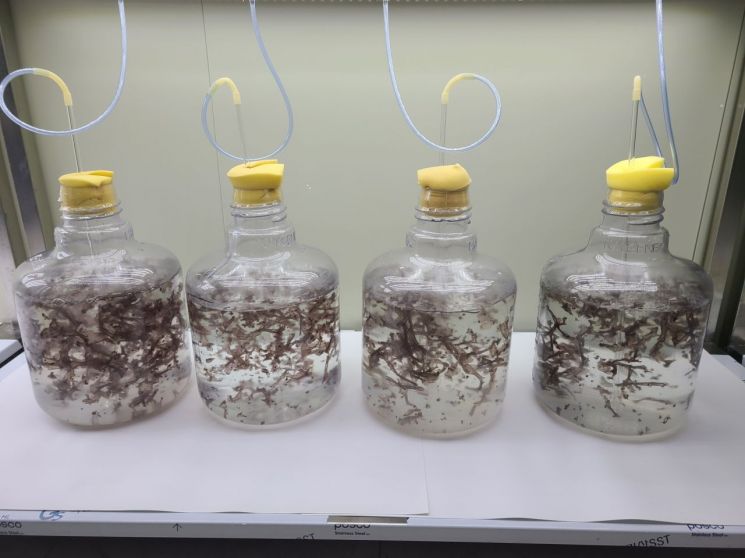
Efforts are underway to revive Korea's endangered native seaweed species, Chamkim.
The Jeonnam Provincial Institute of Maritime and Fisheries Science is focusing on developing new varieties of the native Chamkim, which is believed to have almost disappeared in Korea.
To this end, the Jeonnam Provincial Institute of Maritime and Fisheries Science secured Chamkim seeds through years of observation and research starting in 2022, and established seed cultivation technology in 2024. Beginning this year, the institute will also embark on pilot cultivation and selective breeding for full-scale development of new varieties.
By 2028, restoration of Chamkim as a cultivated species and the development of new varieties are anticipated.
The native Chamkim was first cultivated around 1640 on Taein Island in Gwangyang-gun (now Gwangyang City) during the reign of King Injo of the Joseon Dynasty. It gained recognition for its savory and crispy taste when it was served at the royal table of King Injo. It is said that the seaweed was named "Kim" after the Kim family, who first cultivated it.
According to the monument at the "Gwangyang Kim Sishikji" (Site of the First Kim Cultivation), which is Jeonnam Provincial Monument No. 113, Kim Yeoik, together with Kim Yeojoon, led volunteer soldiers during the Byeongjahoran (Manchu Invasion of 1636) and advanced northward to Cheongju. After hearing news of a peace agreement between Joseon and the Qing Dynasty, he settled in Gwangyang in 1640 and began cultivating seaweed.
Chamkim was a major cultivated species along the southern coast for generations, but environmental factors over the past 20 years have drastically reduced its resources, making it difficult to find even on natural rock beds. Although its growth is somewhat slow, Chamkim contains high levels of amino acids that determine the taste of seaweed, resulting in excellent flavor.
The Jeonnam Provincial Institute of Maritime and Fisheries Science has successfully induced the release of carpospores (seeds) from Chamkim leaves and achieved separate cultivation of shell-borne and free-living filamentous forms. The institute has also secured optimal seed cultivation conditions and technology.
Starting this fall, the institute plans to verify the potential for cultivation, quality and disease resistance, and profitability of native Chamkim through pilot farming. In the future, the new variety will be distributed to seaweed farms, allowing the public to experience the taste of native Chamkim, which carries the historical legacy of being served at the royal table 400 years ago.
Kim Chungnam, director of the Jeonnam Provincial Institute of Maritime and Fisheries Science, stated, "Amid rapidly changing marine environments, we will develop Korea's unique Chamkim as a new variety to contribute to the sustainable growth of the seaweed farming industry and increase fishermen's income."
Meanwhile, according to the Ministry of Oceans and Fisheries, Korea achieved record-high seaweed exports for two consecutive years in 2023 and 2024, with annual exports reaching 1 trillion won. In particular, Mokpo City recorded 200 billion won in seaweed product exports last year, setting an all-time high and ranking first in the nation for seaweed exports.
© The Asia Business Daily(www.asiae.co.kr). All rights reserved.













![$29 Monthly Subscription AI Plant Appliance... US Startup Challenges LG [CES 2026]](https://cwcontent.asiae.co.kr/asiaresize/319/2026010819285284553_1767868133.png)