Medical Community: "Decision-Making Authority Needed"
vs.
Patient Groups: "Limit to Deliberation, Not Decision-Making"
Opinions diverged among witnesses at a public hearing held over the authority and composition of the medical workforce supply and demand estimation body being promoted by the National Assembly.
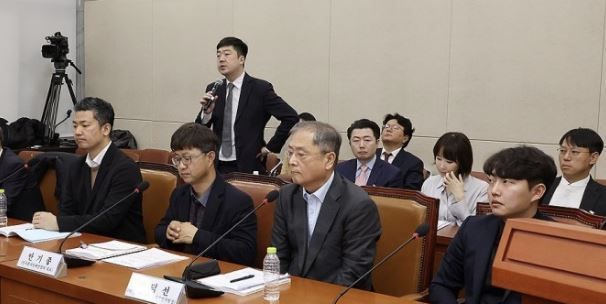 On the 14th, a public hearing was held at the National Assembly's Health and Welfare Committee for the legalization of the medical workforce supply and demand forecasting organization. Photo by Yonhap News
At the public hearing held on the 14th by the National Assembly's Health and Welfare Committee to legislate the medical workforce supply and demand estimation body, the Korean Medical Association (KMA), the Korean Hospital Association (KHA), academia, patient and consumer groups attended and raised their voices regarding the related bills.
The related bills currently submitted to the Health and Welfare Committee focus on discussing the appropriate scale of medical personnel through the Medical Workforce Supply and Demand Estimation Committee (Estimation Committee) to increase social acceptability. However, there are differences in the methods of forming the Estimation Committee and its authority.
Those participating in the public hearing showed differing views on the authority of the Estimation Committee. Opinions also diverged on whether the Estimation Committee should be placed under the government’s Health and Medical Workforce Policy Deliberation Committee (Recognition Committee) and Health and Medical Policy Deliberation Committee (Policy Committee) or operate independently.
The KMA argued that the Estimation Committee should be an independent decision-making body with final decision-making authority. Andukseon, Director of the KMA Medical Policy Research Institute, said, "We are absolutely opposed to placing it under the Policy Committee," adding, "To ensure independence, neutrality, transparency, and expertise, it should be a non-governmental statutory organization or a corporate entity and must secure its own decision-making authority."
Kim Minsu, KMA Policy Director, also said, "It must be an independent organization," and added, "Medical policy deliberations should be conducted scientifically and transparently by experts in an independent intermediary organization."
There were also claims that the Estimation Committee should not be granted decision-making authority. Ahn Gijong, representative of the Patient Organization Coalition, proposed, "The role and authority of the Estimation Committee should be limited to deliberation, not decision-making," and suggested, "The Recognition Committee and Policy Committee, as social consensus bodies, should reflect the Estimation Committee’s results in their deliberations."
Shin Youngseok, research professor at Korea University Graduate School of Public Health, stated, "The Minister of Health and Welfare should adopt the supply and demand estimation results of the Estimation Committee unless there are special reasons," and added, "The Estimation Committee should serve as an advisory body that deliberates on estimation results and proposes policies, while the government should make the final decisions."
A practical compromise regarding decision-making authority was also proposed.
Ok Minsu, associate professor of preventive medicine at Ulsan University College of Medicine, said, "Considering the status issues among committees, it is not easy to grant decision-making authority to the Estimation Committee," and suggested, "Instead, to give sufficient authority to the Estimation Committee, the Policy Committee should be required to reflect the Estimation Committee’s deliberation results, or if decision-making authority is granted, the Policy Committee should be able to request a re-examination of the estimation results."
Jung Jaehoon, professor of preventive medicine at Korea University College of Medicine, said, "The Estimation Committee should not be merely an advisory body, but it is also difficult to consider a system where the Estimation Committee’s decisions are immediately finalized as ideal," and mentioned, "Practically, it is worth considering a procedure where the government or National Assembly must explain the reasons if they do not accept the recommendations or estimation results derived by the Estimation Committee."
Different claims were also made regarding the chairperson and member composition of the Estimation Committee. Director Andukseon said, "The chairperson of the Estimation Committee should be an expert appointed who is not a government member, and at least two-thirds of the members should be professionals from the relevant occupations such as doctors."
Policy Director Kim Minsu emphasized, "The chairpersons of each Estimation Committee should minimize cases where Ministry of Health and Welfare officials hold ex officio positions or are appointed by the ministry."
Patient and consumer groups expressed differing positions. Representative Ahn Gijong said, "The Estimation Committee should be composed of experts recommended equally by healthcare provider groups and consumer groups," and added, "If the provider group’s recommended members constitute the majority, it is difficult to guarantee the fairness of the deliberation results."
Kang Jeonghwa, president of the Korea Consumer Federation, said, "I do not oppose the committee being composed of members recommended by occupational groups, labor, patient, consumer groups, and academia, but I have concerns about the provider side’s recommended members making up the majority of the Estimation Committee."
© The Asia Business Daily(www.asiae.co.kr). All rights reserved.