Four-Day Rotational System Based on Last Digit of Birth Year to Prevent Congestion in First Week
100,000 KRW per Person Paid in Paju Pay Starting the Afternoon After Application
Applications for the ‘Paju City Livelihood Recovery Living Stability Support Fund’ to stabilize people’s livelihoods and revitalize the local economy will begin on the 21st. Once applications are received, 100,000 KRW per person will be paid in Paju Pay, the local currency, starting from the afternoon of the following day and can be used immediately.
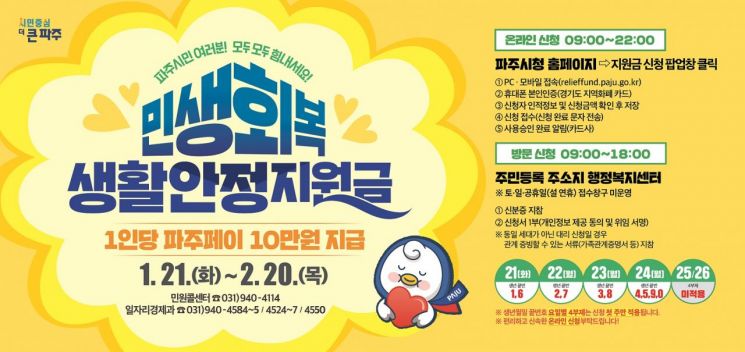 ‘Paju City Livelihood Recovery and Living Stability Support Fund’ Application Notice. Provided by Paju City
According to Paju City on the 14th, the Livelihood Recovery Living Stability Support Fund can be applied for by Korean nationals registered as residents in Paju City as of 24:00 on December 26, 2024.
Applications for the Livelihood Recovery Living Stability Support Fund will be accepted both online and offline, with the application period running from the 21st to February 20. To prevent congestion during the first week of applications from the 21st to the 24th, a four-day rotational system based on the last digit of the birth year will be applied for both online and offline applications.
Citizens who already use the Paju Pay card can apply online through the Paju City Livelihood Recovery Living Stability Support Fund website. Those without a Paju Pay card can visit their local eup/myeon/dong administrative welfare center to apply in person and receive a card.
Online applications are accepted from 9 a.m. to 10 p.m., including weekends and holidays, while offline applications are accepted on weekdays from 9 a.m. to 6 p.m. If you already have a Paju Pay card, applying online or bringing the card to an offline counter will enable quick payment.
Online applications cannot be made by proxy for adults, but for minors, applications can be combined if the father or mother is the head of the household or the spouse of the head of the household.
For offline applications, adults can apply by proxy if they are the head of the household or a household member excluding cohabitants within the same household. If not in the same household, proxy applications are allowed only for direct lineal relatives.
For minors, offline proxy applications are allowed by an adult head of household or household member if in the same household, and by family members if not in the same household. However, minors under 14 years old must have proxy applications only within the same household.
Paju City has formed a dedicated task force (TF) led by the vice mayor to ensure the prompt and smooth payment of the Livelihood Recovery Living Stability Support Fund and has prepared detailed operational guidelines regarding application methods, payment means, and usage locations.
Paju City plans to thoroughly inspect all systems related to application and payment during the remaining period and will operate both the Paju City Civil Service Call Center and the Job Economy Division Call Center simultaneously to provide prompt and accurate guidance for various inquiries.
Kim Kyung-il, Mayor of Paju City, stated, “We will prepare without any setbacks so that all Paju citizens can receive the Livelihood Recovery Living Stability Support Fund quickly and conveniently,” adding, “Since the support fund is provided in local currency, we hope it will invigorate the local economy and be a great help to small business owners.”
The usage period for this Livelihood Recovery Living Stability Support Fund is until June 30, 2025, starting from the date the Paju Pay card usage approval message is received, and any unused amount after the expiration date will be automatically forfeited.
◇The locations of offline application counters by eup/myeon/dong are as follows.
△ Munsan-eup (1st floor small meeting room, Administrative Welfare Center) △ Jori-eup (2nd floor shared office, Administrative Welfare Center) △ Beopwon-eup (3rd floor small meeting room, Administrative Welfare Center) △ Paju-eup (2nd floor meeting room, Administrative Welfare Center) △ Gwangtan-myeon (1st floor lobby, Administrative Welfare Center) △ Tanhyeon-myeon (2nd floor small meeting room, Administrative Welfare Center) △ Wollong-myeon (2nd floor cultural classroom, Administrative Welfare Center) △ Jeokseong-myeon (1st floor lobby, Administrative Welfare Center) △ Papyeong-myeon (1st floor office, Administrative Welfare Center) △ Jangdan-myeon (1st floor lobby, Administrative Welfare Center) △ Gyoha-dong (1st floor multipurpose room, Administrative Welfare Center) △ Unjeong 1·2-dong (1st floor lobby, Administrative Welfare Center) △ Unjeong 3-dong (multipurpose meeting room) △ Unjeong 4-dong (multipurpose room) △ Unjeong 5-dong (1st floor multipurpose meeting room, Administrative Welfare Center) △ Unjeong 6-dong (5th floor multipurpose meeting room, Administrative Welfare Center) △ Geumchon 1-dong (4th floor large meeting room, Administrative Welfare Center) △ Geumchon 2-dong (1st floor small meeting room, Administrative Welfare Center) △ Geumchon 3-dong (3rd floor large meeting room, Administrative Welfare Center)
© The Asia Business Daily(www.asiae.co.kr). All rights reserved.



![$29 Monthly Subscription AI Plant Appliance... US Startup Challenges LG [CES 2026]](https://cwcontent.asiae.co.kr/asiaresize/319/2026010819285284553_1767868133.png)