Core National Technologies Are Not Impossible to Change Jobs
"Non-Compete Agreement Leads to Civil Lawsuit"
MBK Partners and Youngpoong have gained an advantageous position in the management rights dispute by acquiring additional shares of Korea Zinc.
Key technical personnel, including Lee Jae-jung, Vice Chairman of Korea Zinc, previously stated that "if MBK manages Korea Zinc, all will resign," drawing attention to whether overseas corporate transfers will materialize. Since the precursor technology, a core material for secondary batteries, has been designated as a national core technology, any personnel departure is expected to impact the competitiveness of the smelting industry.
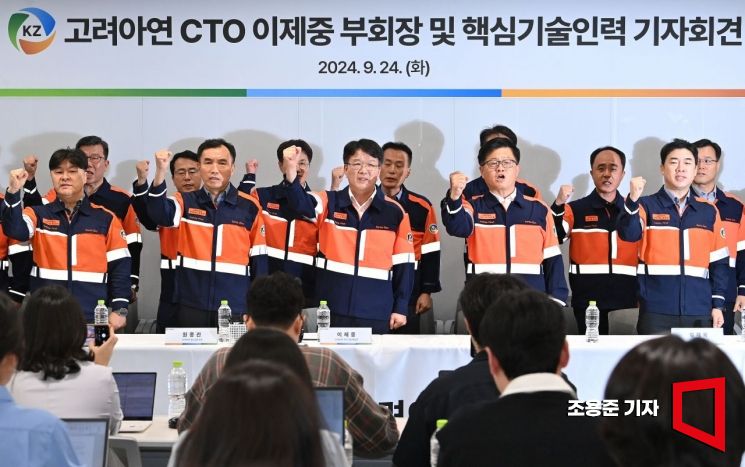 Lee Je-jung, Vice Chairman of Korea Zinc, along with executives and employees, are shouting slogans opposing the public tender offer at a press conference regarding the management rights dispute with MBK and Young Poong held on the 24th at Korea Zinc in Jongno-gu, Seoul. Photo by Jo Yong-jun
According to industry sources on the 23rd, Korea Zinc emphasizes that if MBK's acquisition becomes a reality, the continued departure of technical personnel would be a loss from the perspective of national competitiveness. This is the key point in persuading shareholders ahead of the upcoming extraordinary general meeting next month.
Legal circles believe that even though the precursor manufacturing technology is designated as a national core technology, personnel transfers are not impossible. Even if employees sign non-compete agreements preventing them from joining competitors or starting related businesses for a certain period after resignation, they can still change jobs.
A labor law specialist explained, "Many companies require senior executives or researchers to sign non-compete agreements," but added, "however, such agreements do not fundamentally prevent job changes; instead, companies can file civil lawsuits for damages based on the agreements." This means employees can move, but if there is evidence of technology leakage, legal action can be taken.
In March, SK Hynix filed a provisional injunction against a former researcher who moved to the U.S. company Micron, and the court granted it. At that time, the court ruled, "If the information acquired by researcher A is leaked, Micron could significantly shorten the time required to achieve business capabilities equivalent to SK Hynix in the same field, and SK Hynix’s competitiveness would be substantially damaged."
In the event of litigation, it must be examined whether the company’s technology was leaked or the originality of the technology. Since zinc smelting technology has been commercialized since the Bronze Age, it can be argued that it is not unique to Korea Zinc.
There is also controversy over whether MBK’s attempt to acquire management rights of Korea Zinc constitutes a ‘foreign investment.’ Key personnel such as Chairman Kim Byung-joo and Vice Chairman Bu Jae-hoon, who established MBK, hold U.S. nationality. According to Article 13, Paragraph 1 of the Act on National Advanced Strategic Industries, companies possessing national strategic technology must obtain approval from the Minister of Trade, Industry and Energy when conducting foreign investments such as overseas acquisitions, mergers, or joint ventures.
© The Asia Business Daily(www.asiae.co.kr). All rights reserved.





![$29 Monthly Subscription AI Plant Appliance... US Startup Challenges LG [CES 2026]](https://cwcontent.asiae.co.kr/asiaresize/319/2026010819285284553_1767868133.png)