Visit to Cement Plants in Greece and Austria
Increase Use of Blended Materials to Reduce Clinker Consumption
Replace Fossil Fuels with Waste Vinyl and Others
The TITAN Efkarpia plant, located 35 minutes by car from Thessaloniki, the second-largest city in Greece. This cement plant is focusing on reducing its main raw material, limestone, to cut carbon emissions. When limestone and auxiliary materials like clay are heated at high temperatures, a cement intermediate product called 'clinker' is produced, which requires heating the kiln to over 1450 degrees Celsius. This process emits a large amount of carbon dioxide. At this plant, the use of supplementary materials in cement production has been increased to reduce clinker usage. This contrasts with the domestic cement industry, where the use of supplementary materials is limited. We visited the site to observe carbon reduction technologies in the cement industry.
Kalogerakos Angelos, the overall plant manager of the TITAN Group, expressed pride on the 20th (local time), stating, “Reducing limestone usage and increasing the proportion of supplementary materials is an effective way to reduce carbon emissions.”
Limestone is the main cause of carbon dioxide emissions during cement production. Typically, about 700 kg of CO2 is emitted per ton of cement produced. Of this, 420 kg, or 60%, comes from the limestone used to produce clinker. To address this issue, since 2017, the Efkarpia plant has been using various supplementary materials that can replace clinker, including waste concrete generated in Thessaloniki, as raw materials for cement. The proportion of supplementary materials is about 25%.
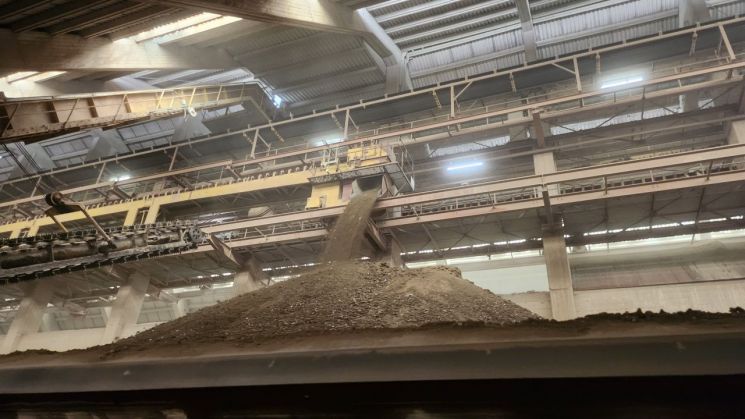 On the 23rd (local time), waste construction materials such as bricks were crushed and piled up at the recycling center within the Mannersdorf plant of HOLCIM Cement Company near Vienna, Austria.
Efforts to reduce carbon emissions in the cement industry through supplementary materials were also observed at the Holcim (HOLCIM) cement plant in Mannersdorf near Vienna, Austria, which we visited on the 23rd. Upon opening the recycling center’s door, crushed waste building materials such as bricks were being piled up. At this site, alternative raw materials for cement production were produced at a rate of 50 to 60 tons per hour. The crushed waste materials turned into fine powder, floating inside the recycling center and creating a hazy atmosphere.
Bernhard Kock, Holcim’s quality and environmental manager, said, “Waste building materials, mostly composed of brick components, are used extensively instead of limestone. You can think of it as cement used 50 years ago coming back as raw material.” The Mannersdorf plant reduced the clinker proportion in cement from the usual 95-97% to 66% by using various supplementary materials.
In Europe, a total of 10 types of supplementary materials can be freely mixed when producing cement, including blast furnace slag, waste concrete, silica fume, two types of pozzolan, two types of fly ash, burnt shale, and two types of limestone powder. The maximum allowable usage is 36%. In contrast, domestically, only two of four types?blast furnace slag, fly ash, pozzolan, and limestone powder?are allowed to be used in limited amounts, with a maximum ratio of 10%, based on Portland cement standards.
Experts agree that a similar trend to Europe is needed domestically. Professor Jinman Kim of the Department of Green Smart Architecture Engineering at Kongju National University said, “Unlike Korea, which only has one type of slag cement mixed with slag from the steel industry, Europe uses various supplementary materials to reduce the limestone proportion in blended cement, minimizing greenhouse gas emissions. Korea’s standards for supplementary material use are significantly lower in both types and amounts compared to Europe. To achieve carbon neutrality in the domestic cement industry, active relaxation of KS standards should be considered.”
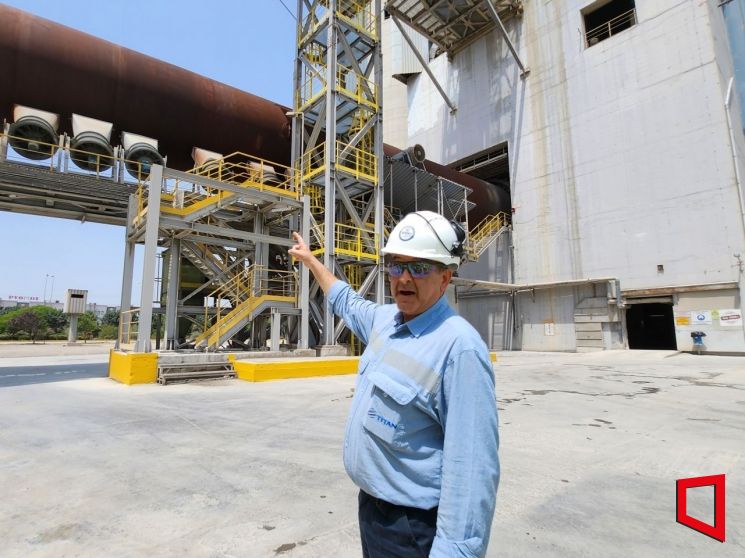 On the 20th (local time), Anastasios Selegidis, Minister of Finance and Administration, is pointing to the kiln at the Titan Cement Efkarpia plant in Greece, explaining the reduction of carbon dioxide.
Another way to reduce carbon emissions is to use alternative fuels such as waste plastics and waste vinyl. At the Mannersdorf plant’s alternative fuel storage, trucks carrying waste plastics were noticeable. The storage facility, with a total volume of 4,500 cubic meters, is divided into three sections to accommodate trucks. Each truck carries about 25 to 30 tons, and 300 to 400 tons are stored daily. Through this, the Mannersdorf plant replaces up to 90% of fossil fuels.
This is why there are calls to increase the alternative fuel ratio, which is only 35% in the domestic cement industry. In Germany, there are even cement plants that have achieved 100% fuel substitution. Peter Hoddinott, former president of the European Cement Association, emphasized, “Europe plans to expand low-carbon cement by reducing clinker use and increasing recycling of circular resources as a carbon neutrality measure, and ultimately introduce carbon capture, utilization, and storage (CCUS) technology on a large scale. The Korean cement industry should prioritize rapidly increasing the recycling rate of circular resources, which is currently somewhat stagnant, to European levels.”
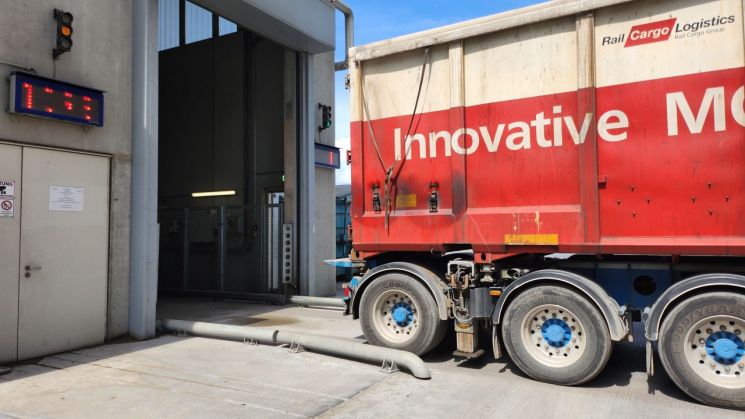 On the 23rd, at the Mannersdorf plant of HOLCIM cement company near Vienna, Austria, waste plastics loaded on trucks are being moved to the alternative fuel storage facility.
© The Asia Business Daily(www.asiae.co.kr). All rights reserved.