MS Promises Carbon Negative by 2030
But Carbon Emissions Jump 30% in 3 Years
Will Require Major Suppliers to Comply
WSJ: "Samsung Electronics, SK Hynix Within Scope"
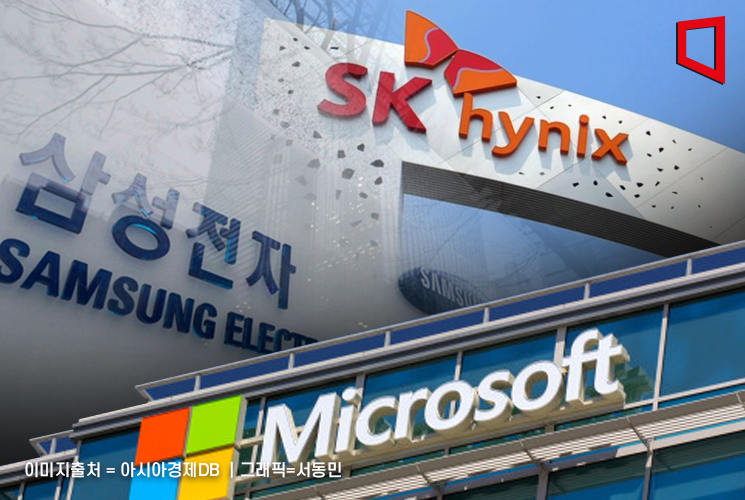
Microsoft (MS) has decided to mandate its major suppliers to use 'carbon-free' electricity in order to reduce carbon emissions. This move comes as MS's carbon emissions have surged by nearly 30% since 2020. Consequently, concerns have arisen that Samsung Electronics and SK Hynix, which supply server semiconductors to MS, could be directly impacted.
Major foreign media outlets, including The Wall Street Journal (WSJ), reported on the 15th (local time) that Melanie Nakagawa, MS's Chief Sustainability Officer, stated, "We will request suppliers who deliver goods and services on a large scale to use 100% renewable energy by 2030."
In the 'Sustainability Report' released that day, MS revealed that carbon emissions from 'Scope 3' in the previous year increased by 31% compared to 2020. Scope 3 refers to carbon emissions generated by suppliers and is considered the most robust net-zero (carbon neutrality) implementation measure for companies.
As a result, MS's total carbon emissions increased by 29% during this period. Previously, MS had pledged to achieve 'carbon negative' status by 2030, going beyond net-zero to make its annual net carbon emissions negative. However, as progress stalled, MS appears to have decided on stronger ESG goals.
WSJ viewed that Samsung Electronics and SK Hynix, MS's major DRAM suppliers, would fall directly within the scope of these changes. While there is a transnational consensus on net-zero as a climate crisis response, the speed of ESG implementation varies among companies. Samsung Electronics aims to switch to 100% renewable energy by 2050, while SK Hynix has committed to achieving a 33% renewable energy usage rate by 2030. Both lag behind MS's target.
If MS enforces its targets, given the significant share of server DRAM in memory semiconductors, domestic companies' performance could be greatly affected. Rishi Zaluria, an analyst at Canadian investment bank RBC Capital, stated, "MS suppliers will need to change their processes to catch up with MS's climate goals."
However, regarding whether MS can terminate contracts with suppliers that do not comply with its climate goals, the company dismissed this, saying, "We have not reached that stage yet."
WSJ predicted that "forcing suppliers to comply with new guidelines is likely to resonate throughout the big tech industry." With the surge in power demand due to the AI boom, including data center construction, concerns are growing that the AI craze will exacerbate the climate crisis.
As the demand for ESG compliance from major U.S. tech companies is likely to spread like a trend, there is also an assessment that domestic companies need to respond proactively.
© The Asia Business Daily(www.asiae.co.kr). All rights reserved.









![The Special Connection Between the Statue of Martyr Lee Jun in Jangchungdan Park and Mayor Oh Sehoon ③ [Current Affairs Show]](https://cwcontent.asiae.co.kr/asiaresize/319/2026012110001599450_1768957215.jpg)
