"Low Birthrate Policy Goals and Targets Need Specification"
"Family Budget and Other Realities Must Be Addressed"
It was pointed out that the policy direction must be completely changed to solve the low birthrate problem. Instead of vague policy goals, support should be focused on young people who are willing to choose marriage and childbirth, and family budgets (direct budgets for low birthrate response) should be made more realistic. It was also suggested that child allowances and parental leave benefits be expanded, and that public discussion is needed on immigration issues and retirement age extension.
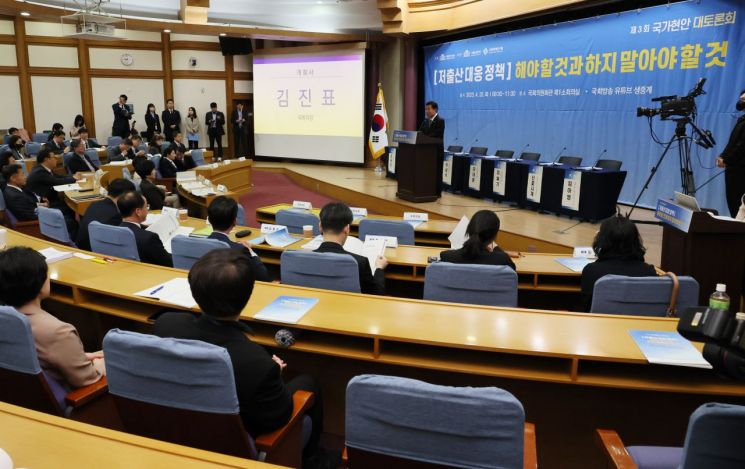
On the 25th, the National Assembly held a major debate on the theme "Low Birthrate Response Policy: What Should and Should Not Be Done." This debate was held to analyze the situation where about 280 trillion won was invested from 2006 to 2021 to solve the low birthrate problem, but the total fertility rate decreased from 1.13 to 0.81, and the number of births also decreased from 450,000 to 260,000, and to find solutions.
Kang Dae-hoon, head of the Social and Cultural Research Office at the National Assembly Legislative Research Office, presented an analysis of the four basic plans for low birthrate and aging society. Kang criticized the government's basic plans, saying, "Due to the excessive inclusiveness of the paradigm of 'improving quality of life' for all generations, detailed tasks that may have different policy targets and goals were indiscriminately included without principles." As a direction for improvement, he suggested specifying and limiting policy goals, targets, and means. Instead of the policy goal of improving quality of life, it should be aligned toward "expanding the choice of marriage and childbirth," and the policy targets should be those who have the intention to marry and have children or those who have involuntarily given up.
Regarding child allowances, the payment target should be expanded to all children aged 0 to 17, and the support amount should be increased. Parental leave should be introduced, and compliance with the statutory 40-hour workweek should be ensured so that daily work and family life can be balanced. Furthermore, solutions should be sought for social structural issues such as employment, housing, and private education.
Choi Byung-kwon, head of the Budget Analysis Office at the National Assembly Budget Office, analyzed the low birthrate response budget and said, "There is a visual distortion effect in the low birthrate budget as projects with low direct relevance to low birthrate are included," and analyzed that "family budgets, which are direct low birthrate response budgets such as child allowances, parental leave benefits, and infant care support, are only half of those in advanced countries with high fertility rates." In particular, cash support budgets accounted for only 30% of the OECD average.
Choi said, "It is necessary to restructure and manage low birthrate policies focusing on projects directly related to low birthrate response," and suggested raising the upper limit of parental leave benefits from the current 1.5 million won to increase income replacement effects, expanding the unit amount and target age of child allowances, and providing incentives for multi-child families to expand social responsibility for childcare.
He added, "Considering our population structure, it is difficult to maintain the current level of working-age population with policies to increase fertility rates alone," and said, "To respond appropriately to the population crisis, it is necessary to combine low birthrate policies with expansive immigration policies."
Meanwhile, Chairman Kim Jin-pyo said in his congratulatory remarks at the event, "The population crisis is a fundamental crisis in that it shakes the foundation of our society's existence," and said, "In short, it is a matter of the nation's survival."
© The Asia Business Daily(www.asiae.co.kr). All rights reserved.









![The Special Connection Between the Statue of Martyr Lee Jun in Jangchungdan Park and Mayor Oh Sehoon ③ [Current Affairs Show]](https://cwcontent.asiae.co.kr/asiaresize/319/2026012110001599450_1768957215.jpg)
