[Asia Economy Reporter Haeyoung Kwon] It has been reported that the Netherlands and Japan have agreed to join the United States in semiconductor export controls against China.
According to Bloomberg on the 26th (local time), officials from the United States, the Netherlands, and Japan are expected to reach an agreement as early as tomorrow regarding semiconductor export control measures against China. These countries are currently discussing such measures in Washington DC.
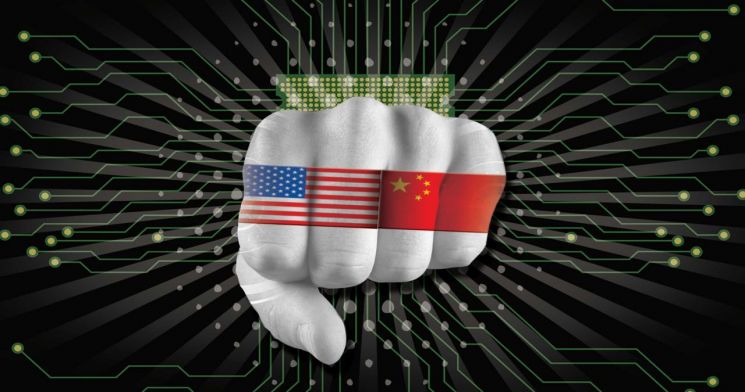
If these countries reach an agreement, export regulations on the Dutch semiconductor equipment company ASML to China will be further tightened. ASML has been unable to export cutting-edge extreme ultraviolet (EUV) lithography equipment to China since 2019 due to the Dutch government's embargo measures, and going forward, it is expected that even older generation deep ultraviolet (DUV) lithography equipment will be prohibited from export. Although DUV lithography equipment does not incorporate the most advanced technology like EUV, it is used to manufacture semiconductors found in automobiles, smartphones, PCs, and robots.
This report came just one day after ASML Chairman Peter Wennink stated after the earnings announcement on the 25th that older generation DUV lithography equipment could still be exported to China. At that time, Chairman Wennink explained that exports to China accounted for 14-15% of total sales.
The Japanese government is also reportedly set to impose export restrictions on its domestic semiconductor equipment company Nikon.
Earlier, in October last year, the United States announced export control measures banning the sale of advanced U.S.-made semiconductor equipment to Chinese semiconductor manufacturers. Semiconductor exports used in artificial intelligence (AI) and supercomputers were also restricted.
Since then, the U.S. government has requested the Netherlands and Japan, major semiconductor production equipment manufacturing countries, to join the sanctions. Since Dutch ASML and Japanese Tokyo Electron are among the world's top five semiconductor equipment companies, cooperation from these countries is deemed essential for the export control measures against China to be effective. Previously, President Joe Biden directly raised this issue during summit meetings with Japanese Prime Minister Fumio Kishida and Dutch Prime Minister Mark Rutte.
To curb China's semiconductor rise, the United States is also requesting South Korea to participate in the export control measures. On the 10th, U.S. Ambassador to Japan Rahm Emanuel stated in an interview with Bloomberg, "We need to work not only through Japan but also through South Korea and the Netherlands." The U.S. particularly believes that Korean companies such as Samsung Electronics and SK Hynix, which have semiconductor production plants in China, should also participate.
© The Asia Business Daily(www.asiae.co.kr). All rights reserved.














![The Special Connection Between the Statue of Martyr Lee Jun in Jangchungdan Park and Mayor Oh Sehoon ③ [Current Affairs Show]](https://cwcontent.asiae.co.kr/asiaresize/319/2026012110001599450_1768957215.jpg)
