Netherlands TTF Natural Gas Futures Surge 198% This Year
Prices Soar Amid Russia's Energy Weaponization and Heatwave
Financial Sector: "Natural Gas Prices Unlikely to Stabilize Soon"
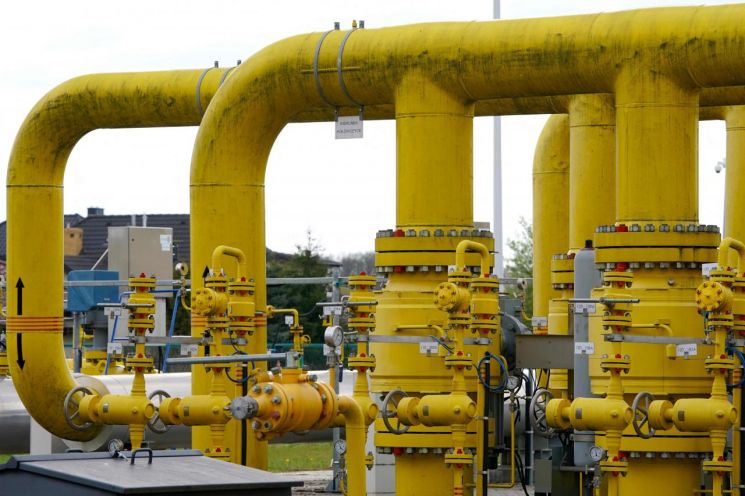
[Asia Economy Reporter Minji Lee] While raw material prices are falling due to concerns over decreased demand amid the economic downturn, there is one raw material that continues to rise alone: natural gas. Although the supply of natural gas is decreasing, demand is increasing due to the scorching heat, causing prices to rise further.
As of the 27th, the Dutch TTF natural gas futures, the benchmark for European natural gas prices on the London ICE exchange, stand at 214 euros per megawatt-hour (MWh). Natural gas prices, which were at 71.765 euros per MWh at the beginning of this year, have surged 198% up to the day before, maintaining an upward trend. The increase rate this month alone is close to 45%. On the New York Mercantile Exchange in the U.S., natural gas futures prices (for September delivery) exceed $8.83 per MMBTU, showing a solid upward trend with a rise of over 50% compared to $5.7 at the beginning of this month.
The sharp rise in natural gas prices can be summarized by two factors: reduced supply of Russian natural gas and increased electricity consumption due to abnormal temperatures. This imbalance between supply and demand has caused prices to skyrocket as many parts of the world, including Europe, increase electricity consumption due to deadly heatwaves, while Russia reduces the supply of natural gas needed for power generation.
Most European countries have been recording new daily high temperatures exceeding 40 degrees Celsius since the beginning of this month. Natural gas is mainly used for heating, cooling, and electricity consumption. In this situation, Russia reduced natural gas supply by 20% starting on the 27th, citing maintenance work on the Nord Stream 1 gas pipeline. However, this is a blatant manifestation of Russia’s ‘energy weaponization’ strategy. In the U.S., natural gas prices continue to rise as air conditioning-related electricity demand in key areas, including parts of Texas, hits record highs.
Minjae Lee, a researcher at NH Investment & Securities, said, “Europe is taking measures such as diversifying natural gas import sources and expanding coal-fired power generation, but has not found a fundamental solution.” He added, “The alternative proposed, nuclear power, is not operating normally due to equipment defects at France’s EDF nuclear power plants and compliance with environmental regulations.” Receiving natural gas via LNG from the U.S. also cannot meet all demand under the current circumstances.
Thanks to this, investment products related to natural gas have yielded returns exceeding 300%. The ‘Shinhan Leverage Natural Gas Futures ETN,’ which seeks twice the price of natural gas futures traded on the U.S. CME, has posted a 365% return this year. Stocks related to city gas, such as GS E&C and Daesung Energy, have returns of about 63% and 20%, respectively, since the beginning of the year.
The securities industry expects it will be difficult for natural gas prices to stabilize in the short term. Although concerns about economic slowdown are suppressing the market, the decline in natural gas prices is expected to be limited. This is because it will take more time to fully resolve the energy insecurity in Europe. Typically, Europe builds up natural gas inventories in the second and third quarters and reduces them in the first and fourth quarters when heating demand increases. However, with Russia limiting natural gas supply, European countries are estimated to be unable to stockpile inventories fully at 100%.
Jung-hwan Na, a researcher at Cape Investment & Securities, said, “The shortage of natural gas inventories could act as a factor for future price increases.” He added, “It is difficult to rapidly expand the amount of natural gas supplied via LNG carriers from North America in the short term, so interest in natural gas or LNG carrier-related stocks will be maintained.”
Meanwhile, individual investors seem to judge that current natural gas prices are excessively high. According to the Korea Exchange, among the 10 ETNs (exchange-traded notes) most purchased by individuals over the past 10 trading days, six were products betting on a decline in natural gas prices. More than 10 billion won flowed into three products that generate double profits from price drops: Shinhan Inverse 2X Natural Gas Futures (17.2 billion won), TRUE Inverse 2X Natural Gas Futures (14.6 billion won), and Samsung Inverse 2X Natural Gas Futures (11.8 billion won). The total amount invested in these six products approached about 57.5 billion won.
© The Asia Business Daily(www.asiae.co.kr). All rights reserved.