Institute for Basic Science Develops Biosensor Based on Porous Gold Nanoelectrodes
[Asia Economy Reporter Kim Bong-su] Domestic researchers have developed a biosensor technology that can instantly diagnose cancer using blood and urine.
The Institute for Basic Science (IBS) announced on the 18th that the research team led by Group Leader Cho Yoon-kyung of the Center for Soft and Living Matter (and a professor in the Department of Biomedical Engineering at UNIST) developed a porous gold nanoelectrode-based biosensor with such functionality. The team successfully diagnosed prostate cancer using the newly developed biosensor, and this technology is expected to be applicable in the diagnosis of pathogens and other diseases in the future.
Biomarkers indicating health status are contained in biological samples such as urine and blood, and analyzing these can reveal the presence of diseases. For accurate diagnosis, biomarkers related to diseases must be isolated and purified; however, currently, sample analysis is possible only in large medical facilities or laboratories, which requires significant time and cost. Especially during pandemics like COVID-19, analyzing numerous samples simultaneously can overwhelm the healthcare system.
Point-of-care diagnostic devices allow simple and rapid diagnosis and are cost-effective, but there are technical challenges in diagnosing cancer or infectious diseases. Biomarkers related to cancer or infectious diseases exist in extremely small amounts in biological samples such as blood, necessitating highly sensitive detection technologies. Increasing the electrode surface area can enhance sensitivity, but this also increases contamination issues.
The research team developed porous gold nanoelectrodes to create biosensors with high sensitivity and accuracy. Using this, they confirmed that prostate cancer diagnosis at the point of care is possible with biological samples without undergoing complex steps such as isolating and purifying biomarkers like exosomes.
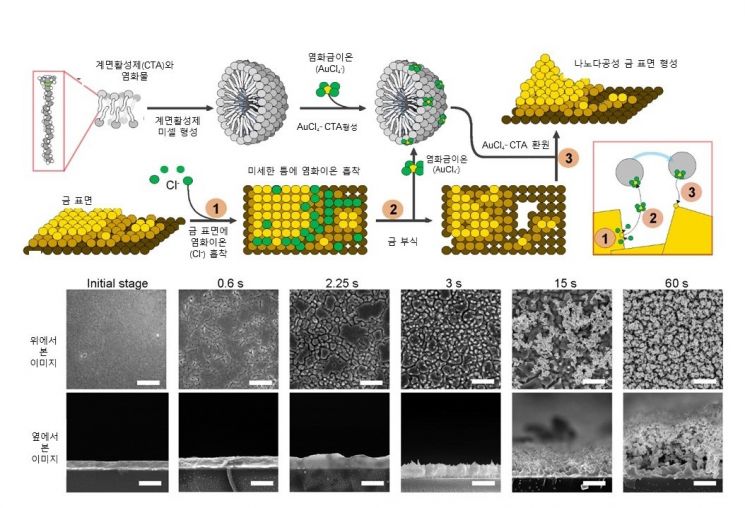
The newly developed porous gold nanoelectrodes were fabricated by placing a flat gold surface in a sodium chloride solution containing micelles and applying repetitive electrical pulses. Micelles are aggregates of surfactants shaped like dandelion seeds, with spherical heads that are hydrophilic and tails that are hydrophobic. Through electrochemical redox reactions induced by electrical pulses, gold on the flat electrode surface was etched and re-adsorbed, promoting the growth of nanostructures and forming nanometer-sized pores. During this process, micelles played a crucial role by preventing etched gold particles from diffusing into the solution and facilitating their re-adsorption onto the gold electrode surface. This method created a large surface area to increase sensor sensitivity while forming nanometer-sized pores to prevent sample contamination. Using this, the team detected proteins attached to cancer cell-derived exosomes in urine and plasma, distinguishing between prostate cancer patient groups and healthy donor groups.
Group Leader Cho Yoon-kyung stated, "This technology will provide a key foundation for the future development of point-of-care diagnostic devices," adding, "We plan to expand research by utilizing the potential of porous gold nanostructures to develop diagnostic chips analyzing blood and saliva samples."
The research results were published online on the 17th in the international journal Advanced Materials (IF 30.849) and were selected as the frontispiece article.
© The Asia Business Daily(www.asiae.co.kr). All rights reserved.