Professor Kim Sang-yeon and Team at Korea University of Technology and Education
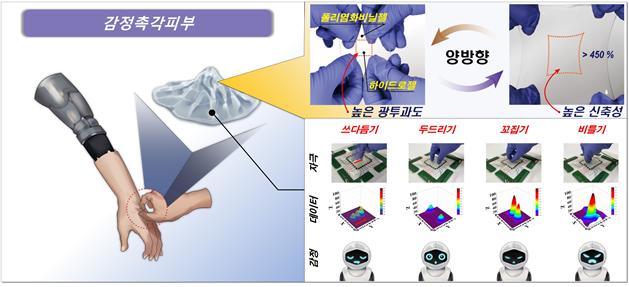
[Asia Economy Reporter Kim Bong-su] Stroking, pinching, even twisting! Transparent skin for robots that can physically interact and emotionally connect with humans like a person has been developed.
The National Research Foundation of Korea announced on the 21st that Professor Kim Sang-yeon’s research team at Korea University of Technology and Education developed an ‘emotional tactile skin’ that allows electronic devices such as robots to exchange tactile emotions with humans.
Humans engage in emotional, empathetic, and affective interactions through various tactile gestures such as stroking or pinching. Recently, with the increase in single-person households and elderly populations, companion robots or smartphone apps that enhance human caregiving functions have gained attention. For such electronic and mechanical devices to actively exchange emotions with humans, an emotional tactile skin capable of detecting and understanding various tactile gestures is necessary. Since emotional tactile skin must express and recognize tactile actions like stroking, caressing, pinching, or twisting, it needs to be soft and highly stretchable like human skin, and very transparent to accurately represent the device’s original skin color.
The research team developed a transparent and highly stretchable emotional tactile skin by combining polyvinyl chloride gel, a raw material inspired by food packaging ‘wrap’, with hydrogel using water as a solvent. They examined the characteristics according to the manufacturing ratio of polyvinyl chloride gel and hydrogel and proposed a method to maintain transparency and elasticity while enabling adhesion. Through the developed tactile skin, they also confirmed the possibility of distinguishing various tactile emotions and emotional exchanges.
This research outcome is the result of improving the material used in food packaging wrap commonly used in daily life. It is expected to be applicable in various fields such as wearable devices, robots, prosthetic hands, and smartphones due to its low cost, transparency, and excellent stretchability. The research team anticipates it will become a new standard in developing various emotional sharing devices capable of emotional exchange with humans.
The research results were published online on the 31st of last month in the international journal in the field of chemical engineering, Chemical Engineering Journal.
© The Asia Business Daily(www.asiae.co.kr). All rights reserved.









![The Special Connection Between the Statue of Martyr Lee Jun in Jangchungdan Park and Mayor Oh Sehoon ③ [Current Affairs Show]](https://cwcontent.asiae.co.kr/asiaresize/319/2026012110001599450_1768957215.jpg)
