Yoon Government Expected to Accelerate Radioactive Waste Disposal Facility Construction...Inevitable to Reverse 'Nuclear Phase-Out'
Temporary Storage Alone Insufficient...Gori and Hanbit Saturation Rate 100% by 2031
Ministry of Industry Also Emphasizes Legalization in Transition Team Report..."Prerequisite for Disposal Facility Construction"
Site Selection to Begin Next Year but Completion by 2060...Need to Reflect in National Agenda
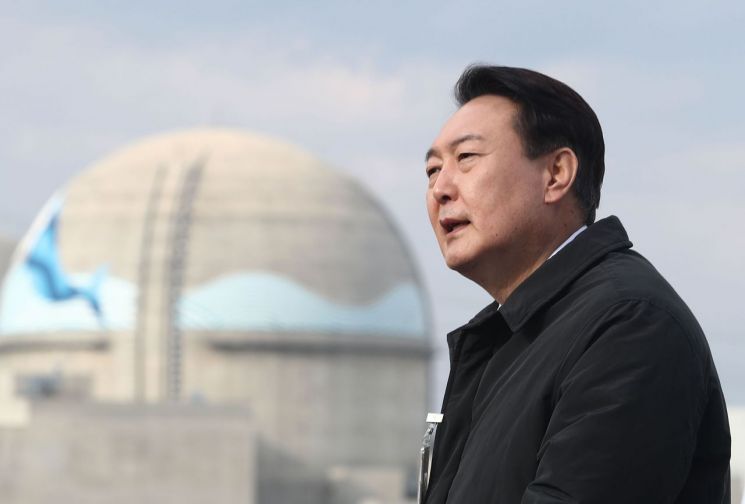 President-elect Yoon Suk-yeol visited the construction suspension site of Shin Hanul Units 3 and 4 located in Uljin County, Gyeongbuk, in December last year during his presidential campaign and announced his nuclear policy.
 [Image source=Yonhap News]
[Asia Economy Sejong=Reporter Lee Jun-hyung] The enactment of the ‘High-Level Radioactive Waste Special Act’ is an indispensable condition for the ‘abolition of the nuclear phase-out policy.’ To increase the share of nuclear power generation, the radioactive waste disposal facility, which is a storage facility for spent nuclear fuel, must be supported above all. As the new government emphasized raising the share of nuclear power generation to 30-35%, the enactment of the ‘High-Level Radioactive Waste Special Act’ is expected to accelerate the long-stalled construction of disposal facilities over the past several decades.
MACSTOR is Insufficient
According to the industry on the 11th, disposal facilities are broadly divided into three types: temporary storage facilities (MACSTOR), intermediate storage facilities, and permanent storage facilities. Nuclear power countries must follow the procedure of building permanent storage facilities after passing through intermediate storage facilities. This is because increasing nuclear power generation to meet the annually increasing electricity demand results in more spent nuclear fuel being discharged than before.
MACSTOR is insufficient to handle the future amount of spent nuclear fuel discharged. MACSTOR is a concrete structure with limited storage capacity, and its storage method is not complete. Spent nuclear fuel, which emits a large amount of heat and radioactivity, takes about 100,000 years to return to a state harmless to nature. The method to safely store spent nuclear fuel during this period is the deep geological disposal method, which involves constructing storage facilities in bedrock at depths of 300 to 1000 meters underground. The International Atomic Energy Agency (IAEA) also considers deep geological disposal the most appropriate permanent disposal method. This conclusion is based on a comprehensive consideration of the economic feasibility and safety of various permanent disposal methods. Advanced countries such as Finland and Sweden, which are building permanent disposal facilities, have also chosen deep geological disposal.
The previous government was not unaware of the importance of disposal facilities. The government had been searching for disposal facility sites since 1986 but faced opposition from local residents and civic groups, resulting in little progress until recently. This is why the domestic nuclear industry has relied on a ‘makeshift toilet’ for nearly 45 years since the Kori Unit 1 began operation in 1978.
MACSTOR Saturation from 2031
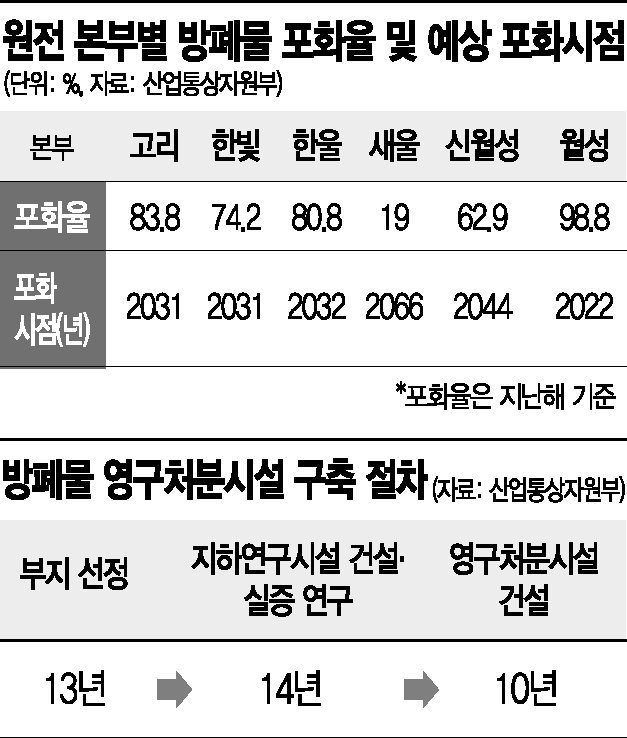
Meanwhile, domestic MACSTORs are approaching their critical point. According to the Ministry of Trade, Industry and Energy, as of last year, the saturation rates of radioactive waste at the Kori and Hanbit nuclear power plants were 83.8% and 74.2%, respectively, and both are expected to reach their limits by 2031. The following year, the Hanul nuclear power plant (80.8%) will also be saturated. The Wolsong nuclear power plant, which was expected to saturate this year, postponed the saturation point by expanding seven MACSTOR units last month. However, MACSTOR, which is literally a ‘temporary’ storage facility, is criticized as only a stopgap measure.
Accordingly, the Ministry of Trade, Industry and Energy emphasized the legalization of disposal facilities in its transition team briefing. The ministry believes that a special law must support the construction of disposal facilities. Since the construction of disposal facilities, which has low local acceptance and takes decades, cannot be promoted without legal grounds, it inevitably becomes a burden. A ministry official explained, "Legalization is a prerequisite for the construction of disposal facilities," adding, "Although it could be done through Cabinet approval, the legal basis is considered weak."
"Must be Included in National Tasks"
The political sphere also shares this consensus. The Democratic Party of Korea proposed the High-Level Radioactive Waste Special Act last year. However, this special act was designed under the nuclear phase-out policy, and it is highly likely that a revised bill aligned with the new government’s stance will be newly proposed before the regular National Assembly session in September. In the People Power Party, lawmakers such as Kim Young-sik are monitoring the disposal facility issue. A representative from Kim’s office said, "We recognize the necessity and importance of disposal facilities," and added, "We plan to concretize the review according to the national tasks announced by the transition team."
Even if the special act is enacted this year, the permanent disposal facility can be secured at the earliest around 2060. According to the 2nd Basic Plan for High-Level Radioactive Waste Management, the construction of permanent disposal facilities takes about 37 years. The site selection process, including in-depth suitability investigations, takes about 13 years. Even if the special act passes at the regular National Assembly session this September and the site selection process begins next year, the groundbreaking can only start in 2036.
There are also opinions that the transition team should include disposal facilities in the national tasks to strengthen the enactment of the special act. Jeong Dong-wook, president of the Korean Nuclear Society, said, "The construction of disposal facilities is an unavoidable path for a nuclear power country," adding, "It is best if the special act is passed within the year as part of the new government’s national tasks, but a Plan B is also needed in case that does not happen."
© The Asia Business Daily(www.asiae.co.kr). All rights reserved.









![The Special Connection Between the Statue of Martyr Lee Jun in Jangchungdan Park and Mayor Oh Sehoon ③ [Current Affairs Show]](https://cwcontent.asiae.co.kr/asiaresize/319/2026012110001599450_1768957215.jpg)

