[Asia Economy Reporter Jeong Hyeon-jin] Among the economic laws managed by government economic departments that allow criminal penalties, 36% explicitly permit overlapping punishments, leading to calls for reform to reduce excessive penalties.
On the 7th, the Federation of Korean Industries (FKI) conducted a comprehensive survey of the penal provisions in economic laws under the jurisdiction of 16 ministries, including the Ministry of Economy and Finance, Ministry of Employment and Labor, and the Fair Trade Commission. They found that out of 301 economic laws, there were 6,568 provisions allowing criminal penalties such as imprisonment or fines.
According to the FKI, 92.0% (6,044 provisions) of these allow for simultaneous punishment of both the violator and the company. The dual punishment provision imposes fines not only on the direct violators such as corporate representatives and employees but also on the related corporations. This means that 9 out of 10 criminal penalty provisions in economic laws include dual punishment clauses.
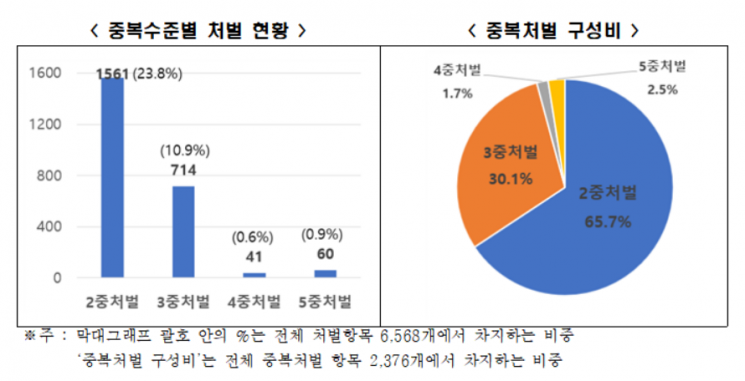
Additionally, the FKI analyzed that 36.2% (2,376 provisions) of the penalty and sanction measures, including imprisonment, administrative fines, and surcharges, are imposed redundantly. By level of redundancy, double penalties accounted for 1,561 cases (23.8%), triple penalties 714 cases (10.9%), quadruple penalties 41 cases (0.6%), and quintuple penalties 60 cases (0.9%).
The FKI stated, "Generally, imprisonment terms specify an upper limit such as 'up to ~ years' or a range like 'at least ~ years and up to ~ years,' but 225 provisions (3.4% of the total) only specify a minimum term in the form of 'at least ~ years.' The average imprisonment period across all penalty provisions was 3.70 years, and the average fine amount was 62.27 million KRW."
The FKI cited the Serious Accident Punishment Act, scheduled to take effect in January next year, as a representative case of excessive and overlapping penalties. If a serious industrial accident occurs due to failure to take safety or health hazard prevention measures, the CEO can be sentenced to imprisonment of at least one year or fined up to 1 billion KRW, with no upper limit on imprisonment and the possibility of simultaneous imprisonment and fines. Additionally, corporations can also be fined, and under the dual punishment provision, a corporation may be fined up to 5 billion KRW.
Yoo Hwan-ik, Director of Corporate Policy at the FKI, said, "Excessive penalties are turning managers and companies into repeat offenders. To revitalize the economy through enhanced entrepreneurship, it is necessary to reduce excessive criminal penalties or simplify overlapping punishments."
According to the Ministry of Government Legislation, the total number of statutes, presidential decrees, prime ministerial orders, and ministerial ordinances increased by 39.5%, from 3,347 in 1996 to 4,669 last year. The proportion of repeat offenders relative to the population rose from 13% in 1996 to 22% in 2010, and there are research results estimating that this proportion will reach 32% by 2020, the FKI added.
© The Asia Business Daily(www.asiae.co.kr). All rights reserved.









![The Special Connection Between the Statue of Martyr Lee Jun in Jangchungdan Park and Mayor Oh Sehoon ③ [Current Affairs Show]](https://cwcontent.asiae.co.kr/asiaresize/319/2026012110001599450_1768957215.jpg)
