Institute for Basic Science Analyzes Satellite Images to Study Correlation Between Urban Green Spaces, Citizen Happiness, and Economic Power
[Asia Economy Reporter Kim Bong-su]
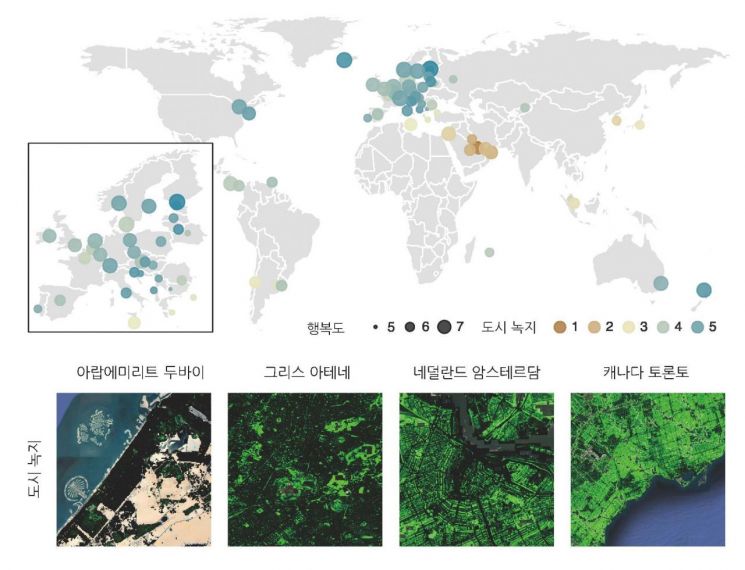
Happiness Levels and Urban Green Space Ratios by Country
Comparing the proportion of urban green spaces (circle color) and happiness survey results (circle size) across 60 countries worldwide reveals a correlation between the two. The boxed area in the lower left provides detailed results for European countries. While previous green space surveys were based on field visits or aerial photographs, this study utilized summer satellite imagery, enabling analysis over a much broader area.
Photo by Institute for Basic Science
A study has found that the greener the urban spaces in economically developed cities, the greater the impact on citizens' happiness.
The Institute for Basic Science (IBS) announced on the 8th that the research team led by Chief Investigator (CI) Cha Mi-young of the Data Science Group at the Center for Mathematical and Computational Sciences analyzed big data from satellite images to identify urban green spaces in 60 countries worldwide and examined the correlation between greenery and citizens' happiness, resulting in these findings.
Urban green spaces such as parks, gardens, and riverbanks provide not only aesthetic pleasure but also beneficial effects on physical health by promoting physical activity and social interaction. Although many studies have been conducted to clarify the correlation between urban greenery and citizens' happiness, most have focused on a few developed countries. Therefore, it has been difficult to determine whether the positive effects of greenery are a global phenomenon and how these effects vary depending on a country's economic status. Additionally, on-site surveys and aerial photographs have limitations in data collection due to the difficulty of conducting large-scale investigations.
The research team used high-resolution satellite data from Sentinel-2, operated by the European Space Agency (ESA), to investigate the green area of 90 cities in 60 countries worldwide. They analyzed the cities with the highest population density (cities containing at least 10% of the national population) and selected images from the summer season of each region for clarity. Images from June to September 2018 were used for the Northern Hemisphere, and from December 2017 to February 2018 for the Southern Hemisphere.
Subsequently, the quantified green area data for each city was compared with the 2018 World Happiness Report by the United Nations (UN) and the Gross Domestic Product (GDP) data by country (with South Korea ranked 11th in 2018) to comprehensively analyze the correlation between greenery, economy, and citizens' happiness.
The results confirmed that regardless of a country's economic status, cities with larger green areas tended to have higher levels of citizen happiness. However, among the 60 countries, the lower 30 GDP countries showed a closer relationship between economic growth and happiness. In cities where the Gross National Income (GNI) per capita exceeded $38,000 (approximately 42.23 million KRW), securing green spaces was a more important factor for happiness than economic growth. In the case of South Korea, the Seoul area was used for analysis, showing a trend of increased urban green space and rising happiness compared to the past.
Co-corresponding author Professor Jung Woo-sung of POSTECH stated, "During the stage of economic development, economic growth is the most important factor for citizens' happiness, but after the economy reaches a certain level, other social factors have a more direct impact on happiness." He added, "This study confirmed through big data analysis that urban green spaces are one of the social factors that enhance the sense of happiness."
IBS CI Cha Mi-young said, "Recently, research using big data from satellite images to solve social problems has been actively conducted. The tool developed this time can be applied to quantify the area of aquatic environments such as lakes and coasts, and research analyzing the correlation between aquatic environments and citizens' happiness can also be conducted."
© The Asia Business Daily(www.asiae.co.kr). All rights reserved.









![The Special Connection Between the Statue of Martyr Lee Jun in Jangchungdan Park and Mayor Oh Sehoon ③ [Current Affairs Show]](https://cwcontent.asiae.co.kr/asiaresize/319/2026012110001599450_1768957215.jpg)
