Leading Efforts to Improve Public Safety in Summer and Social Awareness of Public Officials
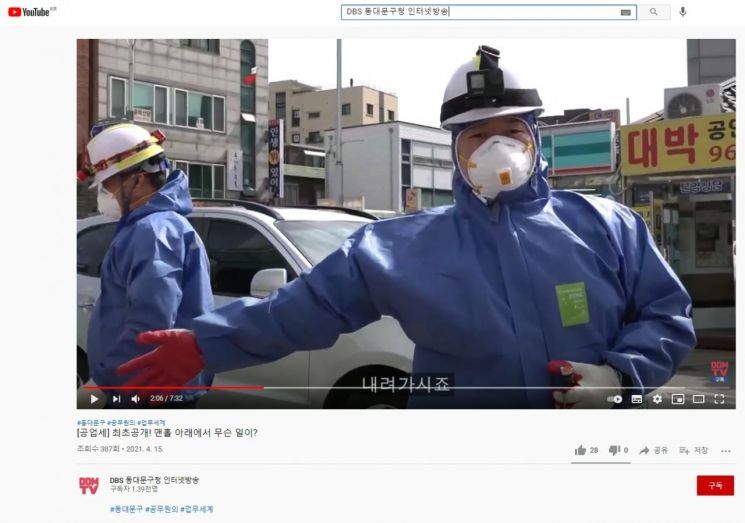 Dongdaemun-gu Office Internet Broadcasting DBS YouTube, The Work World of Public Officials: Dimension Section, Officer Jo Sang-hee Episode
[Asia Economy Reporter Jong-il Park] “When you enter the sewage culvert, there are hygienically difficult things to endure such as food waste, rat carcasses, and cockroaches. There are places where the floor is not visible, and in the narrow sewage culverts, I find myself crawling on all fours without realizing it.”
Dongdaemun-gu (Mayor You Deok-yeol) is drawing public attention by filming a day in the life of Josanghee, an official in the Flood Control Division, who sweats on the front lines of flood prevention for citizen safety during summer while navigating the pitch-dark sewage pipelines, and streaming it on YouTube.
The district decided to produce content to inform the public about the “work world of public officials” to improve the existing perception of civil servants. After recruiting participants through the internal network, Josanghee from the Flood Control Division was selected as the first case.
Then, together with Josanghee, they entered the sewage pipeline to film and uploaded the video titled “[Industrial Tax - The Work World of Public Officials] First Reveal! What Happens Under the Manhole?” on YouTube on the 15th.
This video has attracted attention by recording about 370 views within 5 days (as of the 20th), which is rare among local government videos.
Viewers left positive comments on YouTube such as “It was a video that helped me understand the Flood Control Division,” “The area under the manhole is unfamiliar,” and “Thank you for doing such hard work.”
Josanghee, who handles civil complaints and sewage management, belongs to the Flood Control Division of Dongdaemun-gu Office, which manages about 20,000 road rainwater inlets alone.
Wearing three to four layers of protective suits and entering the sewage culvert is also part of Josanghee’s daily work. The sewage culverts, which collect wastewater discharged from various places and send it to the discharge area, are often unsanitary, with dredged soil and trash piled up to above the knees in many cases.
Because of this, many sewage culverts are narrow, and despite the unsanitary environment, it is often necessary to crawl through them.
“When I first entered, it was quite fascinating. As soon as I went down, it was darker and quieter than I expected. Also, inside the sewage is cool, which was unique.”
This is Josanghee’s impression when first entering the sewage culvert. When entering a sewage culvert, teams of at least two people are formed, and oxygen levels and harmful gases are checked in advance. They must wear safety equipment, protective suits, and masks, and carry portable lanterns.
The Flood Control Division’s sewage team handles about 20 civil complaints daily on average. If they work continuously, one team can handle about 8 complaints per day, but due to poor field conditions, it is practically difficult to resolve complaints received on the same day immediately.
Especially during the rainy summer season, they work 24-hour emergency shifts, often working two consecutive days without rest.
Josanghee said, “Inspecting the sewage culvert can take up to two hours, and after coming out once, the foul smell clings to the body, so officials always carry fabric deodorizer,” adding, “Thanks to those who call to say thank you, I can work with strength.”
You can see a more vivid day in the life of Josanghee from the Flood Control Division on Dongdaemun-gu Office’s internet broadcast DBS YouTube channel.
© The Asia Business Daily(www.asiae.co.kr). All rights reserved.