Turn Signals Required for Both Entry and Exit
Ongoing Confusion Between Rotaries and Roundabouts
Enforcement Remains Inconsistent, System Reform Delayed
"Is it really okay not to use your turn signal when driving straight through a roundabout?"
On the 28th, at the roundabout in front of Yongsan Middle School in Yongsan-gu, Seoul, a taxi entered with its left turn signal on and then immediately switched to the right turn signal before exiting. Out of 12 vehicles that went straight through the roundabout, this was the only case where the driver followed the traffic regulations. Another sedan turned on its left turn signal when entering, but then turned it off right away and went straight. Among eight vehicles that turned right, only one used its turn signal.
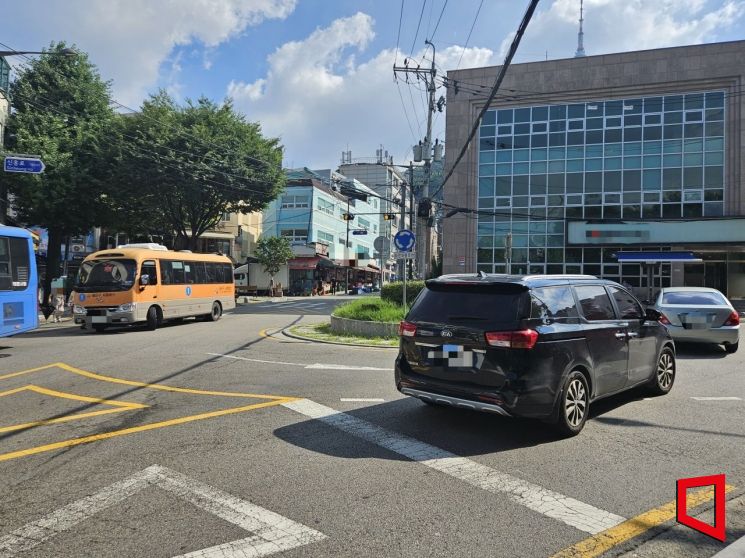 On the 28th, a vehicle entered the roundabout in front of Yongsan Middle School in Yongsan-gu, Seoul without using its turn signal. Photo by Seungwook Park
Although it is mandatory to use turn signals when entering and exiting a roundabout, a significant number of drivers are not complying with the law.
According to the Road Traffic Act, when passing straight through a roundabout, drivers must use the left turn signal when entering and the right turn signal when exiting. Violations can result in a fine of up to 200,000 won. Roundabouts were introduced in 2010 to help vehicles slow down and prevent accidents by circulating around a central traffic island.
Many drivers confuse roundabouts with rotaries. In roundabouts, entering vehicles have the right of way, while in rotaries, circulating vehicles have priority. Roundabouts are a legally defined road type, whereas rotaries have no legal definition or design standards. This lack of understanding leads many drivers to skip using turn signals. Park (26) said, "Sometimes my navigation system says there is a roundabout or a rotary ahead, so I thought they were the same thing. Since I've never been fined, I always thought it was okay not to use my turn signal when going straight through a roundabout."
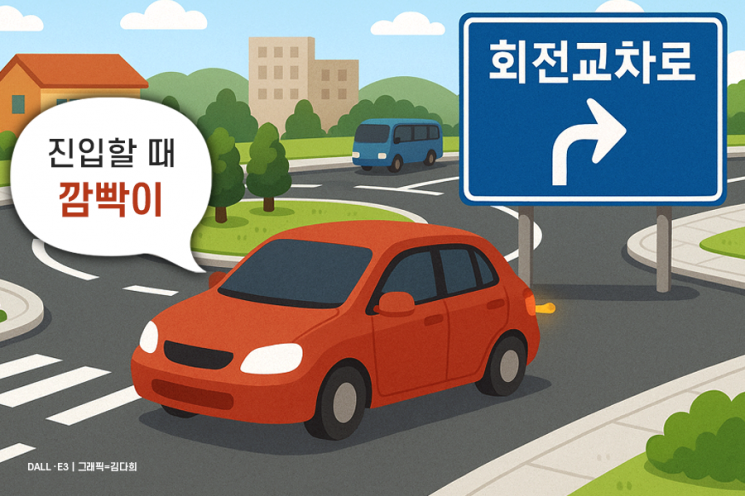
In fact, according to a survey by the Korea Transportation Safety Authority in December last year, more than nine out of ten drivers failed to use their turn signals properly at roundabouts. The percentage of drivers who did not use their turn signals either when entering or exiting was 92.1%, while 6.0% failed to use it at least once.
Enforcement has also been insufficient. According to the National Police Agency, the number of violations for failing to use turn signals at roundabouts was 19,371 in 2021, 17,349 in 2022, 15,309 in 2023, and 22,080 last year, showing inconsistency. This year, from January to May, there were only 7,473 cases.
The Ministry of the Interior and Safety has been working since 2018 to standardize rotaries into roundabouts as a government-funded project, but after the transfer of authority to local governments following fiscal decentralization in 2021, the process has been delayed. As a result, some regions still have rotaries, leading to ongoing confusion.
Kim Youngchun, Senior Researcher at the Korea Transport Institute, pointed out, "Using turn signals at roundabouts is a legal obligation, and increasing enforcement is one of the most effective ways to raise awareness." He added, "It is necessary not only to increase enforcement but also to provide mandatory education on lesser-known or newly amended regulations, such as the use of turn signals at roundabouts, when renewing driver's licenses, rather than just conducting physical fitness tests."
© The Asia Business Daily(www.asiae.co.kr). All rights reserved.