Infamous as a Declining City in the 1980s
A Millennium-Old City Pursuing Sustainability Through Resident Participation
Copenhagen ranked first among 173 cities in the "Most Livable Cities of 2025" selected by the Economist Intelligence Unit (EIU), scoring 98.0 out of 100. In May of this year, it was also named the "Happiest City in the World." However, Copenhagen looked very different 30 years ago. In the late 1980s, Copenhagen was a city on the brink of bankruptcy. The only residents were the elderly and poor students. At that time, the population was less than 500,000, and the city atmosphere was stagnant. How did a city facing bankruptcy become the most livable city in the world? The secret lay in its successful urban regeneration projects.
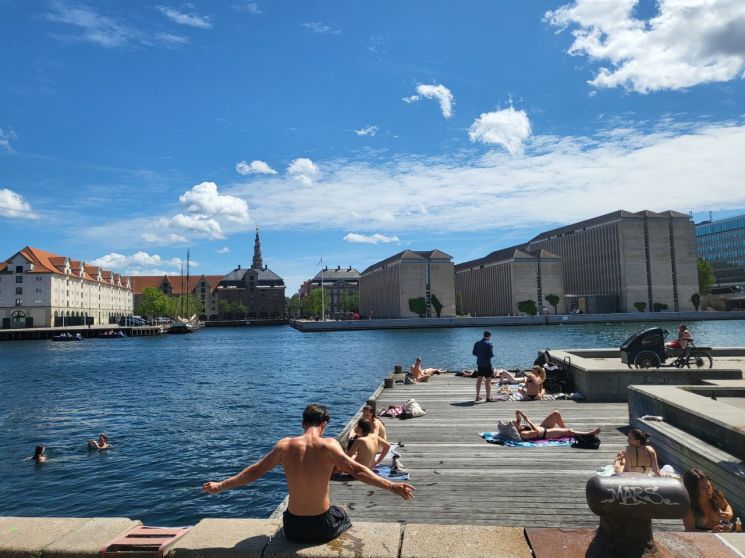 People enjoying swimming at the Copenhagen Harbor in Denmark. The harbor in the city center is always crowded with people sunbathing and swimming from June to August. Photo by Hyunju Lee
Infamous as a Declining City in the 1980s
In the 1990s, the Danish government decided to launch large-scale infrastructure projects for urban regeneration. They constructed a bridge connecting Denmark and Sweden, developed the coastline, and carried out harbor purification projects. At the same time, they began to reorganize the city’s internal environment. This approach was different from previous development policies. Rather than focusing on urban space, they prioritized life in the city and the people themselves. The starting point was not advanced technology, but observing and understanding those who live and work in the city.
Kristin Pedersen, from the Climate and Urban Development Department under the Technical and Environmental Administration of Copenhagen, said at a presentation held at Copenhagen BLOX in June, "In the 1980s, the Copenhagen harbor was a polluted industrial area, but now it has transformed into a city based on leisure and knowledge."
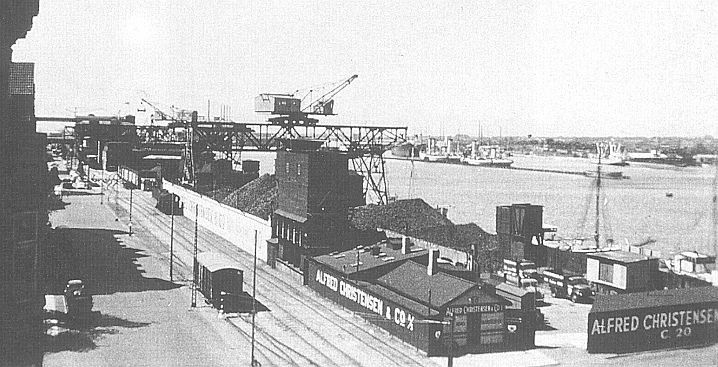
Pedersen stated, "Now, people can use the harbor like a public swimming pool, take walks, or sit and enjoy a beer," emphasizing that "it serves as a communal living room for Copenhagen’s citizens." She added, "The philosophy of urban planning is simple: Urban Life comes first."
The transformation of Copenhagen at that time was heavily influenced by the theories of Jan Gehl, an architect and urban design expert. Jan Gehl, who led modernist architecture in the 1960s, is known for major works such as "Cities for People," "Making Cities for People," and "Designing Cities for Life."
Pedersen explained, "He spread the philosophy of human-centered urban planning, known as Gehlism," adding, "This means incorporating human walking speed, field of vision, and habits of staying in certain places into urban design. Based on this, Jan Gehl prioritized pedestrians and cyclists over cars in Copenhagen and utilized public spaces as venues for social interaction." She continued, "Even the streets near Copenhagen City Hall were redesigned ten years ago. By observing people’s behavior, we discovered that they preferred the sunny side, so we designed wider sidewalks on the sunny side and narrower ones on the shaded side."
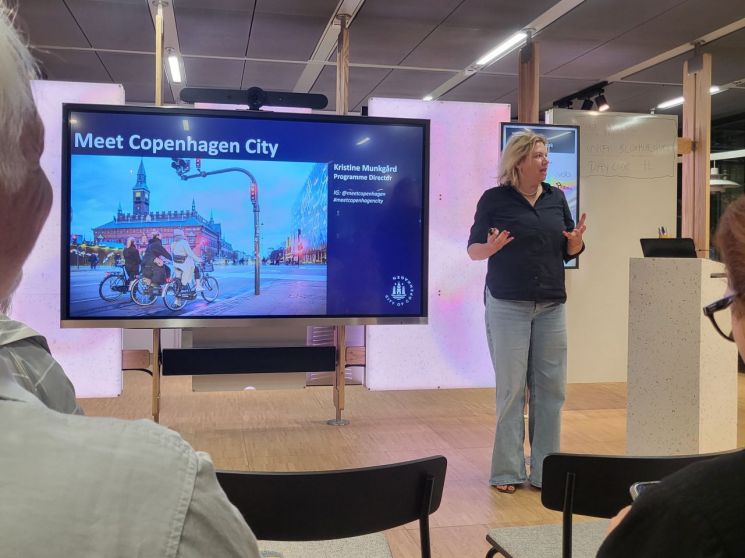 Kristin Pedersen, a member of the "Meet Copenhagen City" team under the Climate and Urban Development Department of the Technical and Environmental Administration of Copenhagen, said at a presentation held at Copenhagen BLOX on June 19, "Copenhagen has now transformed into a city based on leisure and knowledge." Photo by Hyunju Lee
Jan Gehl valued the "edge zone," the gray area where buildings and streets, or private and public spaces, meet. Pedersen explained, "Jan Gehl believed that the vitality of the city emerges from the edge zone," noting, "Rather than monotonous buildings with just a single entrance, placing elements such as benches, windows, or small yards around buildings can play a significant role in shaping the city’s atmosphere."
A Millennium-Old City Pursuing Sustainability Through Resident Participation
While new projects for urban regeneration are underway, efforts to renew the "old city" in a sustainable way continue as well. Copenhagen, once called "Havn"-meaning a small fishing village or harbor-was formed around the 10th century, making it a city with a history spanning over 1,000 years.
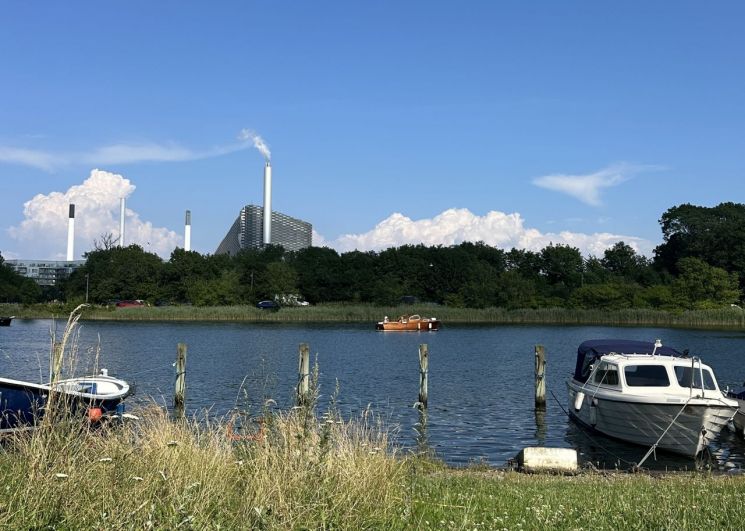 Ji Eun Lee, the only ambassador from an Asian country for this year's Three Days of Design, said, "Since I was 12, I have lived not only in Seoul but also in Chicago and New York, but Copenhagen was the first city where I could 'feel' the city by walking and biking." She added, "While other major cities focus on quickly reaching destinations, Copenhagen offers a sensory freedom to enjoy moments of leisure within the city itself, like sitting briefly in a park or feeling the sunlight by the harbor during transit." Near the Amager Bakke waste incineration plant located in downtown Copenhagen by the riverside, people can launch small boats and swim. Known as 'Copenhagen Hill' instead of an incineration plant, it is an eco-friendly and resident-friendly facility. Provided by Ji Eun Lee.
Copenhagen is currently carrying out projects to regenerate areas that are physically deteriorated or have social and cultural problems. A notable feature is the combination of budgets from various government departments and the implementation of projects together with local organizations. Change starts from the bottom up. Pedersen explained, "The bottom-up approach is a result of reflecting on the failures of top-down urban redevelopment in the 1960s and 1970s," adding, "Now, the approach has shifted to resident participation, and we pursue a complex strategy that combines infrastructure with cultural and social programs."
Sometimes, the entire city is turned into an exhibition showroom. During the Three Days of Design festival (June 18-20), the city transformed into a design exhibition space, including the Lapidarium museum housing centuries-old statues, Charlottenborg-an art institution and former palace, and the boat theater docked at Nyhavn. Exploring the alleyways of Copenhagen to visit the showrooms created by more than 400 design brands is part of the fun.
Lukas Ede, project manager at Creative Denmark, the organizer of Three Days of Design, explained, "One of the ways we work in architecture and interior design is to maintain the old while updating it to meet current needs and trends," adding, "Our main task is to preserve historical value and create new spaces in a sustainable and circular way."
© The Asia Business Daily(www.asiae.co.kr). All rights reserved.