The Wall Street Journal (WSJ) reported on June 11 (local time) that major companies such as Coca-Cola are experiencing declining sales as Hispanic consumers are going into hiding due to crackdowns on undocumented immigrants by U.S. immigration authorities.
During the Trump administration, the large-scale deportation of undocumented immigrants led even those with legal residency status to fear inspections by the U.S. Immigration and Customs Enforcement (ICE). As a result, many have given up regular shopping and dining out.
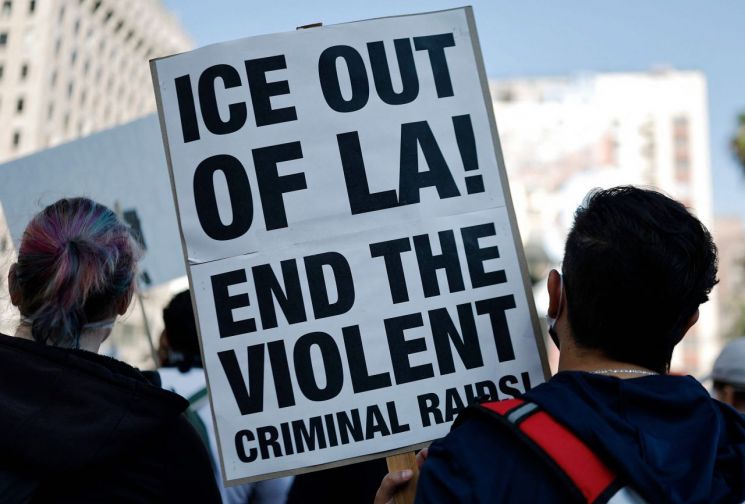 Protest against ICE immigration raids held in Los Angeles, California. Photo by Getty Images Yonhap News
Coca-Cola's North American sales fell by 3% in the first quarter, and company executives explained that a decrease in Hispanic shoppers was partly responsible. In addition, the company suffered a significant blow after a video circulated on social media claiming that Coca-Cola had asked ICE to deport undocumented workers. Although Coca-Cola refuted this as "blatantly false," the boycott continued.
Coca-Cola is not alone. Consumer goods company Colgate-Palmolive, alcoholic beverage producer Constellation Brands, and restaurant chains Wingstop and El Pollo Loco have all told investors in recent months that declining spending among Hispanic consumers has led to lower sales.
Regis Schultz, CEO of JD Sports, which operates the Shoe Palace retail chain targeting Latino consumers in 12 states, said last month, "There has been a significant drop in traffic," adding, "You can definitely see the impact (of immigration policy)."
Constellation's beer sales to retailers fell by 1% last quarter, marking the first decline since 2013. According to a recent Constellation survey, about 75% of Hispanic consumers said they were going to restaurants less frequently. Bill Newlands, CEO of Constellation, said at a recent investor conference, "Overall, consumers are somewhat cautious," and "this is even more true for Hispanic consumers."
According to market research firm Kantar, the proportion of Hispanic shoppers making purchases at offline stores dropped from 62% in the fourth quarter of 2024 to 53% in the first quarter of this year. The number of Hispanic shoppers visiting Walgreens stores in the first quarter of this year fell by 10.5 percentage points compared to the same period last year. During the same period, Home Depot saw a decline of 8.7 percentage points, and Dollar General dropped by 6.1 percentage points.
According to Coca-Cola, Hispanic consumers in the U.S. have an annual purchasing power of $2.1 trillion. Hispanics make up one in five people in the population, and one in four Generation Z consumers.
This is due to the fact that areas with large Hispanic populations and stores frequented by Hispanics have become primary targets of ICE crackdowns.
Plum Grove, located northeast of Houston, Texas, is a region where Latino residents are the majority. Local residents and retailers told the WSJ that widespread fear is spreading due to immigration crackdowns, with parents sometimes sending their U.S.-born children to buy necessities like eggs or milk. Convenience store owners said that ICE agents frequently appear in parking lots, frightening customers.
Even Hispanics who are U.S. citizens are concerned about immigration crackdowns. Manuel Machant, who works at a car dealership in Florida, said he has obtained U.S. citizenship but avoids going out at night when possible and does not go to upscale restaurants with his wife. He told the WSJ that he always carries copies of his passport and citizenship documents.
WSJ stated, "Fear and uncertainty are driving changes in shopping behavior," and "across the United States, especially in southern states with large Hispanic populations, consumer goods companies, food and beverage manufacturers, restaurants, and retailers are being hit hard."
© The Asia Business Daily(www.asiae.co.kr). All rights reserved.