Six Scenarios for the Resumption of North Korea-US Summits
Marking the Seventh Anniversary of the June 12 Singapore Summit
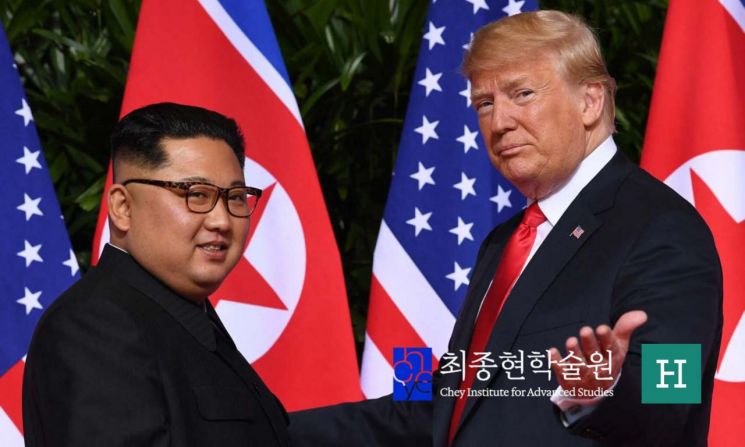
The Choi Jonghyun Academy announced on June 12 that, in collaboration with the Hudson Institute, a U.S. think tank, it has published a report and policy proposal titled "Negotiation, Deadlock, and Deterrence: Scenarios for the Resumption of North Korea-US Diplomacy" to mark the seventh anniversary of the June 12 Singapore North Korea-US summit.
 Partial cover of the report and policy proposal titled "Negotiation, Deadlock, and Deterrence: Scenarios for the Resumption of North Korea-US Diplomacy." Provided by the Choi Jonghyun Academy.
This report was planned to reflect the rapidly changing diplomatic environment, including the strengthening alliance among North Korea, China, and Russia; the advancement of North Korea's nuclear and missile capabilities; the potential second Trump administration; and the launch of a new government in South Korea. Numerous foreign affairs and security experts from both South Korea and the United States participated in the report, which analyzes the potential for the resumption of North Korea-US diplomacy and corresponding strategic responses through six scenarios.
Contributors to the report include prominent U.S. foreign policy and security experts such as Patrick Cronin, Asia-Pacific Security Chair at the Hudson Institute; Frank Aum, former Senior Expert at the United States Institute of Peace; and Jenny Town, Director of 38 North at the Stimson Center. Policy recommendations for the South Korean government were drafted by Professor Chun Jaesung of Seoul National University's Department of Political Science and International Relations, based on discussions from an online workshop among the report's authors.
Kim Yuseok, President of the Choi Jonghyun Academy, stated in the foreword, "While recent international attention has focused on economic security issues such as tariffs and supply chains, uncertainties and unexpected variables related to security on the Korean Peninsula still persist." He added, "On the symbolic occasion of the seventh anniversary of the June 12 Singapore North Korea-US summit, I hope this report provides practical strategic insights to policymakers in both countries."
The scenarios for the resumption of North Korea-US diplomacy presented in the report include: a provisional agreement for stable coexistence between the United States and North Korea; seeking to establish a peace regime through the redefinition and normalization of North Korea-US relations; exploring new diplomatic avenues through trust-building between the leaders of North Korea and the United States; resumption of nuclear negotiations as a possible scenario, but only under the premise of an 'action-for-action' principle; engagement with North Korea to avoid missing positive outcomes by insisting on the 'perfection' of complete denuclearization; and strengthening deterrence against North Korea's nuclear capabilities to reduce risks and enhance negotiating power.
Frank Aum, Senior Expert, proposed a 'small deal' scenario as a way to achieve 'stable coexistence' between North Korea and the United States. He assessed, "By achieving a practical small deal in the short term, it may lead to a more comprehensive and amicable negotiation atmosphere in the future," and added, "The United States' influence in negotiations has weakened, and there is a greater possibility of making more concessions than during the 2019 Hanoi North Korea-US summit."
Korean experts unanimously emphasized that "South Korea's interests as an ally must not be excluded from the US negotiation process with North Korea." Professor Chun Jaesung stated, "South Korea should prepare a mid- to long-term roadmap in anticipation of the resumption of North Korea-US negotiations, and thorough prior coordination is necessary to ensure that the South Korea-US alliance is not undermined, regardless of the form the negotiations take."
Professor Park Wongon of Ewha Womans University said, "North Korea is virtually establishing itself as a de facto nuclear state and may attempt to negotiate nuclear arms reduction with the United States." He added, "To respond to North Korea's excessive demands, such as the withdrawal of US forces from Korea, it is necessary to establish basic principles and guidelines for negotiations in advance."
© The Asia Business Daily(www.asiae.co.kr). All rights reserved.