A pair of storks being protected at the stork release site in Bonghateul, Jinyeong-eup, Gimhae-si, Gyeongnam, have laid and are incubating their first eggs of the new year.
Gimhae City announced on the 3rd that the stork couple began laying eggs from 3 a.m. on the 1st and laid a total of two eggs by the next day.
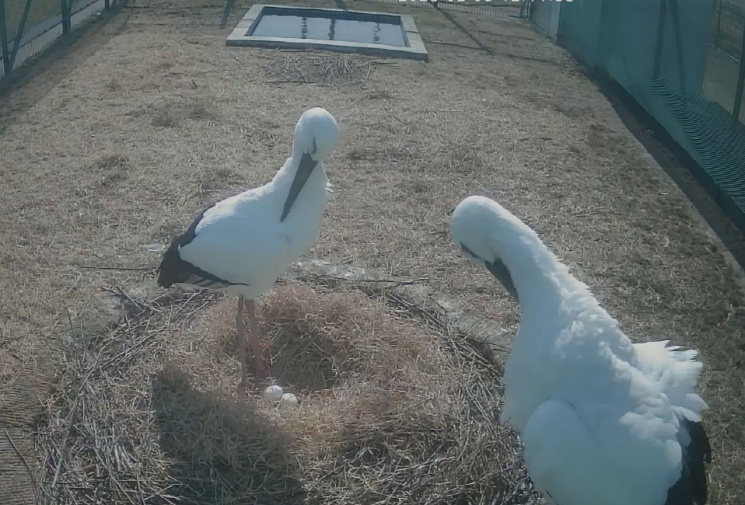 The pair of storks, a female named Baek (left) and a male named A14, living in the Bongha Field aviary in Jinyeong-eup, Gimhae-si, Gyeongnam, laid two eggs. Provided by Gimhae City Hall
Previously, in October 2022, Gimhae City brought in a female stork named ‘Geumi’ and a male named ‘Gwani’ raised at the Yesan Stork Park in Chungnam and settled them here, but Geumi died the following year.
In November of the same year, the city brought in a new female and male stork, assigned management numbers ‘Baek’ and ‘A14’ respectively, and is promoting natural breeding.
Storks, traditionally regarded as auspicious birds that bring good fortune, are rare birds designated as first-class endangered wild animals and natural monuments, requiring special protection due to difficulties in natural breeding.
To support the successful breeding of storks, the city analyzed the causes of two failed hatchings last year and held multiple consultations with the National Heritage Agency and doctors from Yesan Stork Park in Chungnam.
The city lowered the nest tower from the previous height of 1.2 meters to 1 meter and has been closely monitoring the release site daily with closed-circuit television (CCTV), striving to create an optimal breeding environment.
Storks typically lay 3 to 5 eggs and incubate them for about 30 days until hatching.
If hatching is successful, the city plans to raise the chicks until July and then release them into the wild.
If both hatching and chick-rearing proceed safely, the site will serve as a base for stork restoration, preserving the natural ecosystem and utilizing it as an ecotourism resource.
Lee Yong-gyu, head of the Environmental Policy Division, said, “Although hatching failed last year, the stork couple incubating eggs again this year gives us hope,” adding, “We will do our best to ensure the storks settle and continue natural breeding.”
© The Asia Business Daily(www.asiae.co.kr). All rights reserved.