Columbus, Beethoven, and Napoleon Teaching Apes Captured
Criticism Within Japan: "Are They Advocating Colonial Rule and Racism?"
With the J-POP trend, the new music video of the famous Japanese band Mrs. Green Apple, which has also gained recognition in Korea, is causing a widespread controversy for containing racist content. The video mainly features scenes where Western figures such as Columbus and Beethoven are enlightening apes, which has drawn criticism for evoking colonialism.
On the 14th, Asahi Shimbun reported that Coca-Cola Japan decided to suspend all advertisements using Mrs. Green Apple's new song "Columbus." Coca-Cola had been using the song as the theme for its music advertising campaign called "Coke Studio" and was airing multiple versions of the ads. A Coca-Cola representative told Asahi, "We have stopped airing all advertisements using this song. We were not aware of the content of the music video beforehand."
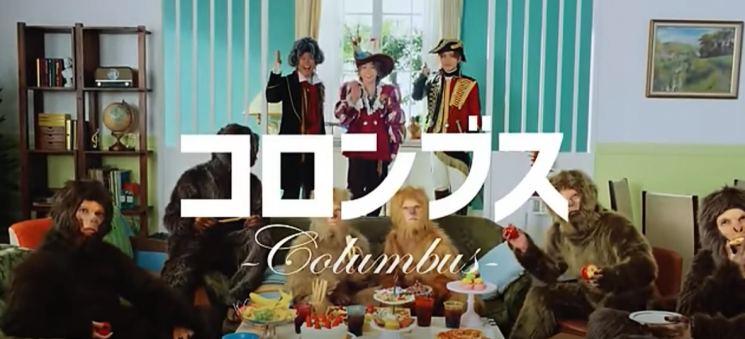 A scene from the music video "Columbus" by Mrs. Green Apple, currently set to private. Netizens are reuploading the video on their own after the record label made it private. (Photo by Beast Roaf YouTube channel)
The lyrics of the song express a message of persistently approaching the other person without giving up, like Columbus sailing, but the music video released on the 12th used a very different story. Band members dressed as Columbus, Napoleon, and Beethoven are shown enlightening apes. Columbus makes the apes pull rickshaws, Napoleon teaches them how to ride horses, and Beethoven teaches them piano. Even in scenes where the costumed members sing, apes can be seen waving their arms or running around in all directions in the background.
 An ape pulling a rickshaw in the music video "Columbus" by Mrs. Green Apple. (Photo by Beast Roaf YouTube channel)
As a result, the controversy over the music video rapidly spread mainly through social networking services (SNS), and criticism began to emerge among experts such as professors. Asahi quoted sociology professor Fuminori Minamikawa of Doshisha University, who said, "This is an inappropriate video lacking consideration in terms of racism and historical awareness," and pointed out, "It can only be seen as an expression that endorses oppression, conquest, and racism based on colonialism in non-Western countries." In particular, Columbus, who is presented as the theme, is viewed as a hero who discovered the New World during the Age of Discovery, but nowadays he is being re-evaluated as a symbol of indigenous conquest, massacre, and colonial rule.
Furthermore, the fact that white Western historical figures are teaching apes presupposes the superiority of Western civilization, and the scenes of apes holding bananas or pulling rickshaws evoke the image of black slavery, the professor criticized. Professor Minamikawa said, "Above all, the problem is that a Japanese artist repeatedly used discriminatory expressions by sympathizing with white historical figures," and added, "They assumed themselves to be honorary whites and showed an attitude of looking down on non-Western people." She raised her voice, saying, "Despite Japan not being free from issues of colonialism and discrimination, they disregarded these matters."
 In the music video "Columbus" by Mrs. Green Apple, Beethoven is seen teaching piano to apes. (Photo by Beast Roaf YouTube channel)
Ultimately, the record label Universal Music took down the music video, stating, "There was a lack of understanding of the historical and cultural background."
Coca-Cola also told Asahi, "Coca-Cola does not tolerate any form of discrimination. We regret this incident. This case is completely contrary to the values we cherish."
In the end, the band leader Motoki Omori issued an apology himself, but the controversy is unlikely to subside easily. Omori said, "I conceived the music video with keywords such as historically famous figures, apes, home parties, and enjoyment," and added, "We never intended to create content that endorses discrimination or tragic history, but our lack of consideration for the possibility that the message could be misunderstood is the cause."
© The Asia Business Daily(www.asiae.co.kr). All rights reserved.