US House Passes Temporary Budget Bill
Much of Economic Uncertainty Eased
Experts Warn of Inevitable Aftershocks
GDP Projected to Drop by 1.5%
The United States federal government shutdown, which lasted for a record 43 days, has finally come to an end, significantly easing much of the uncertainty that had weighed on the U.S. economy. The direct hit to household finances caused by suspended wage payments, which had raised concerns about shrinking consumer spending and employment slowdown, is also expected to be alleviated. With the end of the shutdown and the resumption of economic indicator releases such as employment and inflation figures, the issue of diminished credibility in monetary policy decisions due to the lack of data is also likely to be resolved. However, President Donald Trump claimed that the prolonged shutdown resulted in losses amounting to 1.5 trillion dollars (approximately 2,200 trillion won) for the U.S. economy.
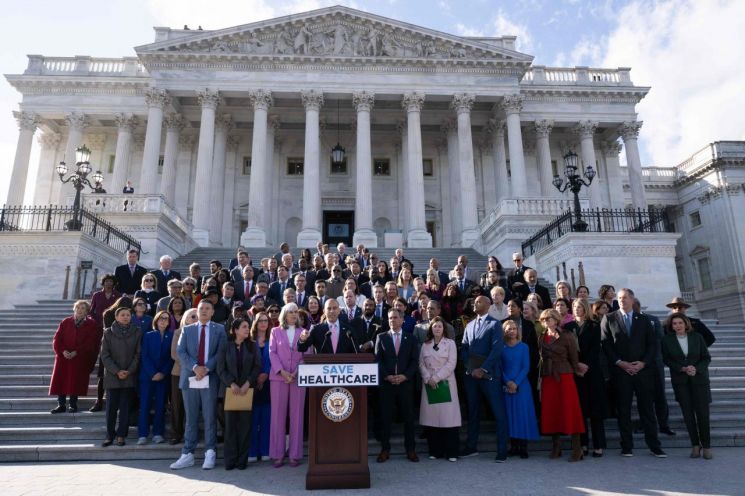 Hakim Jeffries, Democratic House Majority Leader, is speaking about healthcare policy and plans for a vote to end the government shutdown at a press conference held outside the United States Capitol in Washington DC on the 12th (local time), together with Democratic members of the House of Representatives. Photo by AFP Yonhap News
On the 12th (local time), the U.S. House of Representatives passed the Senate's short-term spending bill (a temporary budget proposal) with 222 votes in favor and 209 against. This shutdown lasted eight days longer than the previous record of 35 days. As a result, federal agencies will return to normal operations, and the Supplemental Nutrition Assistance Program (SNAP) for low-income households, which had been suspended, will also resume.
The U.S. economy, which was expected to slow down due to the effects of the shutdown, has also received some relief. The White House had previously warned that the fourth quarter growth rate could drop by as much as 1.5 percentage points due to the shutdown. Kevin Hassett, Chairman of the White House National Economic Council (NEC), stated, "Thanksgiving is one of the hottest periods of the year for the economy," and predicted, "If people do not travel during that time, we could see negative growth in the fourth quarter."
Since the period from Thanksgiving to the end of the year is typically the most active time for consumption and travel, concerns had been raised that a prolonged shutdown could lead to an aviation crisis and labor shortages, which in turn would dampen consumer spending and potentially trigger an economic recession. In fact, the University of Michigan's Consumer Sentiment Index for November fell by 6% from the previous month to 50.3, the lowest level since June 2022.
On this day, President Trump posted on his social media platform, Truth Social, "The Democrats maliciously shut down the country, causing 1.5 trillion dollars in losses to our nation," and added, "They must pay a fair price."
Experts predict that aftershocks from the shutdown are inevitable even after its conclusion. The Congressional Budget Office (CBO) estimated that the six-week shutdown would reduce gross domestic product (GDP) by 1.5 percentage points, with up to 11 billion dollars in losses remaining permanent. Unlike the partial shutdown of 2018-2019, which restricted only 10% of government spending, this time it was a 'full shutdown' with 10% of the budget execution halted, making the impact more severe.
The Wall Street Journal (WSJ) reported, "Although the federal government shutdown has ended, the U.S. economy bears small but clear scars," and noted, "Taking into account the back pay to be provided to federal employees who were unable to work due to furloughs, the burden on taxpayers will also increase." However, some economists believe the impact of this incident will be limited. Goldman Sachs, for instance, has even raised its growth forecast ahead of the year-end.
The risk of data gaps in economic indicators is also one of the scars left by the shutdown. During the shutdown, the operations of statistical agencies were suspended, resulting in a complete halt to the release of key indicators such as the employment report, consumer data, and core personal consumption expenditures (PCE), except for the September Consumer Price Index (CPI). As a result, the U.S. economy was left in the dark for a while, and for the first time ever, the Federal Reserve had to make an interest rate decision without a monthly employment report.
The problem is that even though the shutdown has ended, the release of economic indicators may not resume immediately. White House spokesperson Karoline Leavitt stated at a briefing that "the Democrats have permanently damaged the federal statistical system," and claimed, "There is a high possibility that the October CPI and employment report may not be released at all." She added, "A significant portion of economic data has been permanently damaged, and Fed policymakers will have to act without any information at the most critical time."
This means that the Federal Reserve may have to make interest rate decisions next month without major economic indicators, and monetary policy may fail to adequately respond to macroeconomic conditions. CNBC reported, "As the government shutdown dragged on, concerns about gaps in key economic data became the most prominent issue on Wall Street."
© The Asia Business Daily(www.asiae.co.kr). All rights reserved.